Focus on value, not volume! Why e-commerce companies should care more about their LTV/CAC ratio


The shift every e-commerce company needs to make to grow sustainably in a world of exploding acquisition costs.
The question almost nobody asks
"How many new customers did we bring in this month?" I hear this question constantly. But it's the wrong question. The question you should be asking is: "How much value did we create per euro invested?"
The difference between these two questions is the difference between a company that will grow sustainably and a company that will come under increasing pressure. The reality is that acquisition costs have risen by 222% over the past 10 years, while most companies are still chasing volume instead of value.
The basics: what are LTV and CAC, and what do they actually tell you?
Lifetime Value (LTV)
Lifetime Value (or simply put: customer value) is the total net profit a customer generates over the entire relationship with your company. (Note: net profit, not revenue. This distinction is often forgotten, but it's crucial.) Let's start with a simplified example of how to calculate LTV. (I'll come back to more detailed and precise calculations later.)
A fashion webshop has the following data:
- Average order value: €85
- Purchase frequency: 3.2x per year
- Average customer lifespan: 2.3 years
- Gross margin after cost of goods: 65%
- Operating margin (after fulfillment/shipping): 45%
The calculation, step by step:
- Total revenue per customer = 85 × 3.2 (purchase frequency) × 2.3 (lifespan) = €625
- Gross LTV = 625 × 65% (after cost of goods) = €407
- Net LTV = 625 × 45% (after cost of goods and other costs) = €282
That's a €125 gap between gross and net. And that's exactly where many companies go wrong. They calculate with gross LTV but forget things like fulfillment (order picking and packaging), returns, and customer service.
Customer Acquisition Cost (CAC)
CAC (acquisition cost) covers all the costs of bringing in a new customer. Not just your Google Ads and Meta campaigns. Again, a simplified example from the same fashion webshop:
Monthly costs:
- Google Ads: €25,000
- Meta Ads: €20,000
- Influencer spend: €8,000
- Marketing team (3 FTE): €15,000
- Tooling (email platform, analytics): €2,000
- External content creation: €5,000
- Total: €75,000
With this spend, the webshop brings in 450 new customers. The acquisition cost per customer is then: 75,000 / 450 = €167 (CAC). Looks fine when you compare it to the net LTV above, but are all of those customers actually new customers? I'll come back to that!
Why focusing (only) on new customers is often throwing money away
The skewed split in marketing budgets
I see it constantly at companies: an extreme focus on acquisition costs for (new) customers, per month or per channel. Not entirely illogical when you're focused on growth, and I've certainly been guilty of it myself :). Especially in the first years of a company, it feels like the most important KPI.
And yet it's really quite simple. It's between 5 and 25 times more expensive to acquire a new customer than to retain an existing one. If you compare conversion rates of existing customers versus new customers, you'll see what I mean. And still, at most companies, somewhere between 80% and 90% of the marketing budget goes to acquisition.
Incremental value
Incremental value is the value you generate as a direct result of a marketing activity. It's value you would not have generated if you switched that activity off. Put simply: how much of your marketing actually drives extra sales that wouldn't have happened otherwise?
A practical example:
A home & living webshop was spending €40,000 per month on Google Ads. Google reported 600 "new customers". That works out to a CAC of €67. Not a bad number for that industry.
We ran a holdout test (an experimental method where a group is excluded, the "holdout group", to measure the true performance of a channel or the long-term effects of a change). We paused all ads in 25% of the Netherlands (random postal codes). After 4 weeks, it turned out:
- 40% of the "new customers" were existing customers coming back through ads
- 30% would have found the website organically anyway
- Only 30% was genuinely incremental (extra sales driven by the ads)
The real acquisition cost then becomes: 40,000 / (600 × 30%) = €222. Quite a different number. You could even argue (a bit bluntly) that this webshop was throwing away €28,000 per month (€336,000 per year), money that would most likely have been far better spent on retention (loyalty, customer service, and so on).
A simple strategy based on your LTV/CAC ratio
Now that we know the basics of LTV and CAC and which variables play a role, you can already build a better strategy for yourself. Below is a simple example of how you could start steering on this. (Later I'll go deeper into how to calculate the ratios more precisely and keep them up to date.)
The ratio between customer value and acquisition cost determines whether your business is healthy. This ratio obviously depends on your margins. If you sell a software product, you might have 85-90% margins, while the average e-commerce company has to make do with 40% (or less). Let's assume an average.
At a 3:1 ratio, you earn €3 in customer value for every €1 you spend on acquisition. That gives you enough room for:
- Operating costs (30-40% of revenue)
- Product development and innovation (10-15%)
- Profit margin for growth investments (15-20%)
- A buffer for seasonal fluctuations and market changes
So your target is 3:1. If you track these ratios and see them shift, here are the kinds of actions you could take based on where you currently stand:
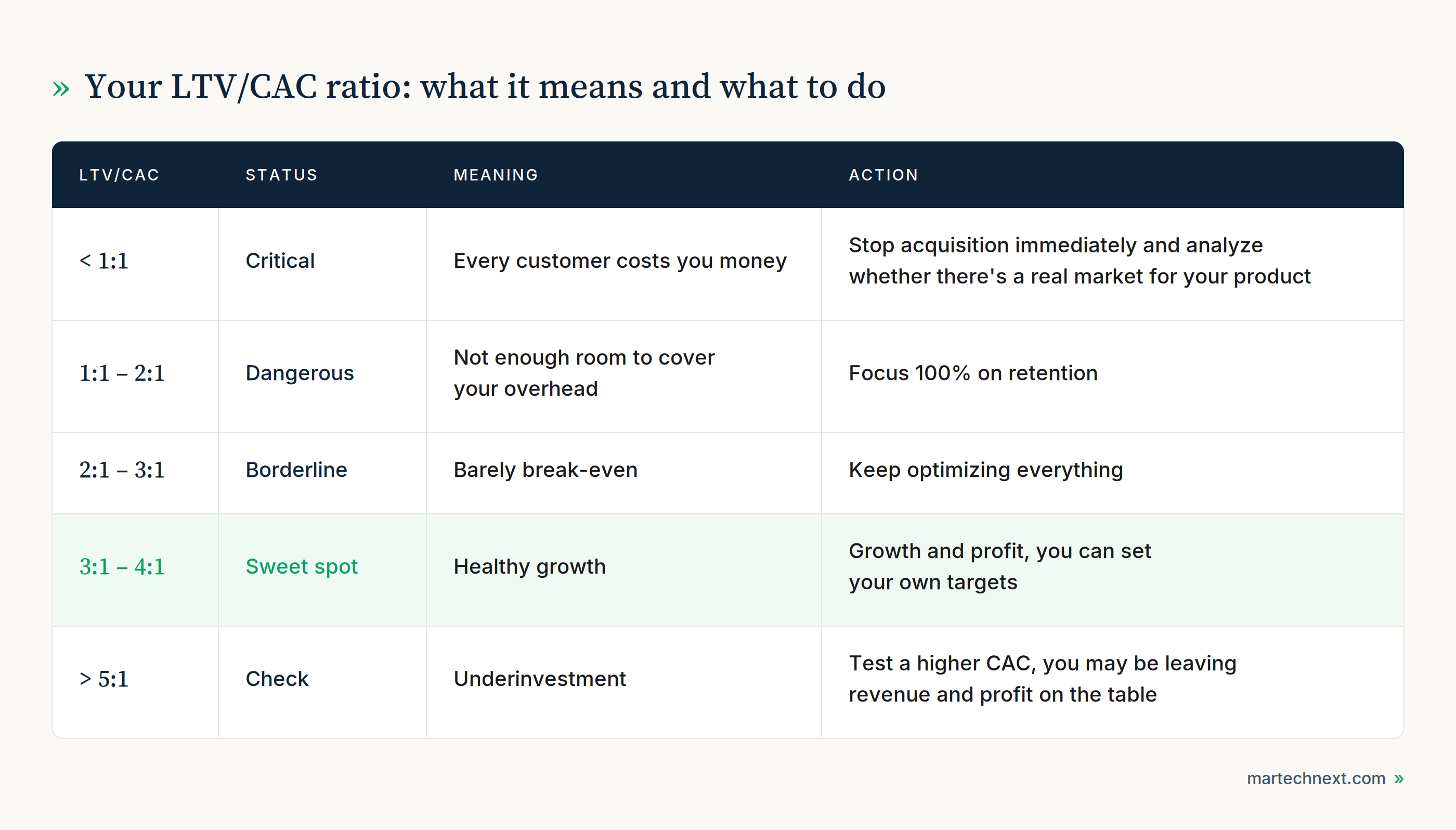
A practical example of a fictional webshop with different ratios over the past 3 years:
Year 1: LTV €95, CAC €78, ratio 1.2:1
- Nearly bankrupt.
- Stopped all paid acquisition
- Focused on improving the offer
- Only used owned channels like SEO and email
Year 2: LTV €135, CAC €45, ratio 3:1
- Break-even
- Carefully restarted advertising
- Marketing budget split between retention and (partly) acquisition
- Focus on improving LTV
Year 3: LTV €205, CAC €58, ratio 3.5:1
- Healthy growth. Acquisition costs rise slightly, but LTV rises faster in proportion
- Focus on scaling up advertising for new customers, now that the LTV/CAC ratio is more than healthy
It's a simple example, but the lesson is: focus on creating value first (raising LTV), then on volume (new customers).
What's next? Calculating LTV, from basic to advanced
We've used a few simple examples for calculating LTV so far. But LTV is not a fixed number and will keep changing (hopefully in the right direction :)). To calculate and track it properly, you need a fair amount of data (and a bit more technical knowledge). To approach this step by step, I've split the calculation methods into 3 phases. You can read this as a path: whether you're an established webshop that wants to get started, or a younger company that wants to grow into more advanced models as your data grows. (From start-up to scale-up, for example.)
Phase 1: The quick & dirty method (less than 6 months of historical data)
For starters who want to begin today (and as worked out earlier in this article).
Take the simplest formula:
LTV = Average order value × Frequency × Lifespan × Margin
A practical example:
- Average order: €75
- Estimated frequency: 2x per year (industry average)
- Estimated lifespan: 18 months
- Gross margin: 60%
LTV = 75 × 2 × 1.5 × 0.60 = €135
(As an alternative, use the payback period: within how many months do you earn back your acquisition costs? A good target for e-commerce: within 6 months.)
Phase 2: Cohort-based LTV (6 to 18 months of historical data)
Now it gets more interesting. We follow groups of customers (cohorts) over time.
A practical example from, say, an online drugstore:
Take all customers who made their first purchase in January 2025. Track their spending per month.
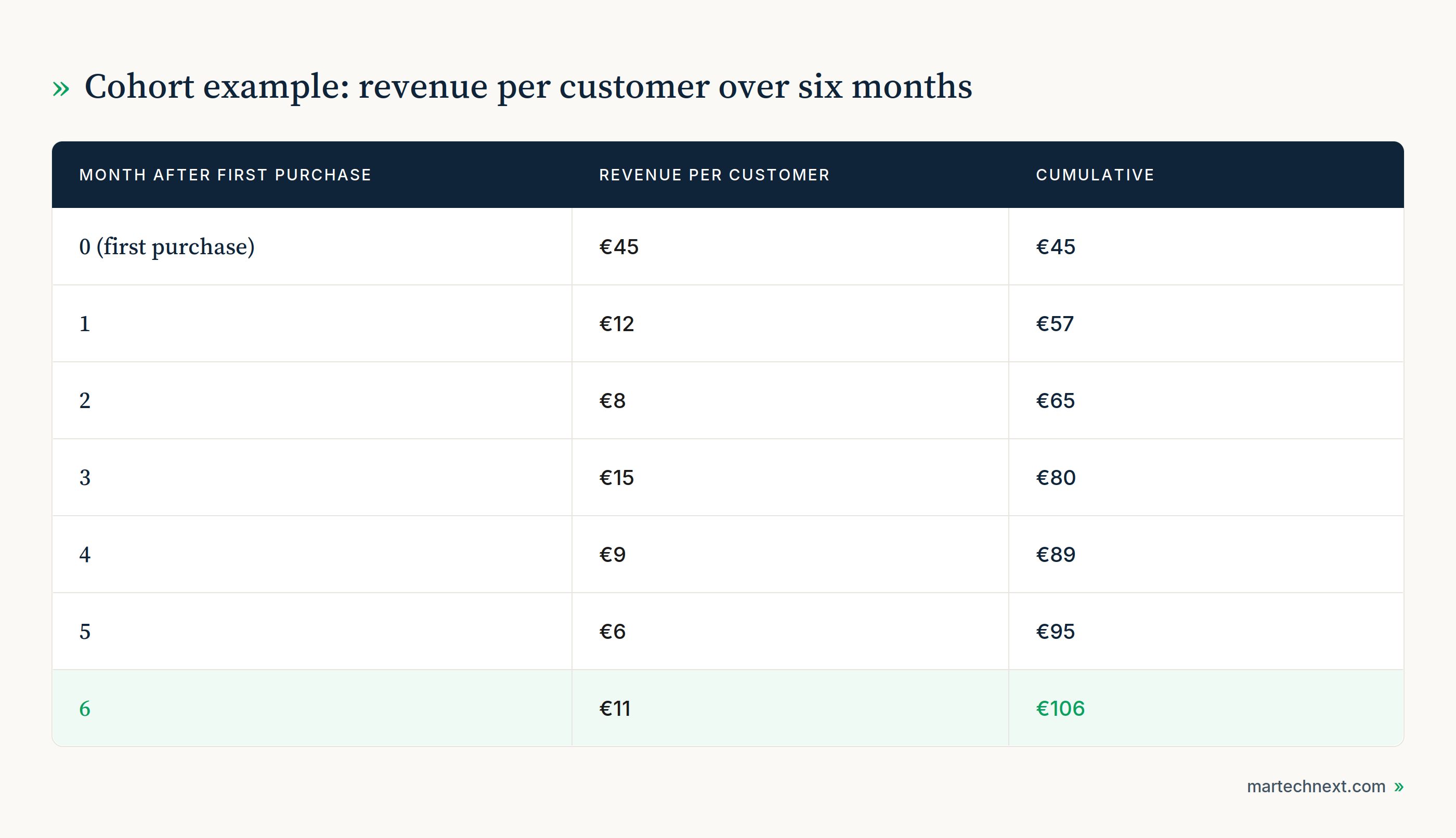
Total after 6 months: €106 in revenue per customer.
With a 60% margin: LTV = 106 × 0.60 = €64
The extrapolation method:
We only have 6 months of data, but we want to forecast 24 months. We can see that revenue declines by roughly 15% per month (the "decay rate", an exponential decline over time).
The calculation for months 7 to 24:
- Month 7: 11 × 0.85 = €9.35
- Month 8: 9.35 × 0.85 = €7.95
- ...and so on
Total after 24 months: €156
With a 60% margin: LTV = 156 × 0.60 = €94
Tip: compare different cohorts. If you compare your February customers with your January customers, you'll often see big differences. Instagram customers might have a 40% higher LTV in January than Google Shopping customers in the same period. Those insights are pure gold for allocating your marketing budget.
Phase 3: Probabilistic models (18+ months of historical data)
For companies that truly want to be data-driven.
The BG/NBD model (Beta-Geometric/Negative Binomial Distribution, quite a mouthful, I know) solves a fundamental problem: when is a customer "dead" (churned) versus "dormant" (might come back)?
A practical example (I'll spare you the exact math :)):
Customer A, the loyal customer:
- Last purchase: 45 days ago (Recency)
- Total number of purchases: 5 (Frequency)
- Customer since: 365 days (T)
- Average order value: €120
The model calculates:
- Probability the customer is still "alive": 78% (despite 45 days of silence, because 5 purchases in a year is an active customer)
- Expected purchases in the coming year: 3.2
- Predicted LTV: 120 × 3.2 × 0.60 margin = €230
Customer B, the one-off shopper:
- Last purchase: 180 days ago
- Total number of purchases: 2
- Customer since: 365 days
- Average order value: €95
The model calculates:
- Probability the customer is still "alive": 23% (a long silence plus few purchases usually means they're gone)
- Expected purchases in the coming year: 0.4
- Predicted LTV: 95 × 0.4 × 0.60 = €23
This model automatically gets smarter as you collect more data. With enough data, it can predict which customers will churn with 85% accuracy. Once you have this insight at the individual customer level, you can confidently shift part of your marketing budget toward retention, which is where the real profit sits!
The retention machine, where the real profit sits :)
The simple math of value versus volume
Let's use another simple example to show the difference between focusing on retention versus acquisition. Say an average webshop with €1 million in revenue spends €160K on acquisition and €40K on retention. With that, they generate 2,000 new customers with an LTV of €150.
What happens if we shift to a 60/40 split (acquisition/retention)?
The math:
- €120K acquisition → 1,500 new customers (25% fewer)
- €80K retention → retention rate rises from 20% to 35%
- LTV rises to €220 thanks to a better customer experience
The result:
- Old situation: 2,000 × 150 (LTV) = €300K in value
- New situation: 1,500 × 220 (LTV) = €330K in value
- Conclusion: 10% more value with 25% fewer customers
How can you actually improve retention from a marketing perspective?
You can probably come up with plenty of examples yourself by now, but to name a few good ones:
- Work on personalization in your email channel, for example. The more relevant you stay, the more customers will feel that your company and offer fit them, and the sooner they'll come looking for you on their own.
- Introduce a loyalty program. Tie it to predicted LTV, for example, and create tiers based on number of orders or order value (or a combination of both).
- Set up proactive automated email flows based on lead scoring and churn prediction. For example, if you see that customers haven't been active or haven't purchased for a certain period, adjust your offers or your message accordingly. Every customer you keep active is almost pure profit! :)
Conclusion
Will you keep chasing volume while your CAC explodes? Or will you make the shift to value-driven growth? I'm phrasing it as a question, but the fact is you don't really have a choice in today's advertising arms race. You have to work on your retention (and therefore your LTV) to keep your CAC healthy in proportion.
With every decision you make in your marketing activities, always ask yourself this question: "Does this increase customer value, or does it lower acquisition costs?"
You can get started today by taking the first simple steps:
- Calculate your LTV/CAC ratio (even with limited data)
- Test the incrementality of your biggest marketing channel
- Shift 20% of your budget from acquisition to retention
These are big and bold decisions for many e-commerce companies, but in the end it's very clear to me: companies that focus on value survive, companies that chase volume disappear.
Want to talk through your LTV/CAC optimization? I'm happy to help you think through the specific challenges in your situation.
-- Bram Versteegh
Bram Versteegh is the founder of MartechNext, covering the business of AI in marketing: who's building it, who's funding it, and how industries put it to work.
Enjoyed this piece? Every week, What's Next delivers sharp analysis, the latest funding rounds in AI marketing, and the martech news that actually matters. Straight to your inbox, free.