Kimi K3: the first open 3-trillion-class model, and why marketers should pay attention
Kimi K3 is the first open 3T-class AI model, with frontier coding scores and a 1M context window. What Moonshot's release means for marketers and martech.


Moonshot AI released Kimi K3 today, and it's a milestone for open models: 2.8 trillion parameters, making it the first open model in the 3T class. It comes with native vision, a 1-million-token context window, and benchmark scores that put it right among the frontier. The full model weights will be released by July 27.
The details
Kimi K3 is built on two architectural updates, Kimi Delta Attention and Attention Residuals, combined with an aggressively sparse Mixture of Experts setup that activates 16 of 896 experts. Moonshot claims roughly 2.5x better scaling efficiency than its predecessor Kimi K2, meaning the model converts compute into capability more effectively.
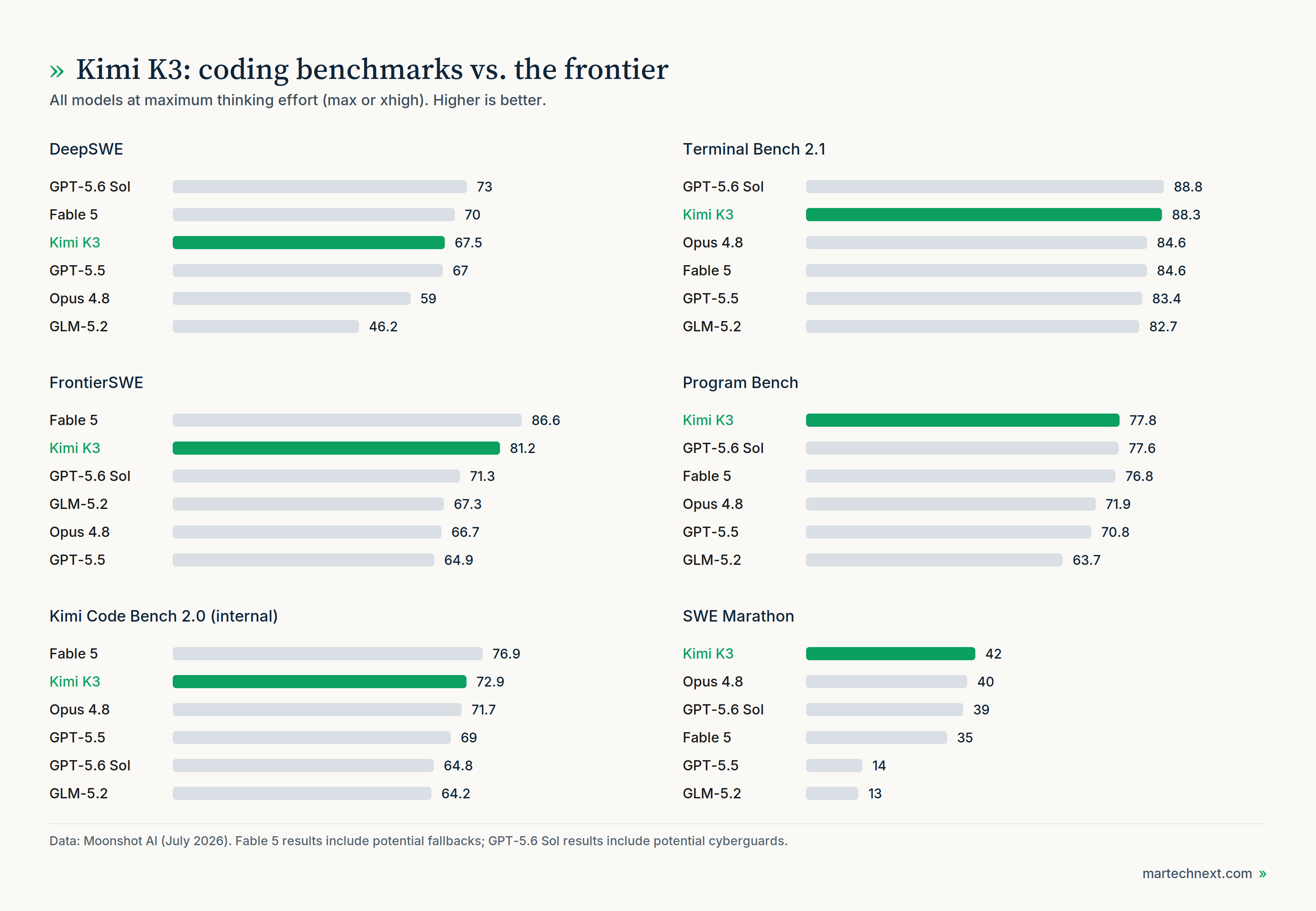
On coding benchmarks, K3 trades blows with the best proprietary models. It tops Program Bench and SWE Marathon, sits within half a point of GPT-5.6 Sol on Terminal Bench 2.1, and lands between Claude Fable 5 and the rest of the field on FrontierSWE. Moonshot is refreshingly candid about the overall picture: by its own admission, K3 still trails Claude Fable 5 and GPT-5.6 Sol in general performance and user experience. But for an open model, this is uncharted territory.
Beyond coding, the launch leans heavily on agentic knowledge work. Moonshot showcases K3 producing consulting-style industry reports with interactive visualizations, publication-ready slide decks, spreadsheet automation, and even video editing: the model cut its own teaser video from 56 source clips, work that would take an experienced human editor a day or two.
Pricing through the Kimi API: $0.30 per million cache-hit input tokens, $3.00 cache-miss, and $15.00 per million output tokens.
The MartechNext take
You might wonder why a Chinese frontier model release belongs on a martech platform. Three reasons.
The price of intelligence keeps collapsing, and that resets the martech value equation. Every time an open model closes the gap with the proprietary frontier, the model layer becomes more of a commodity. For marketing teams and martech vendors, the strategic implication is the one I keep repeating: the model is not your moat. Your data foundation, your customer profiles, and your workflows are. If frontier-adjacent intelligence costs $3 per million input tokens and the weights are downloadable, the differentiation question shifts entirely to what you feed it and how you orchestrate it.
Open weights matter for European marketers specifically. A model you can self-host is a model you can run inside your own infrastructure, with your customer data never leaving your environment. For personalization use cases that touch first-party data, that's a meaningful compliance and privacy story. I expect a wave of martech vendors quietly swapping in open models for exactly this reason, and "which model runs under the hood" becoming a procurement question rather than a marketing bullet.
The knowledge-work demos are the agency-replacement story again. Look past the coding benchmarks and you see what Moonshot is really selling: an agent that produces research reports, slide decks, dashboards, and edited video autonomously. That's the same structural shift I wrote about with Birdsview in retention marketing, now aimed at the content and insights layer. The work martech agencies bill for is increasingly the work these systems demo for free.
Now the caveats, because launch-day benchmarks deserve them. These numbers are vendor-run, with different agentic harnesses per model, and the comparison footnotes read like a legal document. Directionally credible, but not gospel. More interesting to me is what Moonshot lists under limitations: K3 shows "excessive proactiveness", meaning it can make unexpected decisions on the user's behalf when instructions are ambiguous. For a coding agent, that's an inconvenience. For an autonomous marketing agent sending messages in your brand's voice, it's exactly the trust problem I flagged in the Birdsview piece. The capability curve is racing ahead of the control curve, and for marketers, control is the part that determines whether you dare to deploy.
The bigger picture: nine of the past twelve months, the size ceiling for open models was set by Kimi. The gap between open and closed keeps shrinking, the cost keeps dropping, and the winners in martech will be the ones who built their data house in time to take advantage. If you needed one more reason to stop paying the double spend on tools and start investing in your foundation, this is it. :)
-- Bram Versteegh
Bram Versteegh is the founder of MartechNext, covering the business of AI in marketing: who's building it, who's funding it, and how industries put it to work.
Enjoyed this piece? Every week, What's Next delivers sharp analysis, the latest funding rounds in AI marketing, and the martech news that actually matters. Straight to your inbox, free.