Invisible to travelers in ChatGPT? How to make sure your travel brand gets found
Travelers now research trips in ChatGPT and Gemini almost as often as in Google. A deep dive into GEO: how travel brands stay visible in AI answers.

In this article:
- Why AI platforms are closing in on search engines as the starting point for travel research
- GEO (generative engine optimization) explained, and why it's SEO in new clothes rather than a new discipline
- The biggest risk almost nobody manages: inconsistent and outdated information
- Co-occurrence: the new backlink, and the new role for destination organizations
- Why direct suppliers currently beat the OTAs in AI answers, and why that window is closing
- A practical roadmap for teams with limited capacity
It usually starts with a small moment inside a travel company. An employee types the name of their own hotel or travel brand into ChatGPT, asks for a recommendation for the destination, and watches the competitor get named while their own brand doesn't appear. The question that follows is always the same: how do we fix this? That's the exact moment AI visibility stops being a vague future theme and becomes an acute problem. And travel is the industry that needs to get to work on it now.
Travelers research trips through AI now
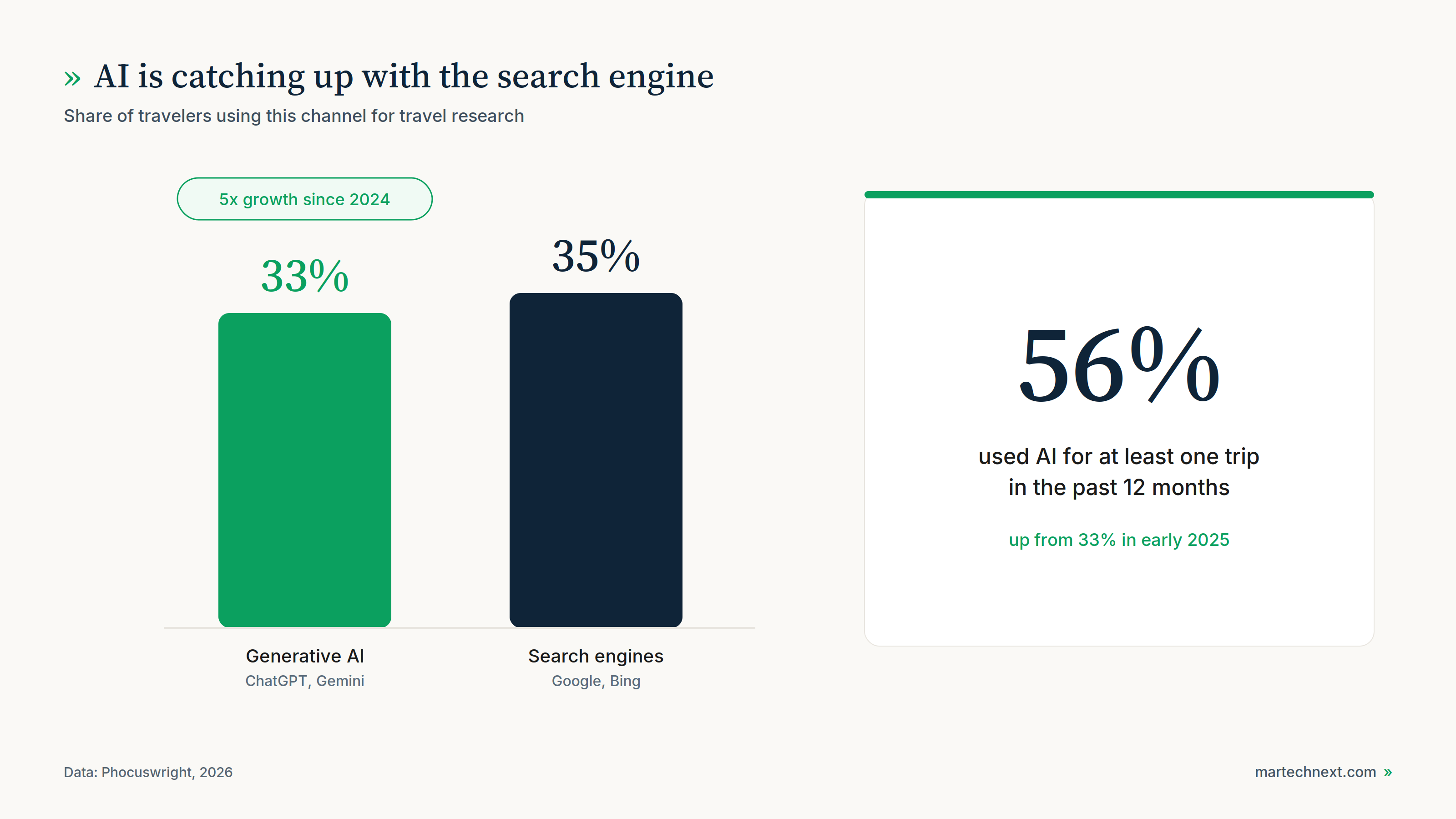
Let's start with the numbers, because they leave little room for doubt. According to Phocuswright, usage of generative AI platforms like ChatGPT and Gemini for travel research has grown fivefold in a single year. They now sit at 33%, just behind classic search engines at 35%. Measured more broadly, 56% of travelers used AI for at least one trip in the past twelve months, up from 33% in early 2025. Phocuswright calls it the fastest behavioral shift they've measured in over a decade of consumer research, with every generation posting double-digit gains.
Adoption is not evenly distributed, and that's useful information rather than a footnote. The US leads. In Europe, adoption trails partly due to stricter regulation slowing feature rollouts, with the UK ahead of France and Germany. But everywhere the curve points the same way. If you operate in a market where the numbers still look modest, read the US data as a preview, not as someone else's problem. Waiting until adoption in your market matches the US means entering the game when everyone else is already on the field.
A scene from a recent industry conference illustrates the gap perfectly. Speakers asked a room full of travel professionals who had a strategy for AI visibility. Two hands went up. Then they asked who had personally researched a trip with an AI tool. Every hand in the room went up. That's the opportunity in one image: the usage is mainstream, the strategy is not.
And there's good news buried in the data. Visitors who land on a travel website via ChatGPT or Claude have largely done their research already. They arrive better qualified, and it shows in conversion. Practitioners I've spoken with saw AI-referred traffic grow five to eight times in a year. Still from a small base, but the growth curve is unmistakable. Half of travelers who see AI answers still click through to the source websites, and that click is worth more than the average search click ever was.
GEO is not a new SEO. It's SEO in new clothes
Here's where the first mistake gets made. Plenty of vendors present AI visibility as a completely new discipline, disconnected from everything you already know. The reality is more nuanced. AI visibility, usually called GEO (generative engine optimization), still leans heavily on the principles of SEO. The difference is in the execution, not the foundation. Google itself, tellingly, still just calls all of it SEO.
What makes it more complex is that every AI model works slightly differently. ChatGPT leans heavily on the Bing index for its web search, while Gemini correlates much more closely with Google's rankings. A strong position in Google doesn't automatically translate into visibility across every AI platform. And everything moves fast: what works today can shift within months.
We're roughly where SEO stood fifteen to twenty years ago. Nobody knows exactly what drives visibility, and the moment you think you've figured it out, it changes. That doesn't mean you can't act. It means you work from proven principles and monitor relentlessly. Anyone declaring SEO dead has it backwards: SEO is the foundation GEO stands on.
Write for the machine and the human
The biggest practical shift is in how you structure content. Think of the classic online pancake recipe: before you reach the ingredients, you scroll through a long story about the writer's grandmother. For a human, charming. For an AI model, noise. Many travel websites still work exactly like this: long, atmospheric landing pages with the relevant information buried somewhere in the middle.
AI models work within a limited window of information. They prefer short, clear blocks of content in which a question gets answered directly. In practice this is called content chunking: you break your content into compact, self-contained blocks that an AI can easily pick up and cite. At the same time, thinking shifts from individual keywords to entities. You no longer just want to rank for "boutique hotel Amsterdam"; you want the AI model to associate your brand with the right concepts, atmospheres, and destinations.
The foundations that support this are partly familiar from SEO: a fast, well-indexed website, clean structured data so models can identify your brand, products, and location, a logical heading structure, and FAQ blocks that answer concrete questions. On top of that, strong E-E-A-T signals (Experience, Expertise, Authoritativeness, Trustworthiness) weigh heavily, because AI systems prefer sources they recognize as reliable.
Your biggest risk: contradictory and outdated information
This might be the most important point in this whole piece, because it's so concrete. AI models are extremely literal. Where a human effortlessly ignores an outdated page, an AI takes it at face value.
Still selling your Easter promotion in May? Does your site say the pool opens in October when it's already open? Is your property name consistent everywhere? These contradictions are a far bigger risk than most companies realize. A real example: a hotel renamed one of its properties, updated the website neatly, but forgot the metadata. Overnight, the hotel vanished completely from AI answers, simply because the name the model was looking for no longer matched what the website reported. Only when the company noticed it had disappeared from the answers did anyone ask: what happened to our hotel?
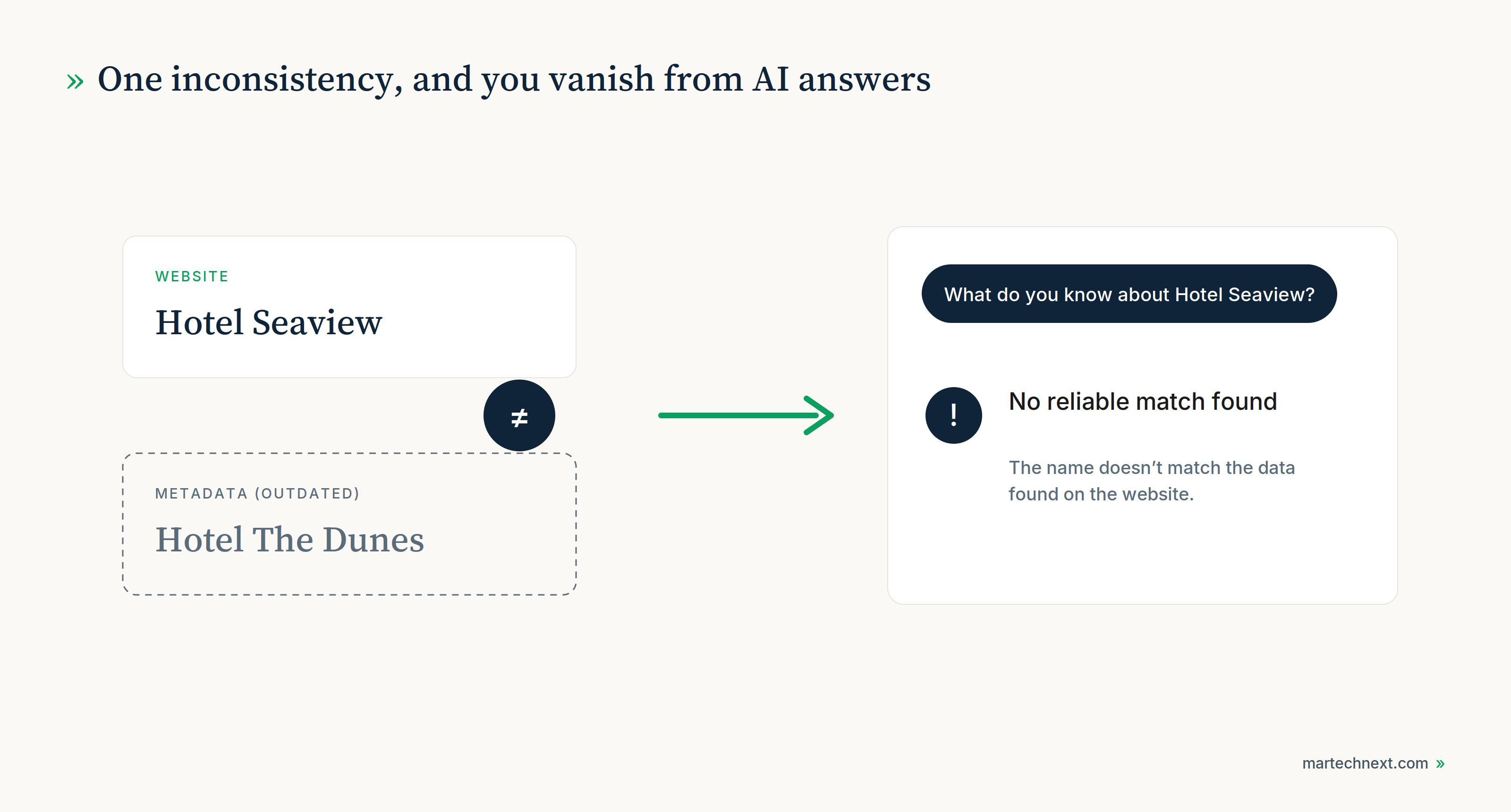
In travel this happens more often than you'd think. Properties change brands and chains all the time. For SEO, everyone knows how to handle that with redirects. For GEO, almost nobody thinks about it yet. The good news: you can absolutely communicate such a change properly toward the AI models. You just have to know it's necessary. So always start with a check on the reliability and consistency of your own information, before you invest a euro in visibility.
Co-occurrence: the new backlink
In the old SEO world, backlinks were the core measure of authority. In the world of AI visibility, something similar is emerging: co-occurrence. In short, it's valuable when authoritative sources mention your brand in the same context as a topic. If your travel company is named in a piece about the best treks in a region, that helps your visibility, even without a classic link.
This creates a genuinely new role for destination marketing organizations and tourism boards. A DMO no longer needs to steer purely on visitor numbers or clicks to its own site. Its biggest lever may be actively naming the businesses in its region and functioning as a source. That creates a cycle: the organization strengthens its region, and the affiliated travel businesses get found. For an independent supplier, the practical implication is clear: actively seek partnerships with parties that can mention you in the right context.
And in this phase of the journey, don't forget your Google Business Profile. A well-optimized profile demonstrably helps visibility at the moment the traveler makes a concrete choice.
Direct versus OTA: your window of opportunity
Now the strategically most interesting part. Who wins in this new landscape, the supplier or the big booking platforms? Right now, direct travel suppliers hold a remarkable advantage. AI models frequently recommend the supplier itself rather than the OTAs. The reason is logical: the content an AI needs is richer and more specific when it comes from the supplier. An OTA optimizes for simplicity and comparability, and that's often not what convinces an AI model.
It matches how travelers search now. The query is no longer "hotel Barcelona center" but something like "I'm looking for a boutique hotel in a lively neighborhood, close to good seafood restaurants". That kind of nuanced, context-rich information rarely lives neatly structured in an OTA database, but it does live in the supplier's own descriptions.
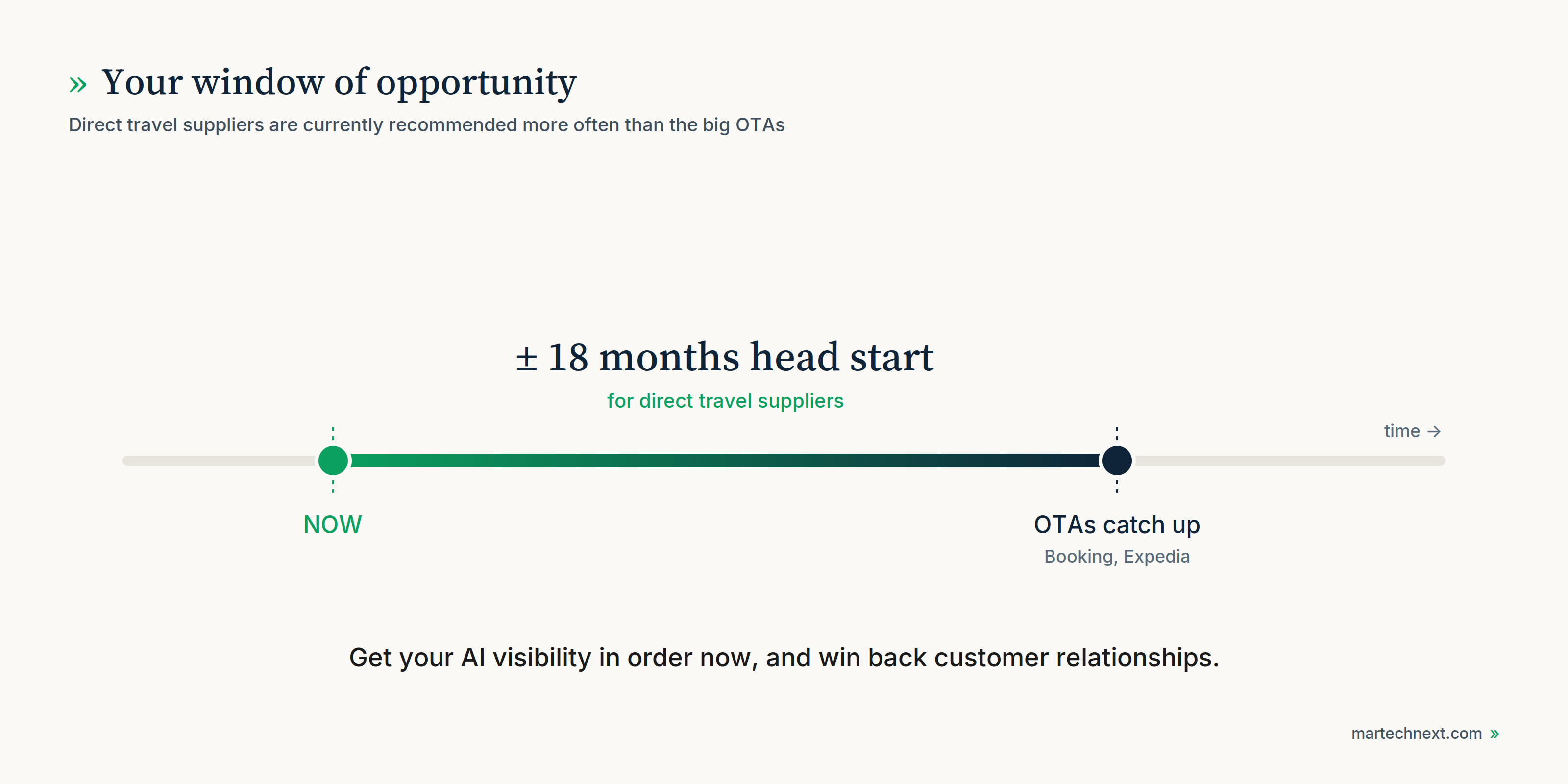
There is a timer on this, though. Industry experts estimate that direct suppliers have roughly eighteen months before the big players, Booking and Expedia first among them, close this gap. They have enormous, capable teams working on exactly this, while hedging by shifting toward B2B and infrastructure roles. The message is clear: the advantage is real, but temporary. Whoever gets their AI visibility in order now wins back customer relationships that will be much harder to capture later. For why owning that direct relationship matters so much economically, see my piece on the shift from acquisition costs to AI-driven growth in travel (link it here).
So is the website obsolete?
A fair question, because you increasingly hear that websites will disappear. The opposite is true. Everything above revolves around your website. It has simply gained a second audience: alongside your guest, the AI models now read along. Your website is where you communicate with those models and where your information comes from. That makes it more important, not less.
The data backs this up. Only 8% of travelers found an AI answer sufficient on its own, and half click through to the source website after an AI answer. Travel is a high-stakes purchase where people want to verify. Behavior also shifts slower than headlines suggest: eighteen months ago we all assumed we'd soon be booking entirely in chat, and in practice that turned out to be an unpleasant experience for a complex trip. The traveler may now do 80 to 90% of the dreaming and orienting through AI, but still takes the final, decisive step on a website built for conversion. And even if the interface eventually shifts to voice or a wearable, there will always need to be a source the AI pulls its information from.
Where to start: a practical roadmap
The biggest hurdle is rarely willingness, it's capacity. In many travel companies the same person is responsible for SEO, GEO, CRM, and often paid media on top. So this isn't about doing everything at once, but about the right order and the highest-impact steps. Three starting points:
1. Start with monitoring. You don't need an expensive tool on day one. Open ChatGPT yourself and ask the questions your guest would ask. See what comes out, and whether you're in it. Mind one detail most people miss: over 80% of users are on the free model, and the answers of the free and paid models differ substantially. With web search turned off, you get answers based on outdated training data. For a serious picture, monitor deliberately and consistently, with the right models and settings.
2. Get the technical basics in order. Check that you're not unintentionally blocking AI crawlers, ensure correct structured data, a logical site structure, and accurate, consistent information. It's the least sexy part of the work, and it's what prevents your investments from leaking away.
3. Work from a prioritized roadmap. There are hundreds of small things you could do. The craft is determining which ones have the most impact today: the low-lift, high-impact optimizations. And don't wait for perfect data. The dream of one clean, complete customer database has existed for twenty years and remains unrealistic for most travel companies in the short term. It's far smarter to work within your current data limitations and focus on what actually matters to the customer.
Ready to be found in AI?
The through-line is clear: travelers are already in the AI platforms en masse, most travel companies are not, and there is still a window in which you can build a lead. The companies that get their foundation in order now, make their information consistent, and optimize deliberately for both Google and the AI models are the companies that will be named. This isn't a separate trick next to your marketing, it's the same discipline that has always mattered: being findable where your customer searches. The place where they search has simply moved. :)
As always, I don't have all the answers, and in a field this young, anyone who claims to should make you suspicious. But the principles above are the ones I see working in practice today. Wrestling with AI visibility in your own organization, whether in travel or elsewhere? I'd love to exchange thoughts.
-- Bram Versteegh
Bram Versteegh is the founder of MartechNext, covering the business of AI in marketing: who's building it, who's funding it, and how industries put it to work.
Enjoyed this piece? Every week, What's Next delivers sharp analysis, the latest funding rounds in AI marketing, and the martech news that actually matters. Straight to your inbox, free.