Marketing Before the Search Bar: What Predictive Intent Means for the Conversation Economy
"Predictive intent" claims marketers can reach customers before they search. Here's what's genuinely new, what's a rebrand, and how to act on it responsibly.


In this article:
- Why "predictive intent" matters if the conversation, not the search bar, is becoming the funnel
- What's actually new here versus what's a rebrand of existing ABM and intent-data tooling
- The data precondition nobody skips past, no matter how good the model is
- The Target pregnancy story, and why it's the cautionary tale this category needs
- A practical, non-hyped roadmap for testing predictive intent without creeping out your customers
- My verdict: cautiously interested, evidence still pending
Picture a mid-sized outdoor retailer's marketing manager looking at a new dashboard row: a household flagged as "78% likely to buy ski gear in the next four weeks," generated before anyone in that household has typed a single search query, opened an email, or clicked an ad. No keyword to bid on. No search intent to capture. Just a model saying: this person is about to want something, reach them now.
That's the pitch behind "predictive intent," a phrase getting airtime in martech trade coverage this year, including a recent piece from Martech Series arguing marketing is shifting from reactive, search-triggered targeting to models that anticipate need before it surfaces as a query.
It's a good story. The question worth asking, as always, is whether the technology backs it up, and what happens to the rest of our search-visibility playbook if it does.
Why this matters right now
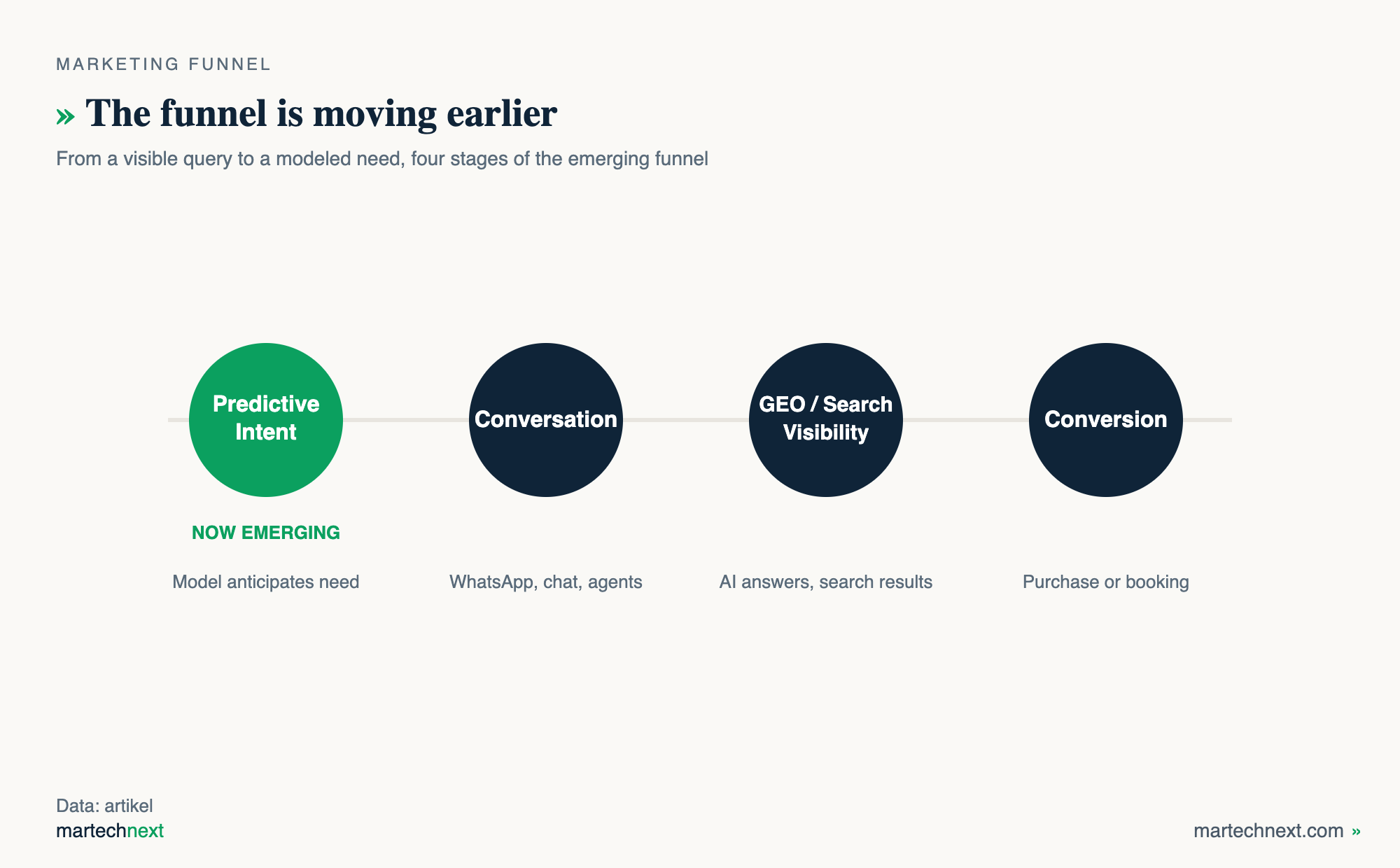
I've spent a fair amount of space on this site arguing that the conversation is becoming the new funnel: commerce moving into WhatsApp threads, Meta Business Agents, and ChatGPT product answers instead of ten blue links (see the Meta Conversations 2026 piece. The GEO playbook I've written about is essentially SEO's successor: getting your brand surfaced correctly when someone asks an AI assistant a travel or shopping question.
But all of that still assumes a query happens. Someone types something, or says something, and then the system responds. Predictive intent proposes skipping that step entirely: model the need before the question exists, and act on it.
If that's technically real, and reliably so, it's not a footnote to the GEO thesis. It's a layer that sits in front of it. Your product feed still needs to be clean for ChatGPT to recommend you. Your WhatsApp journey still needs to convert once someone's in the thread. But before either of those matters, a predictive layer decides whether you get a shot at the conversation at all.
That's a genuinely exciting proposition for marketers tired of bidding on the same high-intent keywords everyone else is bidding on. Reaching someone before the auction even opens is, in theory, the cheapest possible acquisition channel there is.
What's actually new here, and what isn't
Here's where I want to slow down, because this is exactly the kind of claim that deserves scrutiny before adoption.
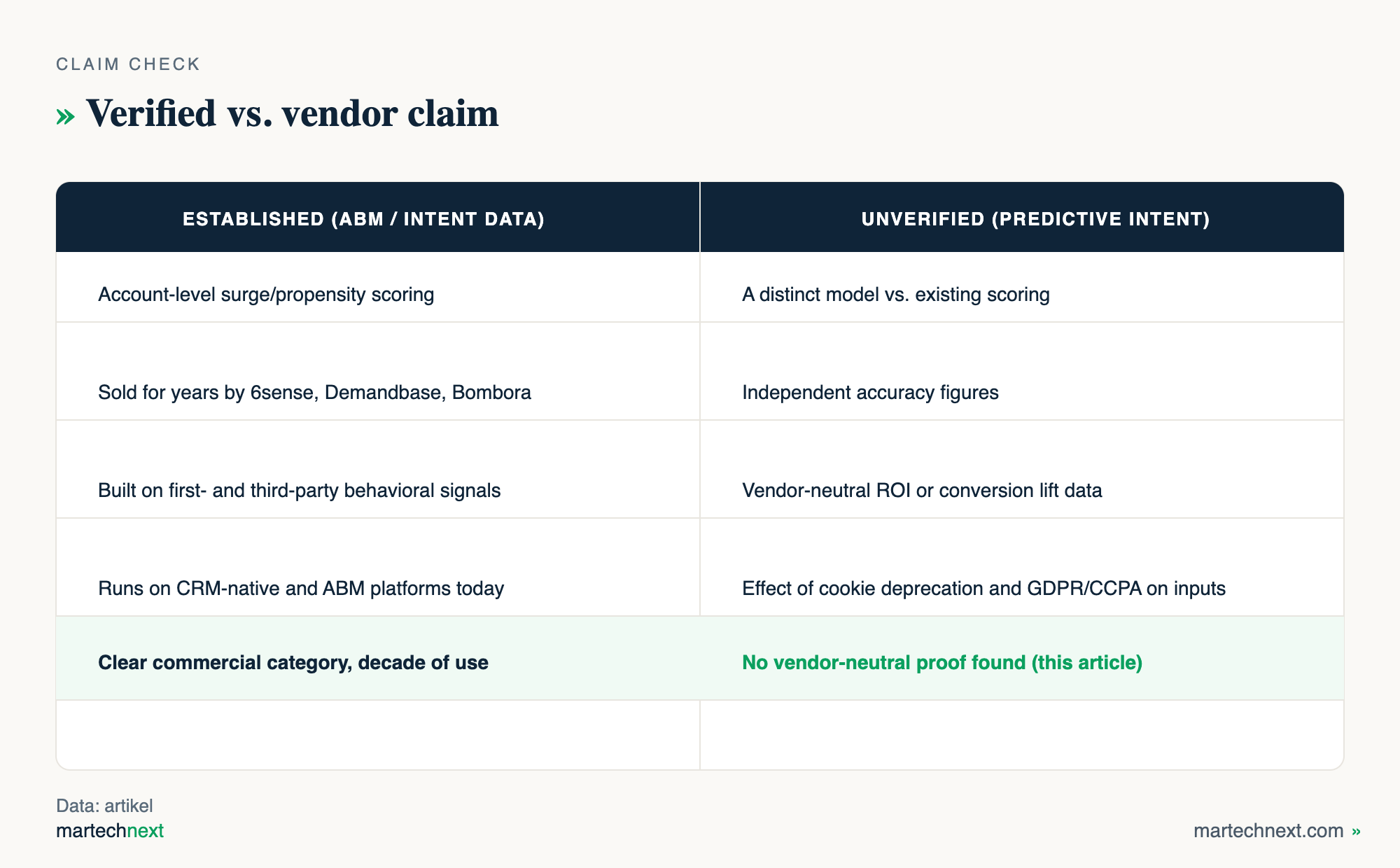
Intent data as a category isn't new. Vendors like 6sense, Demandbase, Bombora, and TechTarget's Priority Engine have been selling account-level "surge" and propensity scores for years, built by aggregating first- and third-party behavioral signals into a model that flags which accounts are showing buying signals before a rep or a marketer notices (per Demandbase and DemandScience's own explanations of how their intent data works). That's the mechanic ABM has run on for a decade.
So what, specifically, does "predictive intent" add on top of that? Based on what I could verify, the honest answer is: it's unclear. The Martech Series piece and adjacent trade coverage describe the concept in aspirational terms, marketing before the search happens, but I found no source that draws a clean technical line between "predictive intent" and the propensity scoring that's already commercially available. It's entirely possible this is a genuinely new modeling approach. It's also entirely possible it's a rebrand riding the AI wave, the same way "smart" got attached to every product category around 2015.
I'll say the quiet part: I couldn't verify any independent, vendor-neutral figures on accuracy, conversion lift, or ROI specific to "predictive intent" as its own category. If a vendor pitches you a number here, ask what it was measured against, what the sample size was, and whether anyone outside the vendor validated it. Vendor-run benchmarks are directionally interesting. They are not proof.
That's not a reason to dismiss the idea. It's a reason to treat the label skeptically while taking the underlying capability seriously.
The data precondition nobody gets to skip
Assume, for a moment, that predictive intent models genuinely work better than existing propensity scoring. They'd still need the same thing every AI system needs to function: clean, unified, structured behavioral data flowing from every touchpoint into one place.
This is the thesis I keep coming back to on this site: the right order is data, then automation, then AI. MIT's widely cited figure that roughly 95% of enterprise AI pilots fail isn't because the models are bad. It's because most organizations are trying to run sophisticated prediction on top of what I've called data spaghetti, disconnected systems, inconsistent identifiers, half-synced CRMs.
Predicting intent before a search happens is, structurally, a harder problem than scoring an account that's already showing surge activity. It needs more signal, cleaner joins across channels, and a feedback loop that tells the model when it's wrong. If a vendor is pitching predictive intent without first talking about the data foundation underneath it, that's worth noticing.
There's also an open question I want to flag honestly rather than paper over: how third-party cookie deprecation and GDPR, CCPA, and CPRA constraints actually affect the data inputs this kind of model needs. I looked for a solid, current answer on this and didn't find one I'd stand behind. Any vendor claiming their predictive model is "privacy-safe by design" deserves a direct follow-up question: safe under which regulation, using which consent basis, for which data types. Don't accept the phrase at face value.
The creepy line, and why it matters more than the accuracy number
The most famous story in this space is Target's pregnancy-prediction model, the one where a father allegedly received maternity coupons addressed to his teenage daughter before she'd told her family she was pregnant. It's the go-to anecdote every predictive marketing article reaches for, including, I'd guess, some future draft of this exact piece if I hadn't stopped myself.
I want to use it carefully. The exact details of that story have been disputed and likely embellished across a decade of retellings (multiple accounts diverge on specifics). Treat it as illustrative of a risk, not as a clean, verified case study.
But the underlying dynamic is real regardless of the exact anecdote: a model that's accurate enough to predict something a customer hasn't disclosed yet can produce a genuine trust rupture, even when it's technically working as designed. This is exactly why automation needs human accountability layered on top of it. The model can flag the propensity. A person, or at minimum a rules layer with real judgment built in, should decide how and whether that gets acted on in a customer-facing way.
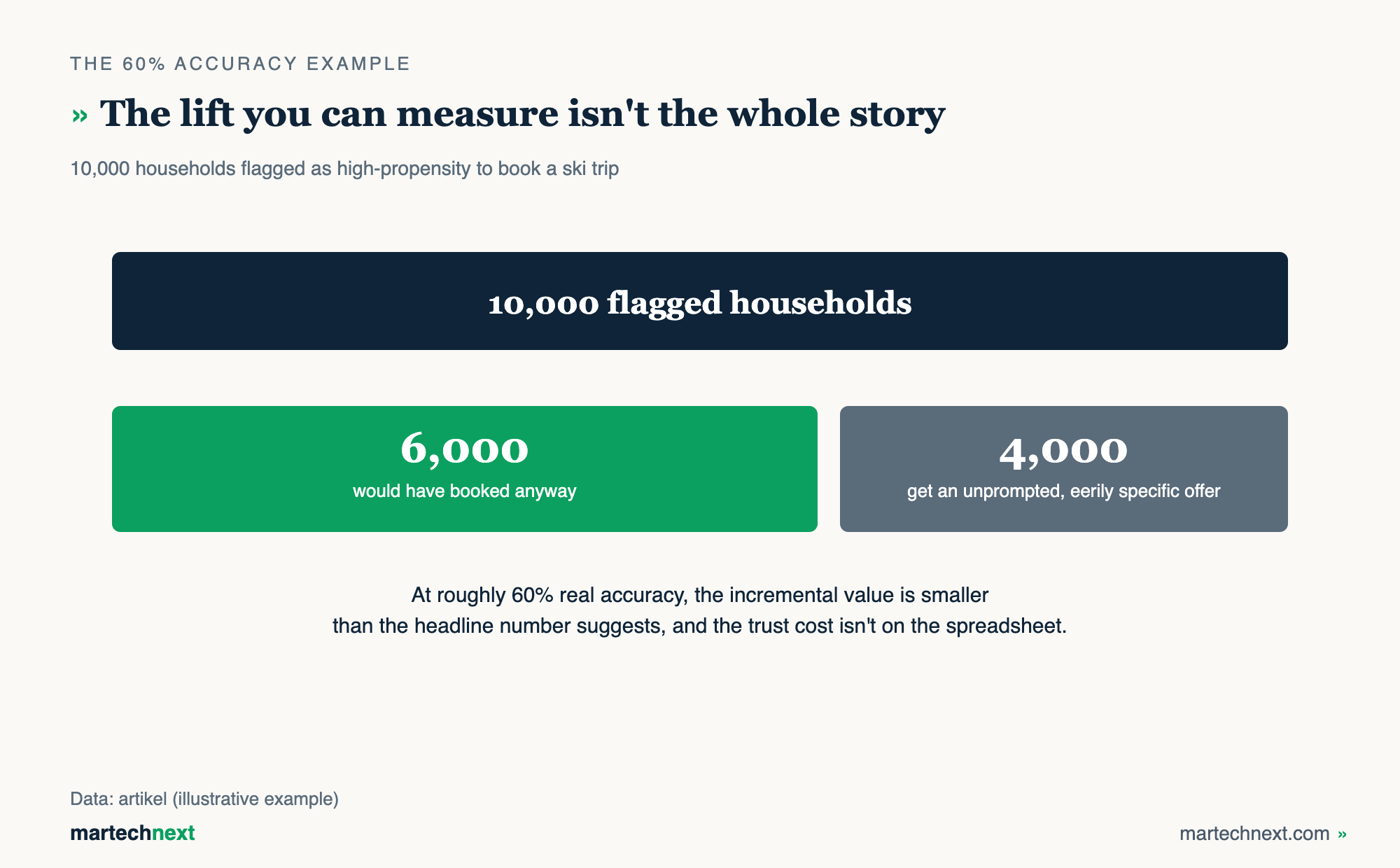
Say a travel brand's predictive model flags 10,000 households as high-propensity for a ski trip, at roughly 60% real accuracy. That means around 6,000 of those people were probably going to book anyway, so the incremental value is smaller than the headline number suggests, and the other 4,000 get an eerily specific offer for a trip they had no plans to take. Best case, that's a mildly odd email. Worst case, it's the moment a customer decides your brand is watching too closely.
The lift you can measure is never the whole story. The trust you spend to get it usually isn't on the same spreadsheet.
Who's actually positioned to win this
If predictive intent turns out to be a real, distinct capability rather than a rebrand, this is a textbook case of early movers winning the channel, the same pattern I've tracked across AdWords, Facebook, TikTok, and WhatsApp. Being early to a genuinely new targeting layer, before it gets commoditized and priced up, is usually worth more than waiting for the category to mature.
But "early mover" only pays off if the underlying capability is real. Being early to a rebrand just means you paid full price for something you already had.
I don't have a confirmed list of vendors shipping a product specifically labeled "predictive intent" with disclosed methodology (source needed, and I'd genuinely want to see one before recommending a specific tool). Until that exists, the honest move is to build the muscle in-house on data you already control and have consent for, rather than buying a black-box score from a vendor who can't explain how it's built.
A practical way to test this without the hype
You don't need to wait for the category to settle to start learning something useful. Here's how I'd approach it:
1. Audit your first-party data before anything else. If your CRM, booking engine, and email platform don't share a clean customer ID, you're not ready for predictive scoring, you're ready for step one of thesis 2.
2. Start with propensity scoring you already have consent for. Existing ABM or CRM-native scoring (Salesforce, HubSpot, and similar platforms already offer this) is a legitimate, lower-risk place to test the underlying idea before buying a new "predictive intent" label.
3. Run it as an internal signal first, not a customer-facing trigger. Let your sales or lifecycle team see the flag before any automated message goes out. That's the human accountability layer calls for.
4. Wire any validated signal into the channels where the conversation actually happens, your WhatsApp journeys, your chat interfaces, not just legacy email blasts.
5. Holdout test everything. Split your flagged high-propensity group, treat half, leave half untouched, and measure the actual incremental lift, not the flattering per-recipient number. This is the same discipline I've argued for in the LTV/CAC piece: totals and incrementality, not vanity multipliers.
If you can't get a vendor to walk you through their methodology at the same level of detail you'd expect from your own holdout test, that's your answer for now.
My verdict
Predictive intent is a genuinely interesting direction, and it fits cleanly into where I think the funnel is heading: earlier, more individual, and less dependent on a visible query. If it works, it's the natural front layer to everything I've written about GEO and conversational commerce.
But right now, it's a compelling concept sitting ahead of its evidence. I couldn't find independent proof that it's technically distinct from the propensity scoring ABM vendors have sold for years, and I couldn't find validated accuracy or ROI figures that weren't vendor marketing copy. That doesn't mean it's fake. It means it's unproven, which is a different thing entirely.
My advice: build the data foundation now, since you'll need it either way. Pilot the concept internally with data you already have consent for. And treat any vendor pitching "predictive intent" as a distinct, priced-up category the way you'd treat any bold new label: ask for the methodology before you ask for the demo.
Are you seeing "predictive intent" show up in vendor pitches on your desk already? I'd love to exchange notes on what they're actually claiming versus what they can show.
-- Bram Versteegh
Bram Versteegh is the founder of MartechNext, covering the business of AI in marketing: who's building it, who's funding it, and how industries put it to work.
Enjoyed this piece? Every week, What's Next delivers sharp analysis, the latest funding rounds in AI marketing, and the martech news that actually matters. Straight to your inbox, free.