Early movers into ChatGPT Ads: what AdWords 2001 can teach you about the next six months
ChatGPT Ads just added conversion bidding and bulk tools. Here's why the speed of that rollout, not the features themselves, is the real signal for marketers.


In this article:
- What OpenAI actually shipped this week, and which parts are genuinely new versus repackaged
- Why the speed of ChatGPT Ads' maturation curve matters more than any single feature
- The tension between new measurement tools and OpenAI's own admitted measurement gaps
- How the $100M ARR claim stacks against independent forecasts, and what that gap tells you
- A practical way to think about testing budget here without betting the farm
- Why this connects to the oldest lesson in performance marketing: early movers win channels
Picture a mid-sized DTC brand's paid media lead, scrolling Search Engine Land on a Friday afternoon, seeing the headline "ChatGPT Ads adds conversion bidding, geo exclusions and bulk campaign tools" and thinking: another platform update, file it under "check later." That instinct is understandable. It's also, I think, wrong. Not because the individual features are groundbreaking. Because of how fast they arrived.
What actually shipped
Let's get the facts straight first, because there's a lot of noise around this one.
According to Search Engine Land, OpenAI's update to ChatGPT Ads includes conversion-optimized campaigns (oCPC), average daily budgets on a rolling seven-day model, automatic budget pacing, geographic exclusions, AppsFlyer and Adjust mobile measurement integrations, Automatic Advanced Matching (hashed PII matching, the same concept Meta and Google use for match rates), and an asynchronous Bulk API for managing campaigns, ad groups and ads at scale.
None of this is exotic if you've run Google or Meta campaigns. Geo exclusions, daily budget pacing, bulk campaign management: this is table stakes on mature platforms. What's notable is that ChatGPT Ads didn't have any of it a few months ago.
Some of these are genuinely new capabilities (oCPC bidding, the Advanced Matching layer). Others are OpenAI catching up to features Google Ads shipped over a decade ago (bulk editing, geo exclusions). Worth being honest about that split: this is less "OpenAI invents advertising" and more "OpenAI builds the boring plumbing every mature platform needs."
The real story is the speed, not the features
Here's the part that made me sit up.
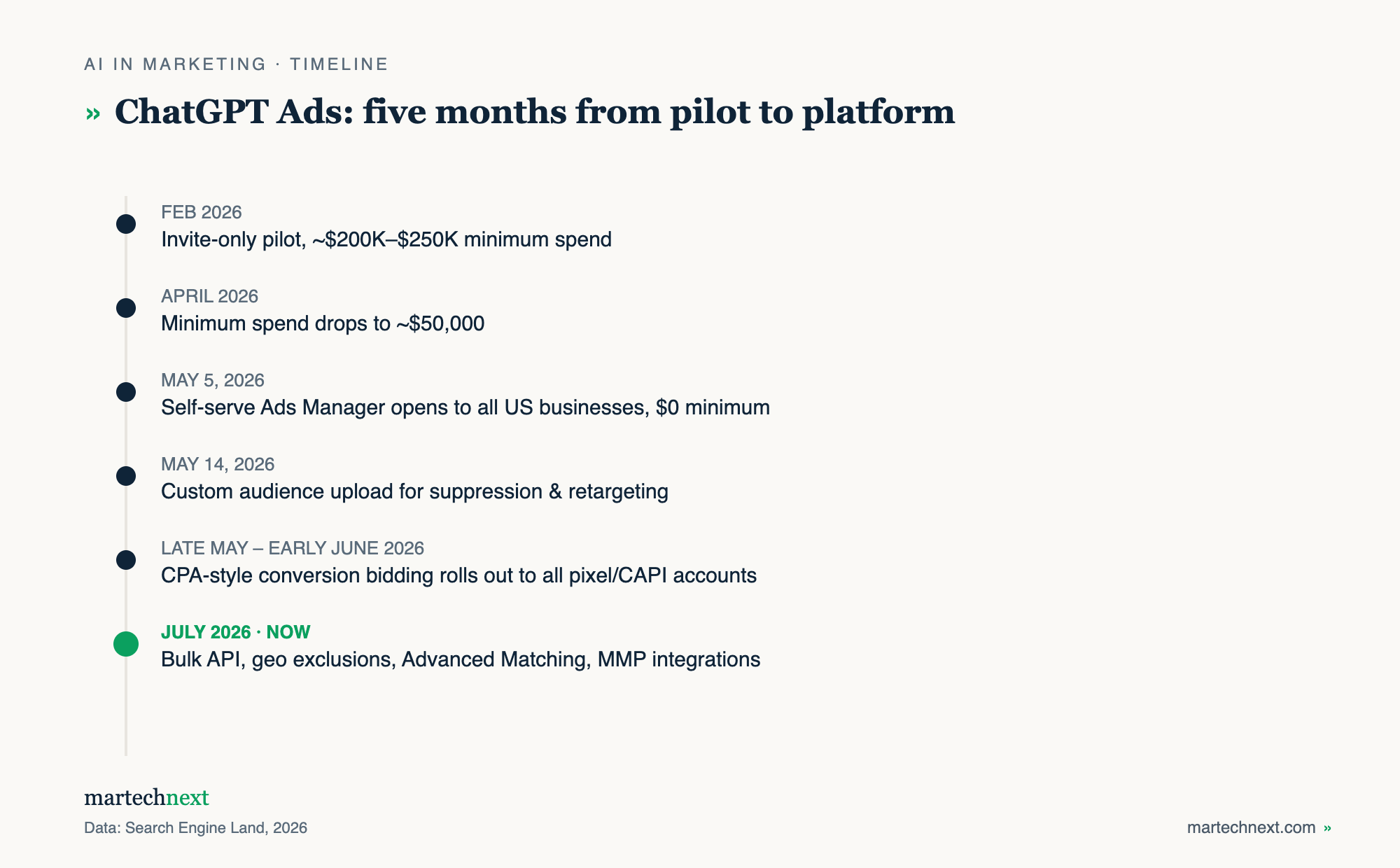
In February 2026, ChatGPT Ads launched as an invite-only pilot with a minimum spend somewhere around $200,000 to $250,000. By April, that minimum had dropped to $50,000. On May 5, 2026, OpenAI opened self-serve Ads Manager to all US businesses with a $0 minimum. Nine days later, custom audience upload arrived for suppression and retargeting. By late May, CPA-style conversion bidding started rolling out to select advertisers, reaching all accounts with pixel or Conversions API setup by early June. And now, in July, we get bulk tools and Advanced Matching.
That's roughly five months from "enterprise pilot with a six-figure floor" to "self-serve platform with conversion bidding, mobile measurement partner integrations, and bulk campaign management."
Compare that to how long it took Google Ads (then AdWords) to get from launch to conversion tracking and automated bidding. Or how long Meta took to go from boosted posts to Advantage+ automation. Those maturation curves ran in years, not months. This one is compressing hard, and that compression is the actual news here.
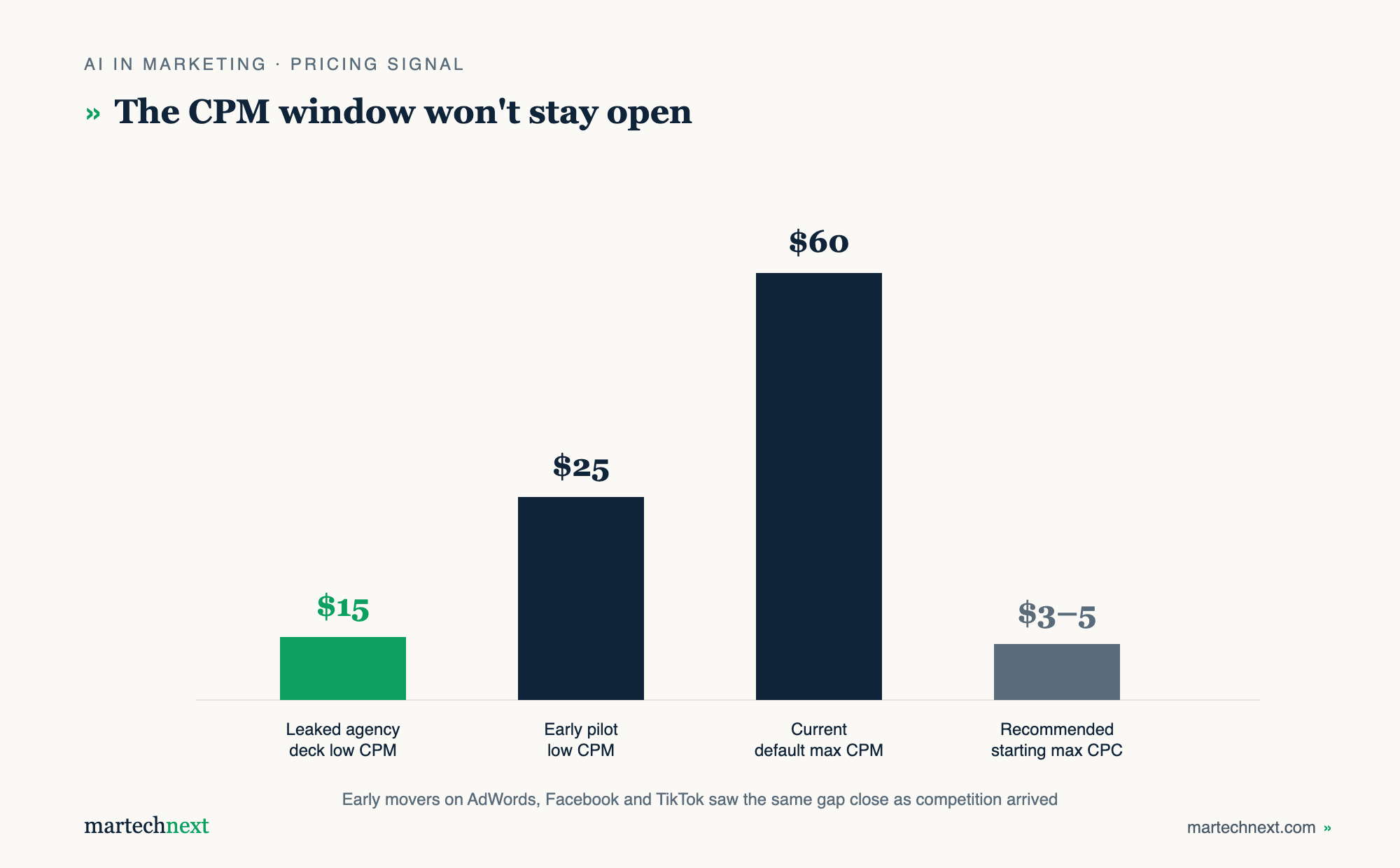
This is thesis #7 in action: early movers win channels. Every platform shift, AdWords in the early 2000s, Facebook ads in 2007, TikTok ads in 2019, WhatsApp Business messaging more recently, rewarded the advertisers who built the foundation before the channel matured and CPCs caught up to competitive reality. Right now, OpenAI is recommending a starting max bid of $3 to $5 per click on a relevance-weighted second-price auction. Early pilot CPMs cleared as low as $25, against a $60 default max, and one leaked agency deck reportedly offered CPMs as low as $15. Those numbers will not last. They never do. AdWords CPCs in 2001 were pennies. They aren't pennies now.
The arbitrage window on any new ad channel is a function of how few advertisers understand the platform relative to how many users are already there. ChatGPT reportedly has 800 million users. Most of them have never seen an ad in the product, because ads currently only reach Free and Go tier users in the US, Canada, Australia and New Zealand, with the UK, Japan, South Korea, Brazil and Mexico coming next. That's a big audience and a comparatively tiny number of advertisers bidding for attention inside it, at least for now.
The window doesn't open twice. It just closes.
Meta Business Agents: buying in the chat
Meta Conversations 2026: the Business Agent is here
The measurement tension nobody's resolved yet
Now for the part that deserves proportionate skepticism, because it genuinely matters.
Search Engine Land has separately reported that OpenAI's ad platform has struggled to show advertisers clear proof that their spend is working. That's not a minor footnote. It sits in direct tension with this week's update, which is explicitly marketed as a measurement upgrade: Advanced Matching, MMP integrations, conversion bidding. You can't optimize toward conversions you can't reliably measure, and you can't build advertiser trust with bidding sophistication if the underlying attribution is still shaky.
This maps straight onto thesis #2, the right order: structure your data first, then automate the repetitive, only then apply AI. Advanced Matching and pixel/CAPI integrations are OpenAI trying to fix the data-plumbing gap retroactively, after already shipping AI-driven bidding on top of it. That's backwards from the recipe, and it's worth remembering that MIT research puts the failure rate of enterprise AI initiatives at 95%, largely because they're built on messy data foundations rather than clean ones. OpenAI isn't exempt from that risk just because it built the model.
None of the specifics here (conversion lift, Advanced Matching match rates, MMP accuracy) have been independently validated. Every number traces back to OpenAI's own product descriptions, relayed through trade press. That's not an accusation of dishonesty, it's just how early-platform reporting always looks: directionally credible, not gospel. Treat it the way you'd treat any vendor-run benchmark.
The $100M question
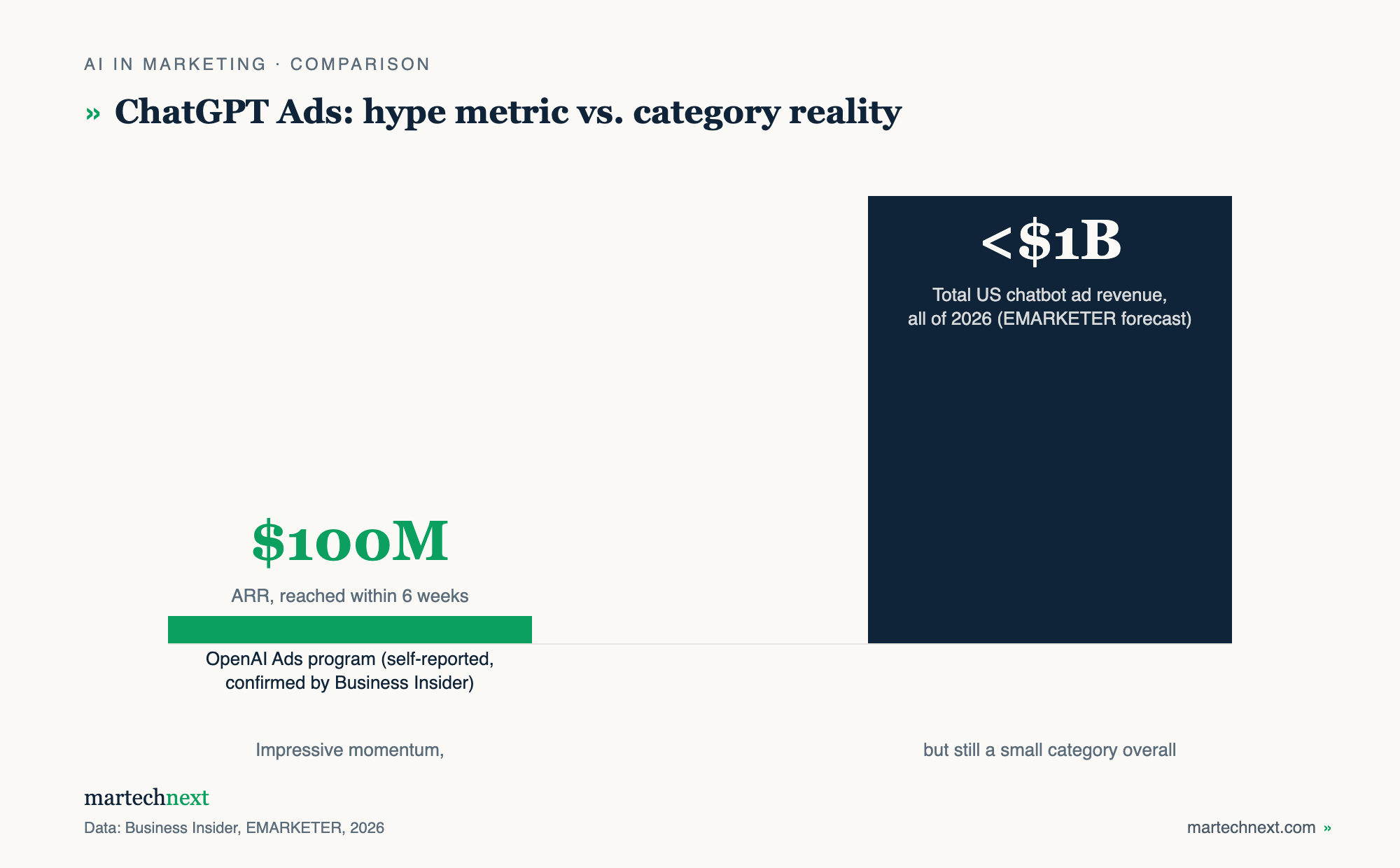
OpenAI's ad program reportedly hit $100 million in annualized revenue within six weeks of launch, with over 600 companies enrolled, a figure a company representative confirmed and Business Insider corroborated independently. That's a genuinely fast ramp for a brand-new ad product.
But EMARKETER expects total US chatbot advertising revenue to stay under $1 billion for all of 2026, and one analyst has pointed out that OpenAI needs substantially more user adoption and ad volume to hit its own internal targets.
Both things can be true. $100M in annualized run-rate after six weeks is impressive momentum. It's also a rounding error next to Google's or Meta's ad businesses, and a sub-$1B total category forecast for the year tells you this channel is still small in absolute terms, even if it's growing fast in relative terms. Don't let "$100M ARR" make you think ChatGPT Ads is already a mainstream channel. It isn't. It's an early one. That's exactly the point.
What advertisers should actually do with this
I'd steer clear of two overreactions here. One is "this is nothing, check back in 2027." The other is "drop 30% of your Google budget into ChatGPT Ads tomorrow." Neither is the right move.
Here's a more useful way to think about it, tied to thesis #1, value over volume:
1. Treat this as a test-and-learn channel, not a scale channel, for now. Run a small, deliberately-sized pilot (think holdout-test discipline, not "spend until it stops working"). You're paying for optionality and channel knowledge, not immediate ROAS.
2. Get your pixel and Conversions API instrumentation in order before you touch conversion bidding. oCPC only works as well as your conversion signal. If your data plumbing is spaghetti, don't expect an AI bidding layer to fix it, that's the exact trap thesis #2 warns about.
3. Measure by LTV:CAC and incrementality, not raw conversion count. With CPA-style bidding now live, it's tempting to chase the volume metric the dashboard shows you. Resist it. The same discipline that applies to Google and Meta applies here: a cheap conversion that churns in a week isn't a win.
4. Remember oCPC is optimized cost-per-click, not true pay-per-conversion. OpenAI is still charging you per click while predicting conversion likelihood behind the scenes. Don't let the naming imply you only pay when someone converts.
5. Build your feed and off-site measurement discipline now, while the audience-to-advertiser ratio is still generous. This is the same principle behind GEO for organic visibility: the brands that show up cleanly and get measured accurately before the channel matures are the ones who compound that advantage once CPCs rise and the auction gets crowded.
How this stacks against the incumbents
I want to be careful here, because the honest answer is: we don't yet have solid comparative performance data. What we do know is structural. ChatGPT Ads targets contextually, based on what's actually being discussed in the conversation, not demographically. There are no match types, no Quality Score, no audience segments in the traditional PPC sense, though custom audience upload for suppression and retargeting arrived shortly after the May self-serve launch.
That's a fundamentally different targeting model than Google's Performance Max or Meta's Advantage+, both of which lean hard on algorithmic audience expansion across demographic and behavioral signals. Whether contextual-only targeting scales as well as those systems is genuinely an open question. Nobody has published a clean comparison yet, and I'd be skeptical of anyone claiming otherwise this early.
What I can say is this: the whole thing is evolving in the direction of a full-funnel commerce layer, not just an ad slot. OpenAI is testing multi-advertiser placements and a shopping product carousel with Etsy and Shopify checkout integration. That's the conversation becoming the funnel, quite literally: discovery, ad, and checkout in the same thread. This is thesis #6 made concrete.
The thread is the new funnel, and OpenAI is racing to build the toll booth before the traffic arrives.
Open questions worth watching
A few things I'd keep an eye on over the next two quarters:
- Whether independent agencies publish real conversion-lift and Advanced Matching match-rate data, rather than OpenAI's own descriptions
- Whether the exact rollout sequence for conversion bidding gets a clean, primary-source timeline from OpenAI (reporting has been inconsistent across outlets)
- Whether the multi-advertiser placement test and shopping carousel actually convert, given OpenAI's earlier, publicly walked-back struggles with Instant Checkout
- Whether minimum viable test budgets stay this accessible once conversion bidding is fully rolled out, or whether OpenAI starts nudging spend minimums back up as demand increases
The verdict
This update, taken feature by feature, is unremarkable. Bulk APIs and geo exclusions are not innovation, they're maintenance. But the speed at which OpenAI compressed five months of platform maturation, from a $250K enterprise pilot to a full self-serve, conversion-bidding, bulk-manageable ad platform, is the actual story, and it rhymes with every ad platform that ever mattered.
I'm not telling you to move your media budget wholesale. The measurement gaps are real, the $100M figure is self-reported, and EMARKETER's sub-$1B forecast is a useful reality check against the hype. But I am telling you that the advertisers who spend the next two or three months building a small, disciplined test here, clean conversion tracking, modest budgets, LTV:CAC framing instead of raw conversion chasing, will understand this channel better than their competitors when the arbitrage window closes and everyone else shows up at once.
That's how it went with AdWords. That's how it went with Facebook. My money says it plays out the same way here :)
Wrestling with where ChatGPT Ads fits your own channel mix? I'd love to exchange thoughts.
-- Bram Versteegh
Bram Versteegh is the founder of MartechNext, covering the business of AI in marketing: who's building it, who's funding it, and how industries put it to work.
Enjoyed this piece? Every week, What's Next delivers sharp analysis, the latest funding rounds in AI marketing, and the martech news that actually matters. Straight to your inbox, free.