Can you actually buy a flight by talking to Alexa? Amazon is about to find out
Amazon's Alexa+ is testing in-chat trip bookings with Priceline. Here's what it means for the "conversation is the new funnel" thesis, and for travel marketers.


In this article:
- Why Amazon picked travel, of all categories, to test in-chat purchasing
- What's actually been confirmed versus what's still press language
- Why travel is the hardest possible test case for conversational commerce
- The reliability problem nobody wants to talk about yet
- Who actually wins if this works: Amazon, Priceline, or nobody
- A practical read on what travel marketers should do right now, not in six months
Picture someone lying on the couch on a Tuesday night, telling Alexa they need a flight to Lisbon for a long weekend in October. No app, no ten browser tabs, no fifteen-minute price comparison ritual. Alexa checks dates, pulls a price, and asks: shall I book it on your saved card?
That moment, the one where a voice assistant closes a real purchase instead of just answering a question, is the moment every conversational AI platform has been chasing and none of them have convincingly nailed. Amazon just said, in effect: we're going to be the ones who crack it, and we're starting with travel.
According to Skift, Amazon's newly announced Model Context Protocol (MCP) support for Alexa+ has pulled in Priceline, Viator, Virgin Atlantic, Lyft, Brightline, FlixBus, and Greyhound as early partners building booking tools for the assistant. A new "Amazon Wallet" feature would let people pay using stored cards, right there in the conversation. Skift frames it plainly: Amazon is betting that stored payment credentials, MCP, and 180 million Prime members can solve the problem that stopped ChatGPT cold, namely getting people to actually complete a purchase inside an AI chat.
That's a big claim. It's also, if it works even partially, a live test of one of the ideas I keep coming back to on this site: the conversation is the new funnel. This is that thesis with its sleeves rolled up, tested against one of the hardest, highest-stakes purchase categories there is.
What's actually been shown, and what's still a press release
Let's separate signal from noise, because there's a lot of noise here.
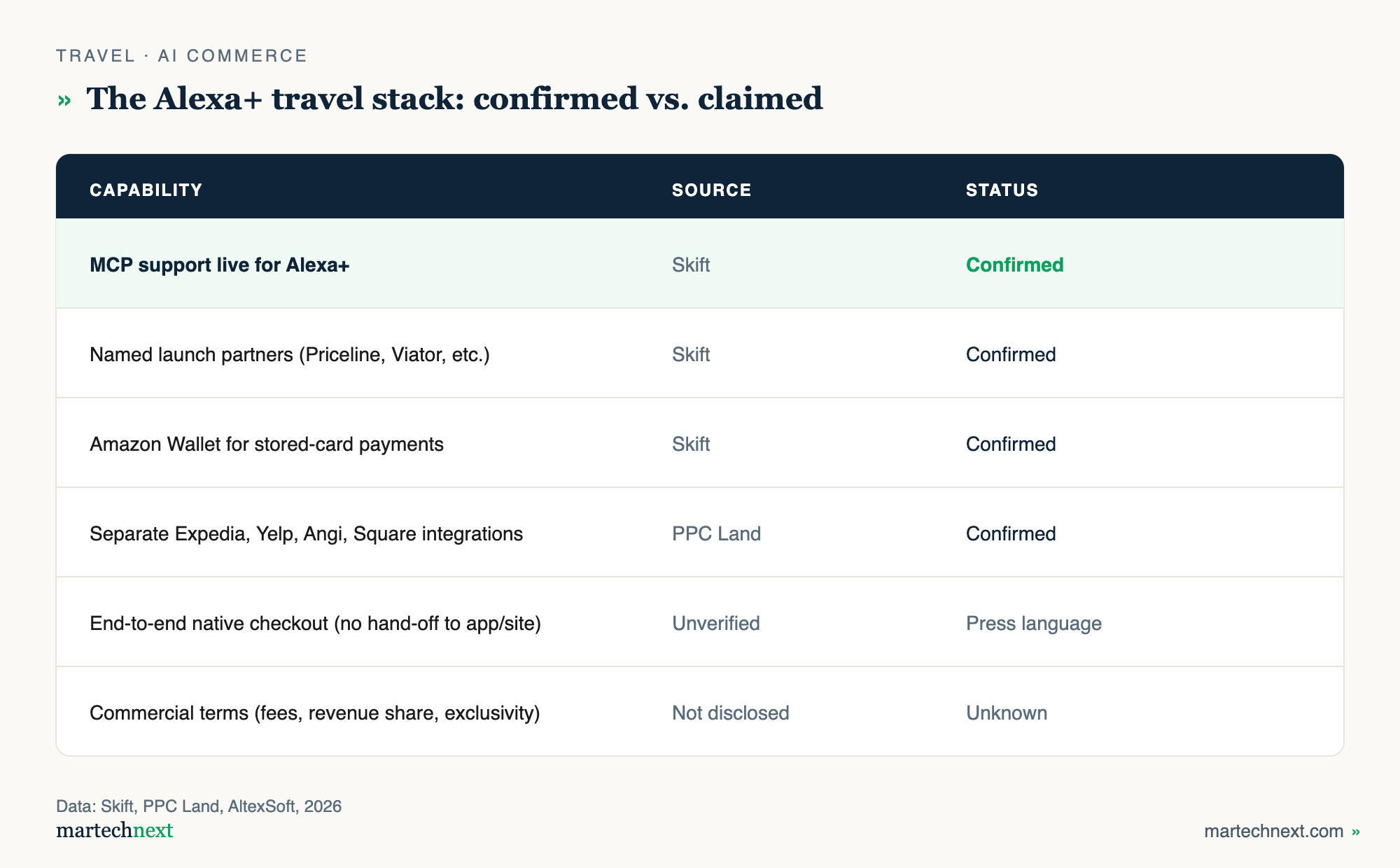
Confirmed, per Skift's reporting: Amazon has MCP support live for Alexa+, a list of named launch partners including Priceline, and a wallet feature for stored-card payments. That's real. Amazon is also not doing this in isolation. Earlier reporting from Skift (April 2026) already flagged Alexa+'s travel planning and booking ambitions, and PPC Land reported that Alexa+ has separately added Expedia, Yelp, Angi, and Square integrations for travel and home tasks. AltexSoft has also written about Amazon bringing travel booking to Alexa using Expedia's inventory.
Not yet confirmed, at least not in anything I've been able to verify: the actual end-to-end mechanics. Does a Priceline booking inside Alexa+ complete the full search-price-confirmation flow natively, or does Alexa hand you off to Priceline's app or site at some point in the process? Skift's language ("trying to sell trips inside a chat") is doing a lot of work here, and it's the kind of phrasing that can describe anything from a fully agentic checkout to a glorified deep link with a friendlier voice.
I'd also flag that the commercial terms between Amazon and Priceline (referral fees, revenue share, exclusivity) haven't been disclosed anywhere I can find (source needed). And whether the separate Expedia integration is a competing bet or a parallel, hedged track is genuinely unclear from the reporting available. Amazon may simply be playing the field, letting multiple OTAs build on the same rails and seeing who converts.
None of that is a knock on the ambition. It's just the difference between "Amazon announced a capability" and "Amazon proved people will book flights this way." Those are two very different stories, and right now we only have the first one.
Why travel is the hardest test case Amazon could have picked
If Amazon wanted an easy win to prove conversational commerce works, travel is close to the last category I'd have chosen. And that's exactly why it's the right one to watch.
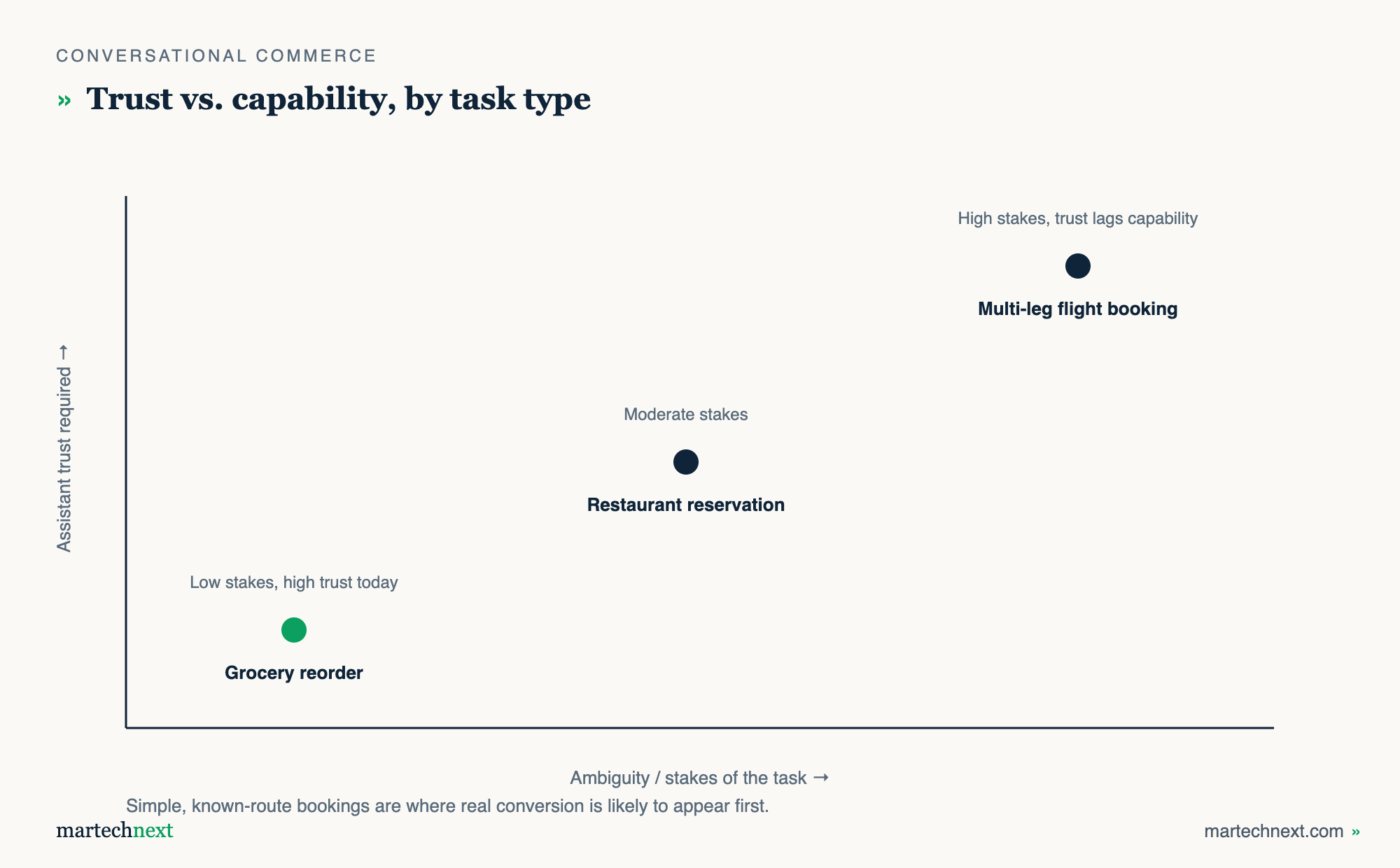
Think about what a flight or hotel booking actually demands compared to, say, reordering paper towels. Dates have to be exact. Cancellation policies matter. Prices move by the hour. A wrong booking isn't a minor inconvenience, it's a ruined trip or a fight with customer support. This is the category with the least tolerance for the kind of "roughly right" answer an AI assistant is often happy to give you.
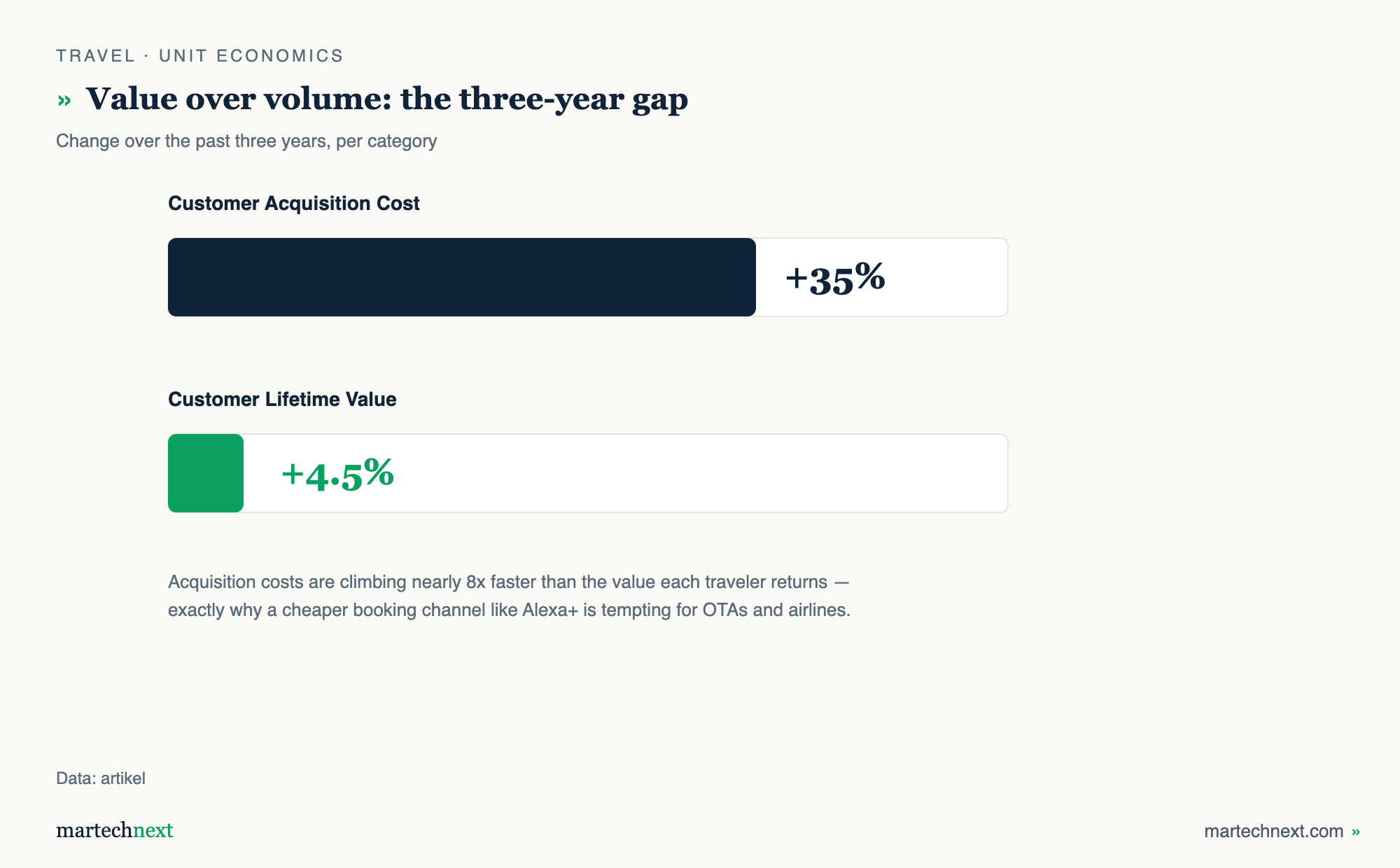
It's also, not coincidentally, one of the categories with the worst acquisition economics in all of commerce. Travel's customer acquisition costs have climbed roughly 35% over the past three years while lifetime value has grown only about 4.5% in the same period. That's thesis #1 territory: value over volume, and it's exactly why a new, potentially cheaper booking channel is so tempting for travel brands right now. If Alexa+ can shave even a sliver off the cost of acquiring or retaining a traveler, every OTA and airline on that early partner list has a reason to lean in hard.
But here's the tension. High-CAC categories are exactly where mistakes are most expensive, and where the trust bar for a new channel is highest. Nobody's cutting corners on a €40 grocery reorder. Plenty of people will absolutely bail on a €600 flight booking the moment the assistant hesitates, mishears a date, or can't clearly explain the cancellation terms.
That tension, high upside if it works, high cost if it doesn't, is the whole story here.
The reliability problem nobody's advertising
Amazon's framing, understandably, is confident: stored credentials, MCP, 180 million Prime members, problem solved. But the on-the-ground reporting on Alexa+ itself tells a slightly different story.
Independent beta testers reportedly described the pre-launch Alexa+ experience as "unbearably erratic," per Men's Journal. Consumer Reports' hands-on review of Alexa+ was positive on the AI assistant itself but flagged the surrounding app experience as a drag on usability. Neither of those reports is specifically about travel booking, and I want to be careful not to overstate that connection. But they're a useful counterweight to the launch-partner press release, and they matter for a simple reason: general-purpose reliability problems tend to show up hardest in the highest-stakes tasks, not the lowest-stakes ones.
This is thesis #5 in action: automation with human accountability. Booking a flight is exactly the kind of task where you want the AI to do the tedious part (searching, comparing, holding the details in its head) and a human, whether that's the traveler themselves or a confirmation step, to do the final judgment call. The trust and control curve lags the capability curve, and nowhere is that gap more visible than in a system that's willing to spend your money on your behalf.
Let's be honest: an assistant that's "unbearably erratic" reordering a book is annoying. The same erraticism applied to a multi-leg flight booked on stored payment credentials is a different category of problem entirely.
Who actually wins if this works
Assume, for a moment, that Amazon gets the mechanics right and people genuinely start booking travel through Alexa+. Who benefits?
The obvious answer is Amazon, and it's not wrong. Owning the conversational interface means owning the first and last touchpoint of the booking journey, which is exactly the kind of position that generates the data flywheel described in thesis #4. Every booking, every hesitation, every "actually, book the earlier one instead" teaches the assistant something, and that learning compounds. Whoever sits at that layer accrues the relationship data, and right now that's clearly Amazon, not Priceline.
Priceline's upside is more modest but still real: distribution into 180 million Prime households without having to build the conversational layer themselves. That's the same logic that made early advertisers pile into AdWords, or early brands pile into WhatsApp Business, back when those channels were unproven but the audience access was undeniable. Thesis #7, early movers win channels, applies directly here. If Priceline, Viator, and the transport players on that list get the booking flow and feed formatting right before their competitors even have an MCP server running, they could lock in a real head start once (or if) volume shows up.
What's conspicuously absent from that early partner list is instructive too: the major hotel chains, the big US airlines, Booking.com, Expedia's core brand. That's either a sign those players are waiting to see if this works before committing engineering resources, or a sign they're wary of handing Amazon the transaction relationship and the data that comes with it. I'd guess it's mostly the former with a healthy dose of the latter. Nobody wants to rebuild their booking flow around a channel that might not survive contact with real users.
What travel marketers should actually do about this
You don't need to have an MCP server running by Friday. But you also shouldn't file this under "wait and see" and forget about it, because thesis #7 exists precisely because the brands that waited on AdWords, on Facebook, on WhatsApp, all paid more to catch up later.
Here's a practical, unglamorous roadmap:
1. Audit your booking flow for machine legibility. Can your availability, pricing, and cancellation policy be read cleanly by an external agent today? If your rates only live inside a JavaScript-heavy booking widget, no assistant is going to surface them accurately, MCP or not.
2. Get your product feed in order before you get your Alexa strategy in order. This is the same discipline GEO and AI shopping feeds demand elsewhere. Structured, accurate, current data is the entry ticket, not a nice-to-have.
3. Decide, deliberately, whether you want to be found via Amazon at all. There's a real strategic question about whether you want your transaction data and customer relationship intermediated by Amazon, versus building your own conversational channel where you own that relationship end to end. Full disclosure, as always: I'm the founder of Zoey, a WhatsApp journey automation platform for the travel industry, so I have skin in this exact game, owning the conversational relationship directly rather than renting it from a platform.
4. Watch conversion, not headlines. The story worth tracking isn't "Amazon launches feature." It's whether actual booking volume and actual CAC move, six to twelve months from now. Nobody has published that data yet, and until they do, everything here is directional.
5. Don't assume voice and chat convert the same way. A screen lets people compare, scroll, second-guess. A voice conversation compresses that into a much faster yes/no. That could be an advantage (less friction) or a liability (less confidence), and right now nobody outside Amazon knows which.
The verdict
I don't think Amazon has solved conversational commerce for travel yet, and I don't think the reporting so far lets anyone credibly claim they have. What Amazon has done is assemble the right ingredients: distribution (Prime), payment infrastructure (Wallet), a technical standard (MCP), and, crucially, partners willing to be the guinea pigs. That's a meaningfully stronger starting position than OpenAI had when its own in-chat shopping ambitions stalled.
But travel is a brutal proving ground precisely because it punishes the gap between capability and reliability harder than almost any other category. "Unbearably erratic" and "here's your confirmed flight to Lisbon" don't coexist for long before someone loses money or misses a connection.
My honest read: this will work, eventually, for a narrower slice of travel than the press coverage implies. Simple, low-ambiguity bookings (a known route, a known hotel, a repeat traveler with clear preferences) are where I'd expect real conversion first. Complex, multi-leg, first-time trips are where I'd expect the assistant to still hand off to a human or a screen for a long while yet.
If you're a travel marketer, the mistake isn't ignoring this. It's either overreacting (rebuilding your stack around Alexa+ before there's conversion data to justify it) or underreacting (assuming voice commerce is a novelty and skipping the groundwork). Get your data and feeds in shape now. Decide who you want to own the relationship with your traveler. Then watch, for real, whether people actually say yes when Alexa asks for the card.
Wrestling with where conversational channels fit into your travel marketing stack? I'd love to exchange thoughts.
-- Bram Versteegh
Bram Versteegh is the founder of MartechNext, covering the business of AI in marketing: who's building it, who's funding it, and how industries put it to work.
Enjoyed this piece? Every week, What's Next delivers sharp analysis, the latest funding rounds in AI marketing, and the martech news that actually matters. Straight to your inbox, free.