70% of Shoppers Now Ask AI First: What That Means for Your Consideration Set
A new Roland Berger study of 6,000 consumers finds 70% now use AI for product research. Here's what it means for your GEO strategy and budget.


In this article:
- What a new Roland Berger study of 6,000 consumers across nine countries actually found about AI-driven product research
- Why "70% use AI to research products" is a bigger deal than it sounds, and where the number needs scrutiny
- Why brand reputation is losing ground to recommendations, functionality, and price, and what that means for AI visibility
- How this connects to the conversation-as-funnel thesis and the early-mover advantage in GEO
- A concrete, five-step plan for getting your brand "seen" favorably by AI research tools, starting now
Picture a mid-sized appliance brand's marketing director opening a dashboard next quarter and noticing that organic search traffic is flat, paid search is getting more expensive, and yet product page visits from unfamiliar referrers keep climbing. A little digging shows the traffic is coming from people who asked ChatGPT or Gemini "what's the best dishwasher under 600 euros" and clicked through to whatever got recommended. The brand wasn't mentioned. A competitor was.
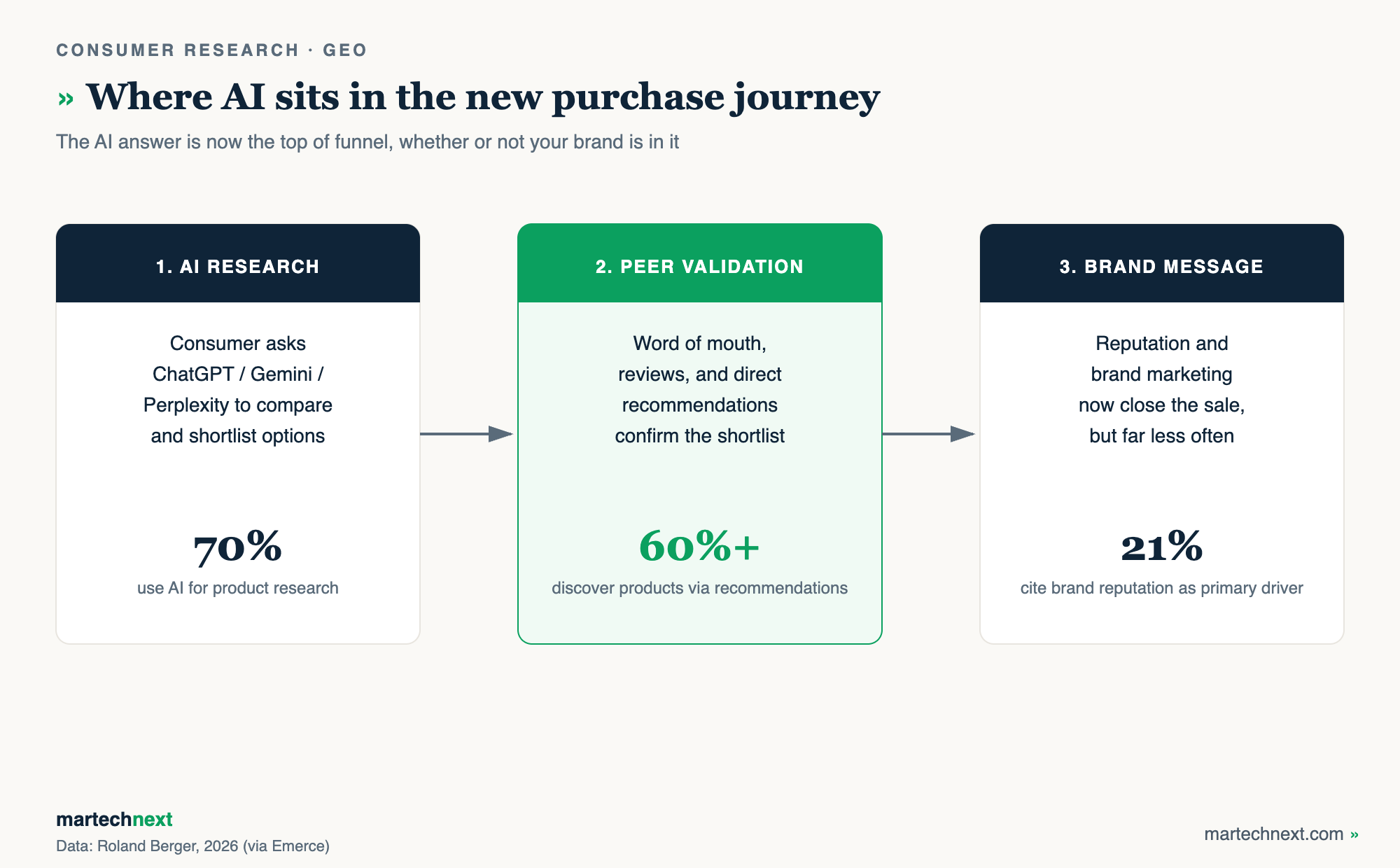
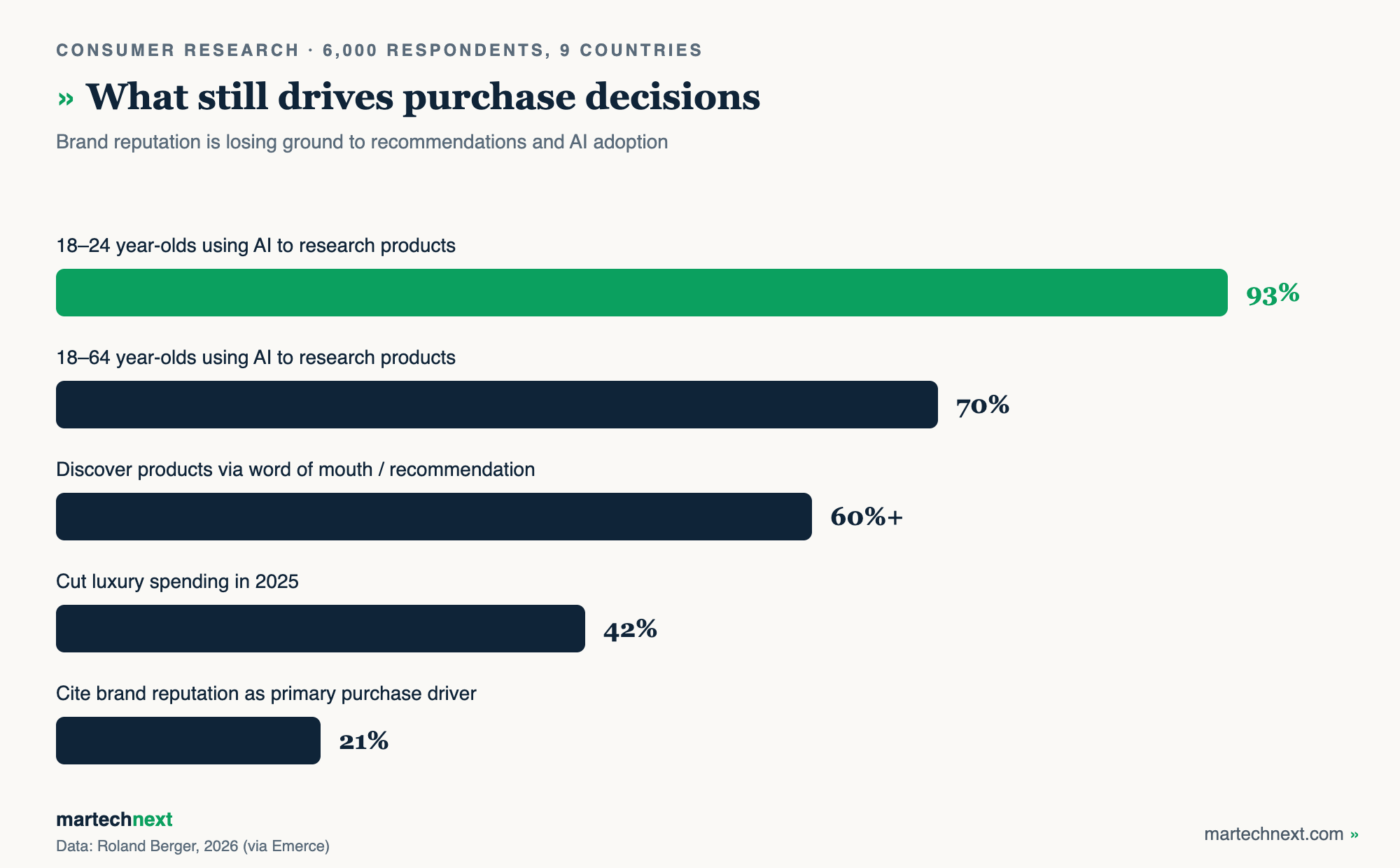
That scenario is no longer speculative. According to a new study by Roland Berger, based on a survey of 6,000 consumers across nine countries (Germany, France, Spain, Italy, and the Netherlands in Europe; the US, Brazil, and Mexico in the Americas; and the UAE in the Middle East), 70% of 18 to 64-year-olds now regularly use AI tools for product research. Among 18 to 24-year-olds, that figure jumps to 93%.
If that holds up, it's the clearest third-party confirmation yet of something I've been arguing for a while: the conversation is becoming the new funnel, and brands that are invisible inside it are quietly falling out of consideration.
What the study actually found
The Roland Berger findings, as reported by Emerce, go beyond a single adoption number. A few data points stand out:
- AI tools are increasingly filtering options, comparing products, and shaping recommendations, essentially doing pre-purchase work that used to happen on comparison sites or in search results.
- Brand reputation is losing its grip: only 21% of respondents now cite it as a primary purchase driver.
- Word of mouth is doing more heavy lifting than brand marketing: over 60% of consumers say they discover products through friends, family, or direct recommendations.
- Demonstrable value, functionality, sustainability, and ease of use now outweigh innovation claims or brand power alone.
- The market is splitting in two directions: one segment paying for durability and quality, the other chasing discounts. 42% of respondents cut luxury spending in 2025, a third shopped more at discounters, and 23% plan to increase that shift further in 2026.
- Dutch consumers are notably more skeptical of AI than the international average (36% versus 24%), with trustworthiness (53%) and privacy/data security (50%) as top concerns.
Put together, this isn't just "people are trying ChatGPT." It's a description of a purchase journey where AI does the shortlisting, peer recommendations do the validation, and brand messaging does less work than it used to. That's a structural shift, not a fad.
Why the 70% number deserves scrutiny, not dismissal
Here's where I have to apply the same standard I'd apply to any vendor claim, including my own: what exactly does "regularly use AI for product research" mean?
The Emerce write-up doesn't spell out whether this includes passive touchpoints like Google AI Overviews (which almost every searcher now sees whether they want to or not) alongside active use of ChatGPT, Gemini, or Perplexity for comparison shopping. Those are very different behaviors with very different implications for marketers. Lumping them together can inflate an adoption number that's directionally right but imprecise.
It's also self-reported survey data, not platform clickstream data. People are notoriously bad at accurately describing their own digital habits ("I use AI regularly" means different things to a 22-year-old and a 55-year-old). And while the study is refreshingly specific about sample size and country coverage for a report of this kind, six thousand respondents across nine countries in one bucket ("18-64") still means real variance is getting smoothed out. I'd want to see the country-by-country and age-bracket breakdown before quoting this number in a board deck.
The bigger gap: the study describes behavior (people are asking AI), not outcome (brands absent from AI recommendations measurably lose sales). That causal link is the one every marketer actually cares about, and it's the one piece of evidence I haven't seen published yet, from Roland Berger or anyone else. Correlation between AI usage and reduced brand loyalty is strongly suggested here. Proof that invisibility in AI answers directly costs market share is still, honestly, a thesis rather than a fact.
None of that makes the study wrong. It makes it directionally credible and worth taking seriously, while reserving the specific percentage for "roughly seven in ten," not gospel to three significant figures.
Why this matters even if the number is a bit soft
Here's the thing: even if the true figure is 55% instead of 70%, the strategic implication doesn't change. AI-mediated discovery is growing, brand loyalty is weakening, and peer recommendation plus demonstrable value are winning over polish and reputation. That's consistent with what platform-level signals have already been showing (Meta's Business Agents, WhatsApp commerce, the shift toward answer engines instead of ten blue links, all of which I've covered before).
This is thesis 6 in practice: the conversation is the new funnel. When a consumer asks an AI tool to shortlist products, that AI answer is the top of the funnel now, whether or not your brand shows up in it. Feed quality, structured data, review depth, and off-site content that AI models can actually parse and trust are becoming as important as your paid search account used to be. Generative Engine Optimization (GEO) is the new SEO, and I've written about the mechanics of that shift in more detail.
It also reinforces thesis 7: early movers win channels. Every platform shift, AdWords, Facebook, TikTok, WhatsApp, has rewarded the brands that built the foundation before the channel matured and everyone else showed up to fight over the same few slots. AI answer engines are still in that early window. The brands investing in structured product data, GEO-friendly content, and trustworthy review signals right now are the ones who'll be the "default recommendation" once this behavior fully mainstreams. The ones waiting for definitive proof will be optimizing for a slot that's already taken.
There's a secondary read here too, tied to thesis 4, the data flywheel. If AI tools increasingly favor products with rich, structured, trustworthy first-party data (specs, reviews, verified attributes) over products that just have a strong brand story, then the brands with the best data infrastructure have a real edge, independent of ad spend.
What the discount and skepticism data adds
Two more findings deserve marketer attention, because they change what "winning the consideration set" actually requires.
First, price sensitivity looks structural, not cyclical. With over 40% of respondents cutting luxury spend and a third shifting toward discounters, and nearly a quarter planning to lean further into that in 2026, this isn't a temporary reaction to inflation. It's a durable behavior pattern. Combined with brand reputation dropping to 21% as a purchase driver, the message is blunt: showing up in the AI shortlist isn't enough if your actual value proposition (price, durability, functionality) can't survive the comparison once you're there.
Second, the Dutch skepticism gap (36% versus a 24% international average) is a useful reminder that GEO and AI-visibility strategy isn't one-size-fits-all across markets. A brand rolling out AI-facing content globally should expect different trust thresholds, and different proof requirements, in different countries. Trust signals (third-party reviews, transparent sourcing, verifiable claims) will matter more in skeptical markets than polished brand copy ever will.
A five-step starting point
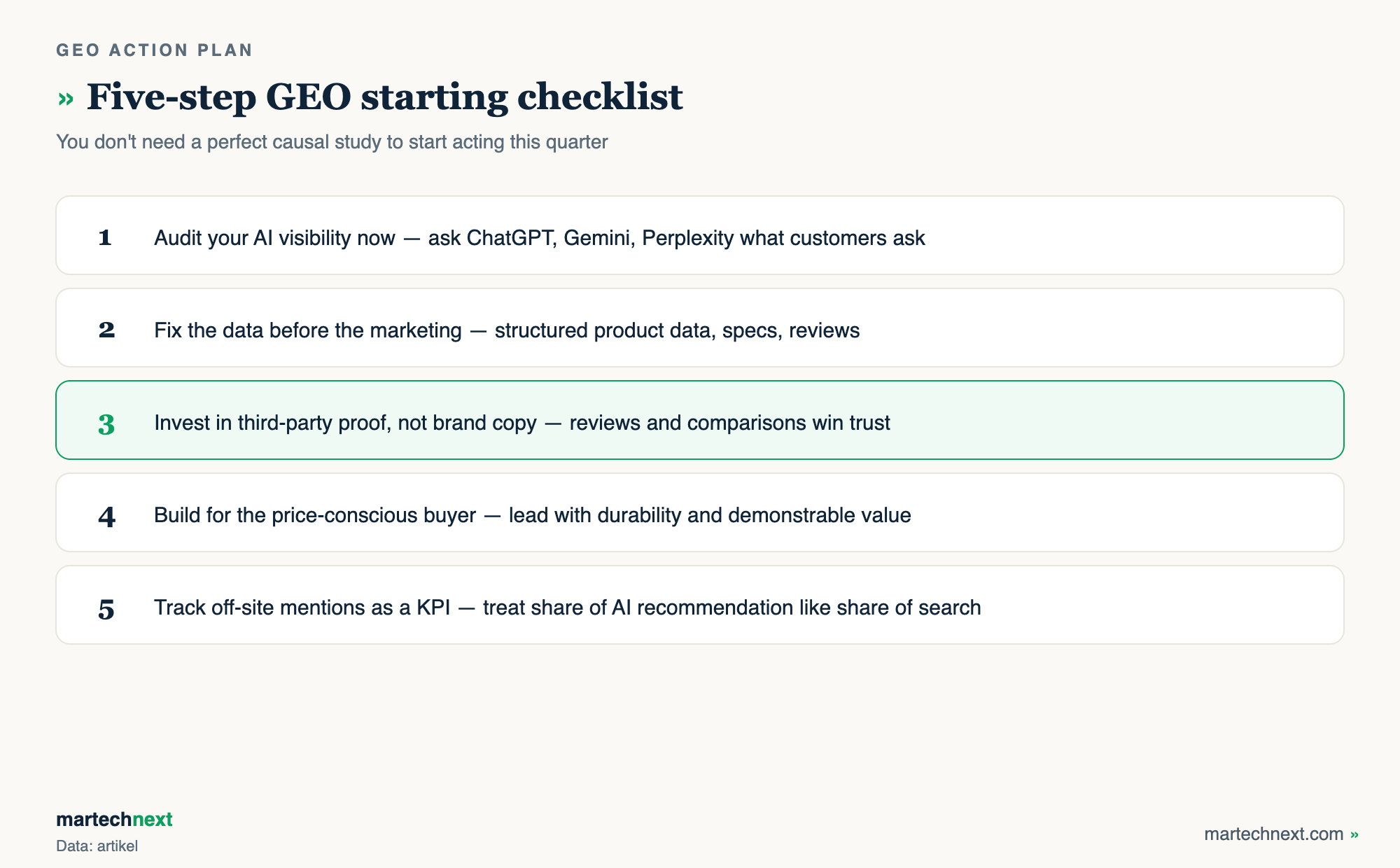
You don't need to wait for a perfectly clean causal study to start acting. Here's a practical sequence:
1. Audit your AI visibility now. Ask ChatGPT, Gemini, and Perplexity the questions your customers would actually ask ("best [category] for [use case] under [price]") and see if you show up, and how you're described.
2. Fix the data before the marketing. Structured product data, accurate specs, and up-to-date reviews are what AI models actually pull from. This is the same "right order" principle behind every AI martech project: data first, automation second, AI last.
3. Invest in third-party proof, not brand copy. Given that 60%+ of discovery now happens through recommendations and brand reputation alone convinces barely a fifth of buyers, reviews, case studies, and comparison content matter more than another campaign.
4. Build for the price-conscious buyer, not just the loyal one. If durability and demonstrable value are winning over brand story, make sure that's what your product content actually leads with.
5. Track off-site mentions as a KPI, not an afterthought. If AI tools are the new comparison shopping engines, "share of AI recommendation" deserves the same tracking discipline your team already applies to share of search.
Verdict
I'd treat the 70% figure the way I'd treat any single-source survey stat: probably directionally right, not precise to the decimal, and not yet proof of a causal link between AI invisibility and lost sales. But the underlying behavior it describes matches everything else we're seeing across platforms, and the risk of waiting for perfect proof is asymmetric. The brands that treat this as a wake-up call and start fixing their data and off-site presence now will have a real head start. The ones that wait for a definitive McKinsey report to confirm it will be optimizing for a consideration set that's already closed.
My take: don't quote "70%" like it's settled science, but don't dismiss it either. Start the GEO audit this quarter.
Wrestling with how to make your brand visible (and trusted) inside AI recommendation environments? I'd love to exchange thoughts.
-- Bram Versteegh
Bram Versteegh is the founder of MartechNext, covering the business of AI in marketing: who's building it, who's funding it, and how industries put it to work.
Enjoyed this piece? Every week, What's Next delivers sharp analysis, the latest funding rounds in AI marketing, and the martech news that actually matters. Straight to your inbox, free.