AI search skips your funnel: why 92% of AI traffic lands on decision-stage pages
A WebFX study of 600,000 AI sessions finds 92% of AI-referred traffic lands on decision-stage content. What that means for your content strategy.

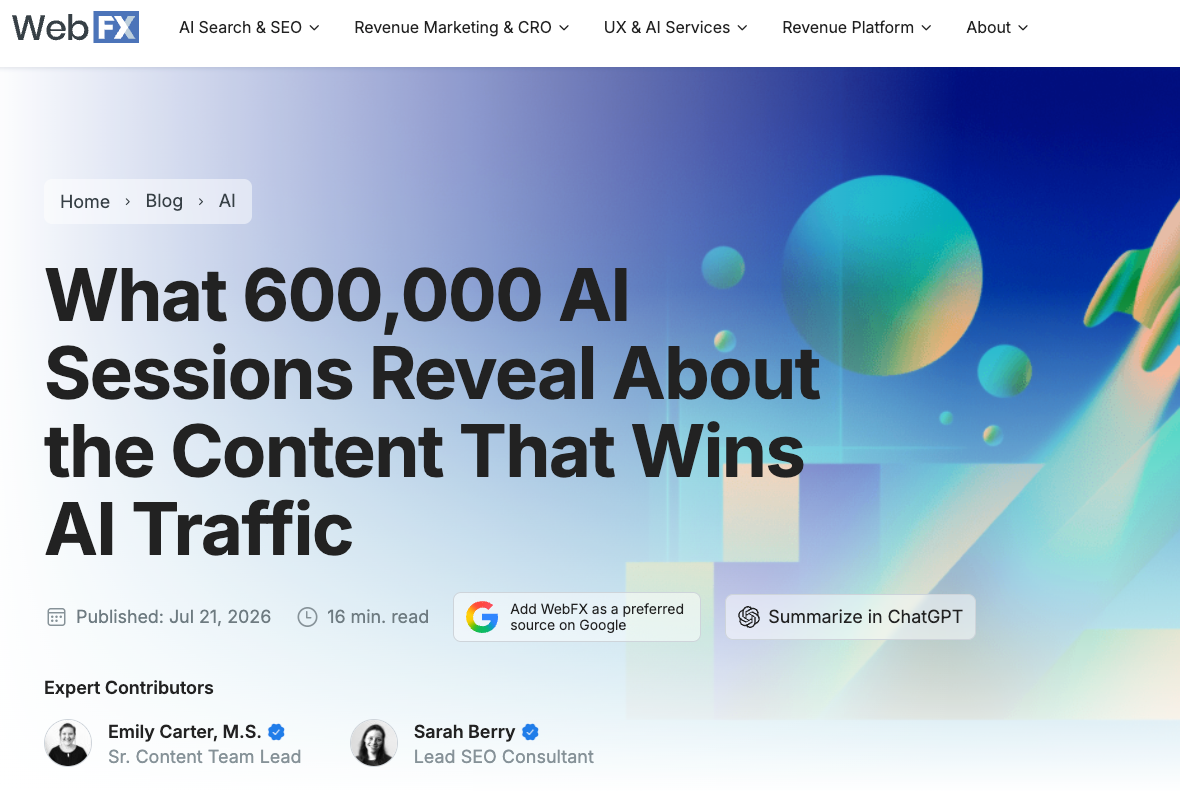
- Why WebFX's new study, analyzing nearly 600,000 AI-referred sessions, is worth your attention even before every methodological detail is public
- What the 92% consideration/decision-stage figure actually implies about how people use ChatGPT, Perplexity, and Gemini to shop
- Why this is a direct, real-world confirmation of the "conversation is the new funnel" thesis
- The one caveat that genuinely matters (landing on a page is not the same as converting on it), and why it shouldn't stop you from acting
- A practical to-do list to start capturing this traffic before your competitors do
Picture a marketing director at a mid-sized B2B software company, staring at her analytics dashboard on a Tuesday morning. Organic search traffic to her blog is flat, has been for a year. But a new referral source keeps showing up in the source/medium report: chatgpt.com. Small numbers, growing fast, and oddly, these visitors aren't landing on the "10 tips for X" listicles that make up 80% of her content calendar. They're landing on the pricing page, the comparison page, the "X vs Y" post nobody on the content team was particularly proud of.
If that pattern feels familiar, or if you've been quietly wondering the same thing while checking your own GA4, WebFX just gave it a name and a number.
The claim: 92% of AI traffic skips the top of the funnel
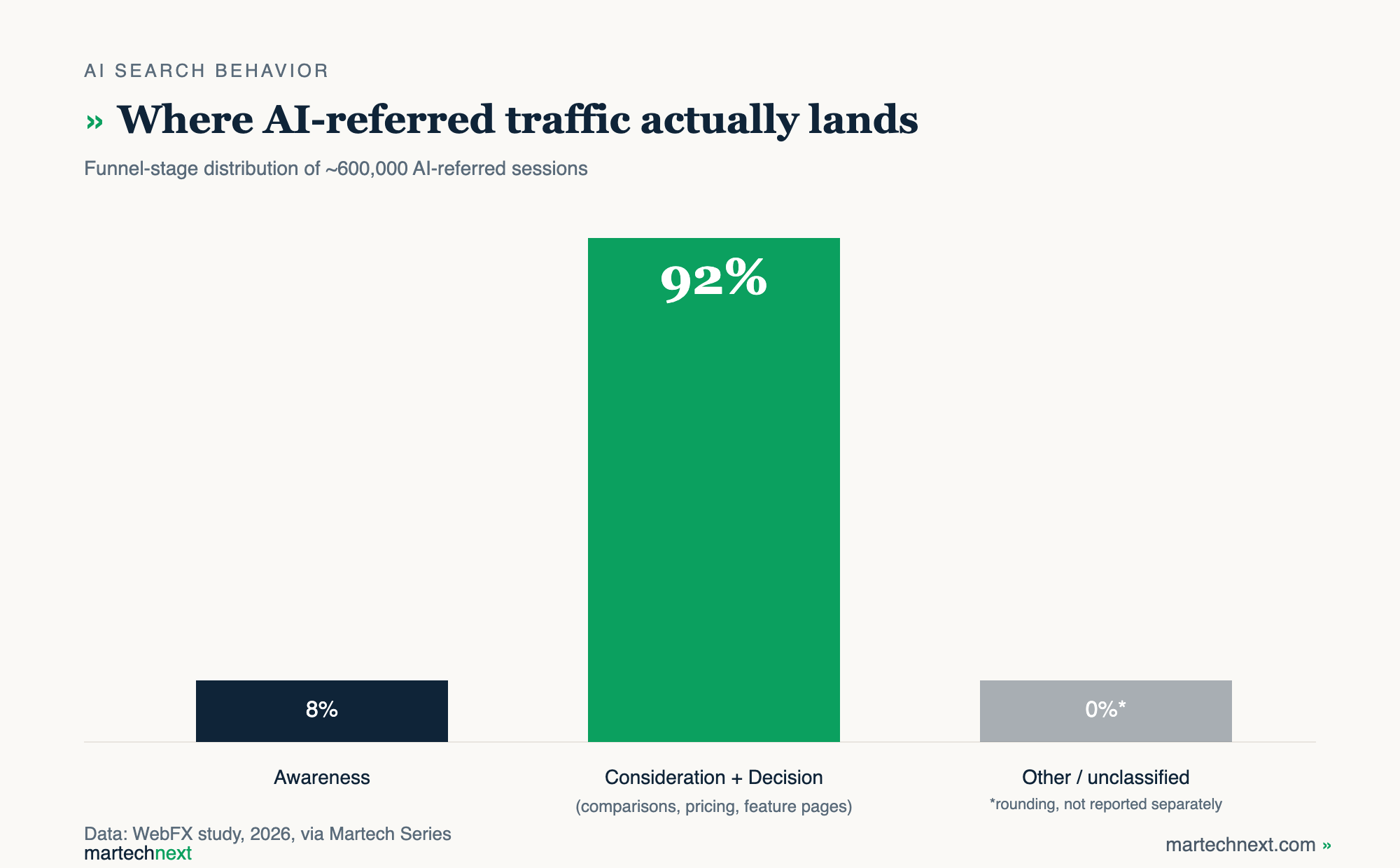
WebFX analyzed nearly 600,000 AI-referred sessions and found that 92% of that traffic landed on consideration or decision-stage content, not on awareness-stage material like general blog posts or explainer content.
Sit with that number for a second, because it's a genuinely interesting one. It suggests that when people ask an AI answer engine a question, the AI isn't sending them to your "what is X" starter content. It's routing them straight to the pages that help someone decide: comparisons, pricing, feature breakdowns, "best for" pages, product specifics. The stuff your content team probably ranks lower in the editorial calendar than the top-of-funnel awareness pieces, because awareness content is what "SEO best practice" has trained everyone to prioritize for the last fifteen years.
If this pattern holds up as more data comes in, it's a real signal, not just a curiosity. It says AI referral traffic isn't a like-for-like replacement for organic search traffic. It behaves differently. It arrives further down the funnel, already having done its awareness-stage thinking somewhere inside the chat window, and it wants to compare, verify, and decide.
What WebFX actually measured, and what's still open
I want to be straight with you about what we know and don't know here, because that matters for how much weight you put on this.
WebFX is a digital marketing agency, and this study is also, functionally, content marketing for their own SEO and GEO services. That doesn't make the finding wrong, agencies sit on enormous amounts of real client data and are often first to spot these shifts precisely because they have visibility across hundreds of accounts. But it does mean I'd love to see the methodology laid out in more detail: which AI platforms were bucketed into "AI traffic" (ChatGPT only, or Perplexity and Gemini too), what time window the 600,000 sessions cover, and exactly how a page gets tagged as "awareness" versus "consideration" versus "decision" in the first place. WebFX's own blog post is the primary source here. I'd encourage you to read it directly rather than rely on secondhand summaries, including mine.
Two other studies are circling the same question. Semrush has published research on ChatGPT clickstream behavior at scale, and Ahrefs has looked at which page types actually capture AI search traffic on its own site. Neither has been cross-checked against WebFX's funnel-stage breakdown in this piece, so I'm not going to pretend they corroborate the 92% figure. What I can tell you is that multiple independent teams are now pointing analytical firepower at the exact same question: what kind of content does AI traffic actually land on. That, by itself, tells you this isn't a fringe curiosity anymore. It's becoming a real measurement discipline.
Why this confirms the thesis: the conversation is the new funnel
Here's the part that connects to something I've been arguing on MartechNext for a while: the conversation is the new funnel. Commerce and research are moving into messaging threads and AI answer engines, and that shift changes where the real decision-making happens.
The WebFX data, if it holds, is one of the clearest quantitative signals yet that this isn't theoretical. When someone types a question into ChatGPT, a meaningful chunk of the "top of funnel" thinking, the awareness stage, has already happened inside the conversation itself. The AI has effectively absorbed the "what is this category, what are my options" step. What it sends you, the actual referral, is someone who's already past that and wants to compare, verify, or buy.
That's a genuinely useful thing to know, because it tells you where to put your effort. If your content strategy still treats top-of-funnel blog content as the front door and decision-stage pages as an afterthought buried three clicks deep, you may be optimizing for a customer journey that's quietly disappearing. The AI is becoming the front door. Your comparison page is becoming the landing page.
This is also why feed quality and structured product data matter more than most marketing teams currently treat them. An AI engine can only cite your comparison page, your pricing table, or your feature matrix if it can actually parse it. That loops straight back to another MartechNext thesis: the right order. Structure the data first, then automate, then let AI make use of it. Sites with clean, well-tagged decision-stage content are the ones positioned to be cited when someone asks an AI "which of these is better for X." Sites with messy templates, PDF spec sheets, and pricing hidden behind a "contact us" form are not.
The early-mover math
Let's do a simple, round-numbers version of this, the kind of back-of-envelope math that tends to clarify a decision faster than a slide deck.
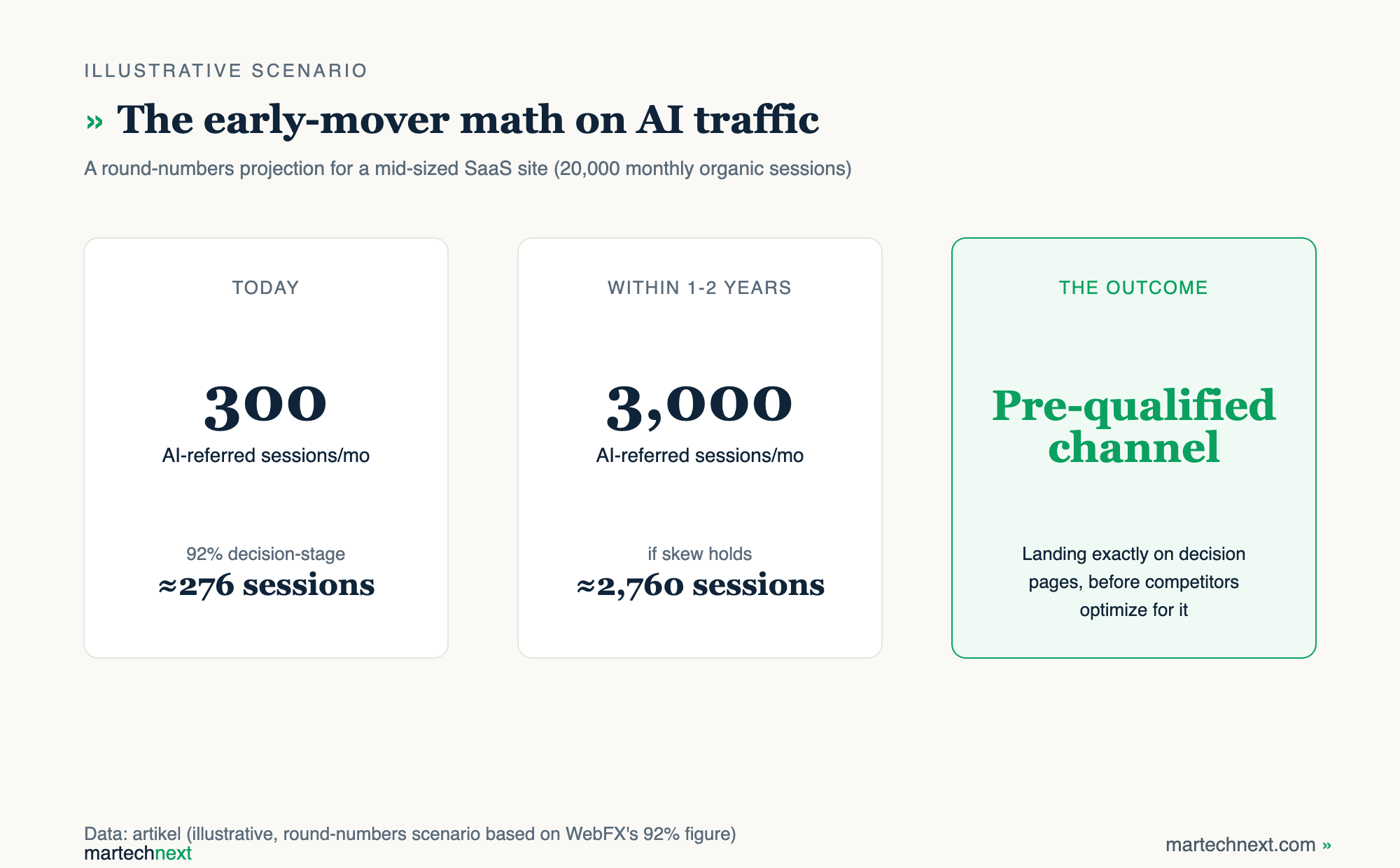
Say a mid-sized SaaS company gets 20,000 monthly organic sessions today, split roughly evenly across awareness content (blog posts, guides) and decision content (comparison pages, pricing, case studies). AI referral traffic is currently a rounding error, maybe 300 sessions a month. If WebFX's 92% figure is even directionally right, roughly 276 of those 300 sessions are landing on decision-stage pages, a page type that historically converts at a meaningfully higher rate than a generic blog post.
Now project that forward. AI referral traffic has reportedly been growing fast across multiple studies, even if the exact growth percentages differ by source and haven't all been independently verified. If that 300 becomes 3,000 within a year or two, and the funnel-stage skew holds, that's not "a bit more traffic." That's a new acquisition channel that arrives pre-qualified, landing exactly where you want prospects to land, at a moment when almost none of your competitors have bothered to optimize their decision-stage content for how AI engines actually read and cite it.
That's the early movers win channels thesis playing out in close to real time. Every previous platform shift, AdWords in the early 2000s, Facebook ads in 2012, TikTok organic in 2019, WhatsApp Business messaging more recently, rewarded whoever built the foundation before the channel got crowded and expensive. GEO and AI-answer visibility looks like the same pattern, just earlier in the curve. I've made this argument before in the context of travel brands disappearing from AI answers entirely; this data gives it a sharper, more concrete edge: it's not just about being visible, it's about which pages you make visible.
The one caveat that actually matters
I'm not going to pile on this study with a long list of nitpicks, because most of them are secondary to the real point. But there is one caveat worth holding onto, because it's the difference between acting smart and acting on vanity metrics.
Landing on a decision-stage page is not the same as converting on it. "92% of sessions land on consideration/decision content" tells you about page-type distribution. It doesn't tell you about conversion rate, cost per acquired customer, or retention. That's the volume-versus-value trap I keep coming back to on this site : a per-session or per-channel statistic can look impressive while the total business impact stays modest, especially if the sample sizes involved (hundreds of AI-referred sessions, not tens of thousands, for most mid-sized sites right now) are still small enough that a handful of outlier conversions can swing the story.
So treat "92% land on decision content" as a genuinely useful signal about where AI traffic behaves differently, not as proof that AI traffic is automatically more valuable traffic. The honest move is to track it separately in your own analytics and let your own conversion data settle the question, rather than importing someone else's aggregate number as your assumption.
That's really the only caveat I'd put weight on here. Everything else, the exact methodology, the platform mix, whether Semrush and Ahrefs land on the same number, is worth watching but shouldn't stop you from acting today. Waiting for a perfectly footnoted study before you touch your decision-stage content is how you end up optimizing for a funnel that no longer exists.
What to do about it: a marketer's checklist
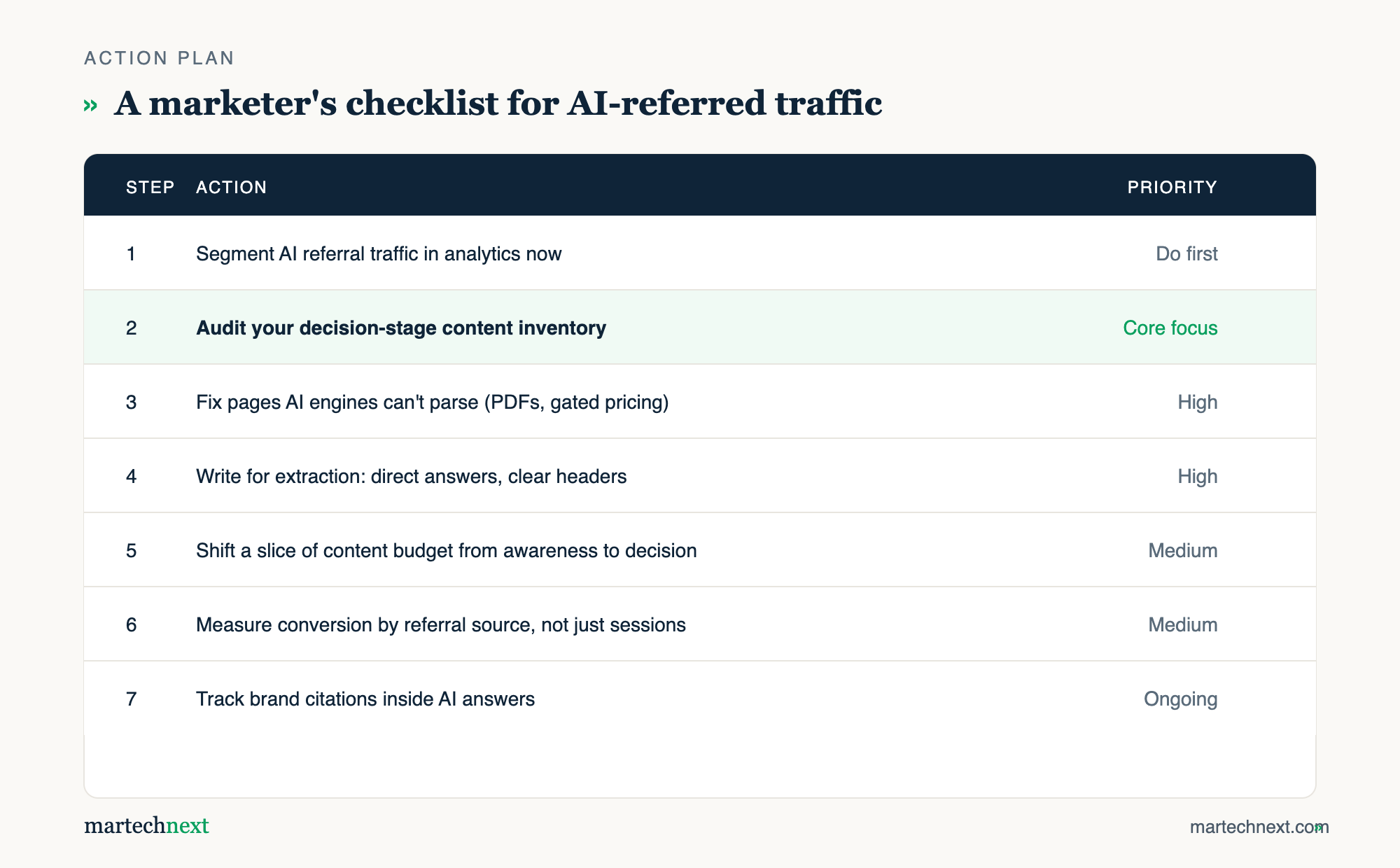
Here's the practical part. If this pattern holds even partially true for your traffic, here's where I'd start:
1. Segment AI referral traffic in your analytics now. Set up a dedicated channel grouping for chatgpt.com, perplexity.ai, gemini.google.com, and copilot.microsoft.com referrals in GA4 or your analytics platform of choice. You can't act on a pattern you can't see.
2. Audit your decision-stage content inventory. List every comparison page, pricing page, "alternatives to X" post, and feature matrix you have. Most teams are surprised by how thin this list is compared to their awareness-stage blog archive.
3. Fix the pages AI engines can't parse. Pricing hidden behind gated forms, specs buried in PDFs, comparison tables rendered as images: none of that is citable by an AI answer engine. Structured, crawlable, plain-text decision content wins.
4. Write for extraction, not just for humans skimming. Direct answers to direct comparison questions ("X vs Y: which is better for Z") get cited more easily than narrative prose. Add clear headers, short direct answers up top, and structured data where relevant.
5. Shift a slice of your content budget from awareness to decision. Not all of it. But if 92% of your AI-referred visitors are already past the awareness stage, pouring more resources into another "beginner's guide to X" is diminishing returns.
6. Measure conversion by referral source, not just sessions. This is where you test the caveat above. Does your AI-referred traffic actually convert better, worse, or the same as organic and paid? Don't assume, check.
7. Start tracking your brand's citations inside AI answers, using whatever GEO monitoring tooling is available to you. Being present in the conversation is the leading indicator; traffic is the lagging one.
None of these require a large budget or a new hire. They require someone on your team deciding this is worth an afternoon this month, not a "maybe next quarter" item.
Verdict
I like this study more than I distrust it. The 92% figure comes with real methodological gaps that deserve to be closed before anyone treats it as gospel, and I'd rather see WebFX's full sample details than take the headline number on faith. But the underlying pattern it points at, AI referral traffic skewing hard toward decision-stage content, fits everything else I'm seeing about how people actually use ChatGPT and Perplexity to shop, and it fits a thesis I've been building on for a while: the conversation is genuinely becoming a funnel stage of its own, not just a curiosity metric in your analytics.
My take: don't wait for a peer-reviewed version of this study to show up. Audit your decision-stage content this month, make sure AI engines can actually read it, and measure your own AI-referred conversion data honestly. If it turns out your AI traffic converts as well as WebFX's data implies, you've gotten ahead of a channel while it's still cheap to win. If it turns out your numbers look different, you've lost an afternoon, not a quarter. That's a good trade either way :)
Wrestling with GEO or AI-referral measurement in your own stack? I'd love to exchange thoughts.
-- Bram Versteegh
Bram Versteegh is the founder of MartechNext, covering the business of AI in marketing: who's building it, who's funding it, and how industries put it to work.
Enjoyed this piece? Every week, What's Next delivers sharp analysis, the latest funding rounds in AI marketing, and the martech news that actually matters. Straight to your inbox, free.