Why the Conversation Is the New Funnel, Not the Feed
AI slop is flooding feeds faster than platforms can clean it up. Here's why marketers should shift attention from feeds to conversations now.


In this article:
- Why Spotify, YouTube, LinkedIn and Meta are all fighting the same "AI slop" fire, and losing on points
- The uncomfortable math: platforms are financially incentivized to tolerate the flood
- Why slop is a data flywheel problem, not just a content quality problem
- Why messaging, chat and AI answers are becoming the cleaner alternative surface
- A practical checklist for shifting budget and attention from feed to conversation
- My verdict: don't abandon the feed, but stop betting your growth on it
Picture a mid-sized DTC brand's social media manager opening LinkedIn on a Tuesday morning to check how a product launch post is performing. Between the notification and the actual post, she scrolls past four AI-generated "thought leadership" carousels, two obviously synthetic testimonial videos, and a meme account that has clearly never employed a human. She doesn't remember what she was looking for. Neither, probably, does the algorithm.
That scene isn't fiction, it's just not attributed to anyone specific, because it's happening to millions of people a day, on every major platform, right now.
Dutch outlet MT Sprout recently rounded up how the big platforms are responding: Spotify with detection and disclosure policies, LinkedIn with (unspecified, still-early) detection efforts, TikTok with creator education. The framing in that piece is right: AI slop is like weeds. It grows everywhere, and pulling it out by hand doesn't work when it regrows overnight.
Here's the angle I want to add to that: this isn't just a content moderation story. It's a distribution story. And it's the strongest evidence yet for a thesis I've been making on MartechNext for a while: the conversation is becoming the new funnel, precisely because the feed is becoming unusable.
The enforcement scoreboard, so far
Let's look at what's actually been shipped, not just announced.
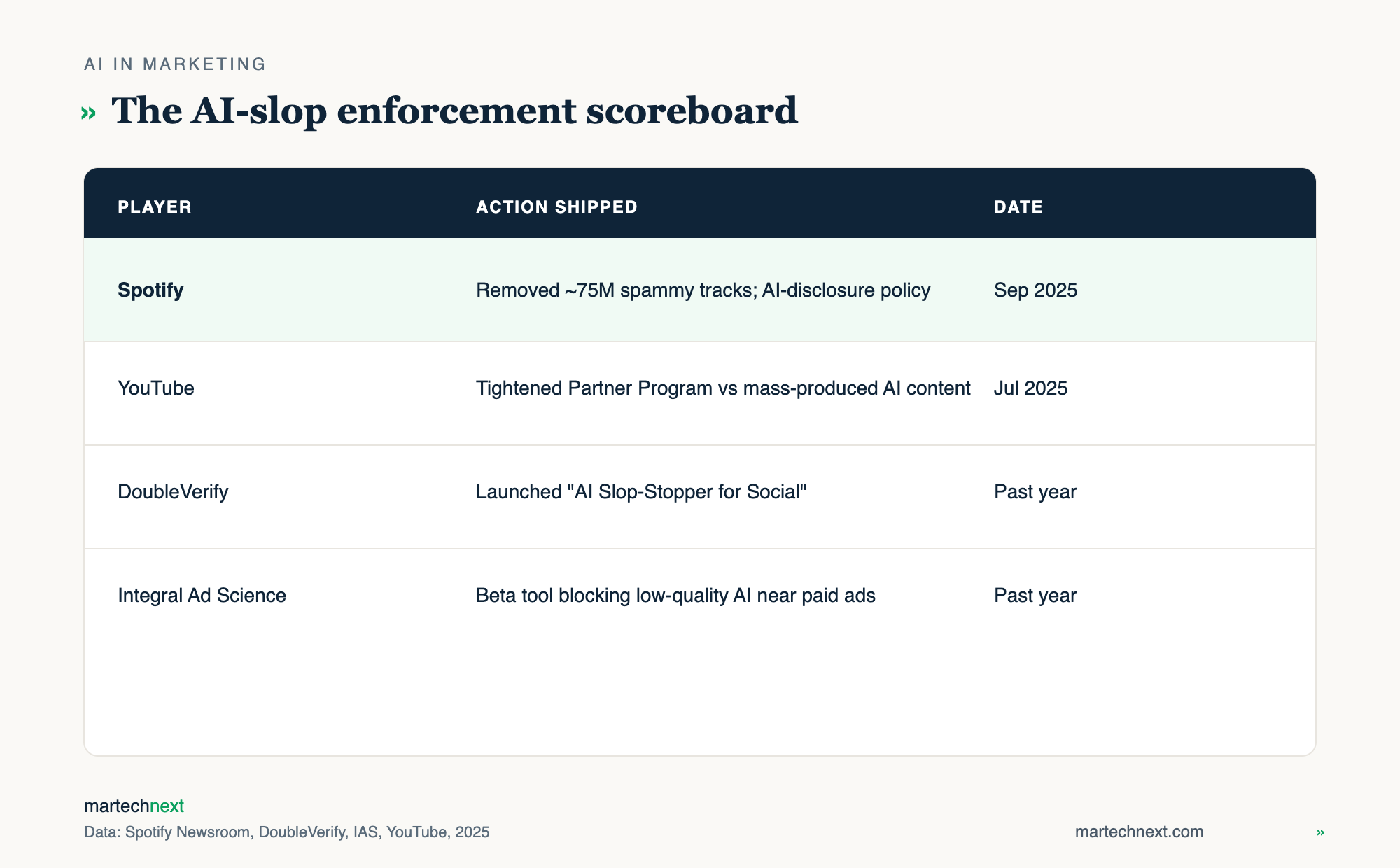
Spotify says it has removed roughly 75 million "spammy" tracks and introduced new AI-disclosure and artist-protection policies (Spotify Newsroom, September 2025). YouTube tightened its Partner Program rules in July 2025 to explicitly restrict monetization of mass-produced, repetitive AI content. Ad-verification vendors DoubleVerify and Integral Ad Science have both launched dedicated products this past year: DoubleVerify's "AI Slop-Stopper for Social" and IAS's beta tool for blocking low-quality AI content near paid placements, building on their existing "Made for Advertising" detection tech.
That's real movement. Three different types of players (a content platform, a video platform, and two ad-verification vendors) all independently concluded the problem was big enough to build dedicated tooling for. That alone tells you something: this isn't a moral panic, it's a resourcing decision made by companies that don't usually spend engineering time on problems that aren't costing them money.
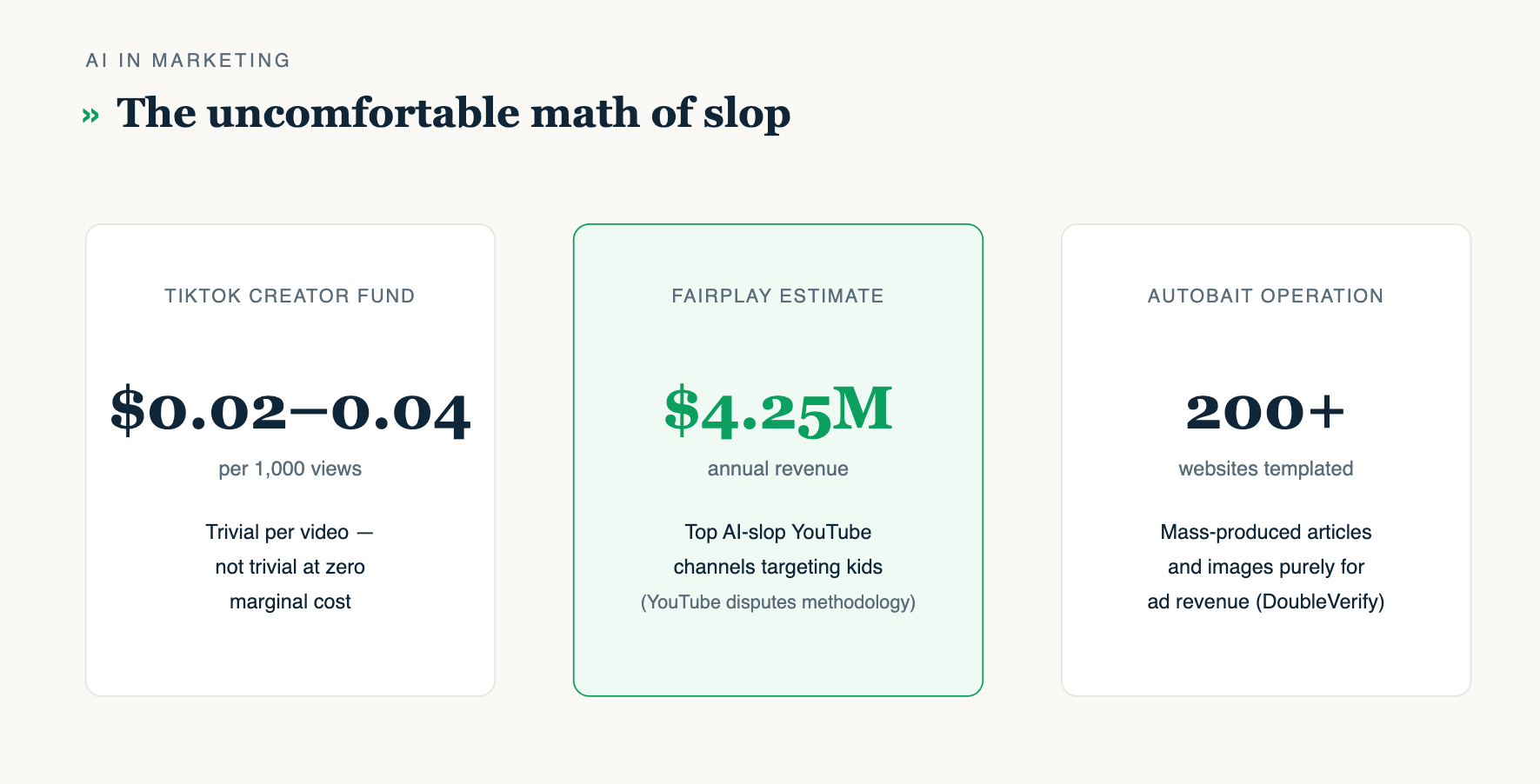
DoubleVerify's research also surfaced something worth remembering the next time someone tells you "AI will just get filtered out eventually": an operation researchers dubbed "AutoBait" used templated LLM prompts to mass-produce articles and images across more than 200 websites, purely to generate ad revenue. That's not a rogue creator experimenting with ChatGPT. That's an industrial process.
The uncomfortable math nobody wants to fix
Here's the part of the MT Sprout piece I think undersells the real story: none of this enforcement touches the actual incentive structure.
TikTok's Creator Fund pays somewhere around $0.02 to $0.04 per 1,000 views across several major markets. That looks trivial per video. It stops looking trivial the moment you can generate hundreds of videos a day with zero marginal cost. Stanford researchers found that AI-image Facebook Pages, some running fully automated pipelines out of Pakistan, India, Vietnam, Thailand and Indonesia, generated hundreds of millions of interactions, with individual viral posts (the now-infamous "Shrimp Jesus" among them) reaching tens of millions of views. Advocacy group Fairplay estimated top AI-slop YouTube channels targeting children earned a combined $4.25 million in annual revenue (Fairplay, cited via Fortune, 2026), a figure YouTube itself disputes on methodology, and neither side has published an independently audited number.
Meanwhile Meta's Creator Bonus Program has reportedly paid creators in markets including India and the Philippines for AI-generated content, even as Meta simultaneously develops its own generative ad-creative tools internally. That's not hypocrisy exactly, it's just what happens when the same company owns both the moderation lever and the growth lever, and growth is the one the CFO asks about.
Let's be honest: engagement-based payouts and recommendation algorithms are the actual root cause here, and none of the announcements above touch them. YouTube's policy update is the closest thing to a structural fix in this whole list, and even that is a rule change, not an incentive change.
This is Thesis 2 in practice, the right order, just applied at platform scale instead of a single company's stack. You can't clean up a mess with a detection layer bolted on top while the machine underneath keeps producing more mess faster than you can remove it. Structure first, then automate, then apply AI, applies to platforms fighting slop just as much as it applies to a retailer trying to personalize email.
Why this is a data flywheel problem, not just a quality problem
Here's the piece that matters most for marketers specifically, and it's the one that gets the least attention in the coverage I've read.
Recommendation and ranking algorithms learn from engagement signals. Slop generates engagement, sometimes more than genuine content, because it's optimized purely for the metric rather than for anything a human actually wants. Every time a slop post gets a click, a comment, a share, that signal feeds back into the model that decides what gets shown next.
That's a negative flywheel. The data flywheel thesis I keep coming back to on MartechNext usually describes something good: every interaction makes your system smarter, and that compounding advantage is the real moat, not the model. Slop inverts it. Every interaction with garbage content trains the ranking system on lower-signal, lower-trust data. The algorithm doesn't get smarter. It gets confidently wrong at scale.
For a brand paying to appear in that feed, this isn't an abstract concern. If the platform's own signal quality is degrading, your targeting, your lookalike audiences, your attribution, all of it sits on top of a foundation that's quietly eroding. You can have a perfect creative and a perfect audience definition and still get worse results, because the environment measuring your performance is measuring itself against noise.
The feed's problem is becoming your measurement problem.
The conversation as the cleaner alternative
This is where I think the MT Sprout framing, weeds that keep growing back, misses the more interesting strategic question: if the open feed is becoming structurally hard to keep clean, where does commerce and discovery go instead?
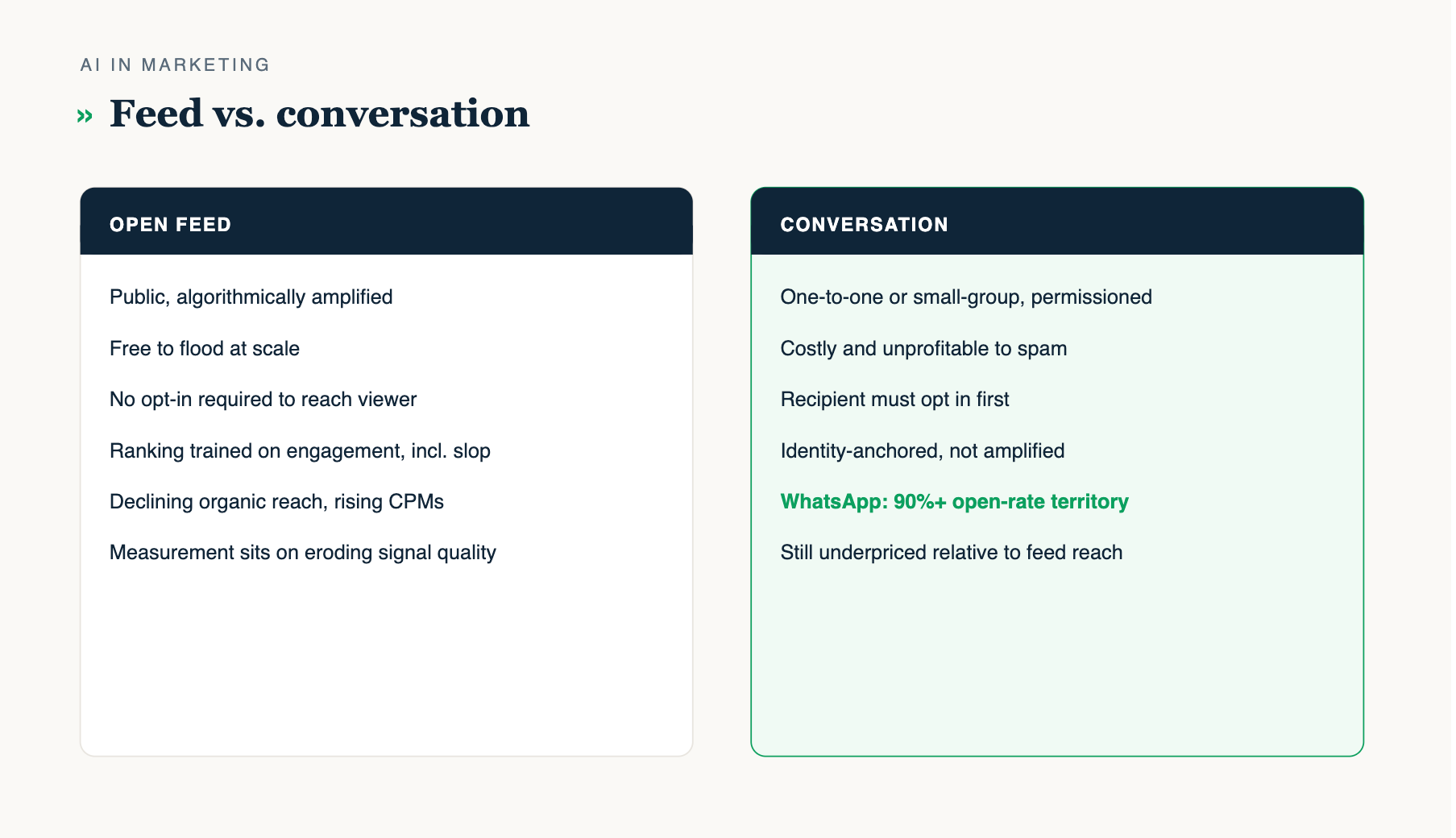
My answer, and the position MartechNext has staked out for a while now: into messaging, chat, and AI answer surfaces. WhatsApp threads. Meta's Business Agents. ChatGPT product answers and the emerging discipline of generative engine optimization. These aren't immune to spam by default, but they're structurally harder to flood, because they're one-to-one or small-group, permissioned, and identity-anchored rather than open and algorithmically amplified. A slop farm can post a thousand AI images to a public feed for free. It's much harder and much less profitable to spam a thousand individual WhatsApp threads where the recipient has to have opted in first.
Consider a simple, round-number comparison. Say a travel brand spends its media budget the traditional way: a €10,000 monthly budget on paid social, competing for attention against an increasingly slop-saturated feed where organic reach keeps declining and CPMs keep climbing because platforms need to backfill declining engagement quality with more ad inventory. Compare that to the same €10,000 invested in building out a WhatsApp journey (from booking confirmation to pre-trip tips to post-trip re-engagement) where every message lands in a channel the customer actively chose, at a 90%+ open rate territory that's genuinely differentiated from feed reach, even if we should always be careful, as I've flagged before, that channel statistics like open rates aren't conversion statistics on their own.
Full disclosure, as always: I'm the founder of Zoey, a WhatsApp journey automation platform for the travel industry, so I have skin in this exact game. That's precisely why I want to be honest about the caveat above rather than let the open rate number do all the work.
What to actually do about it
You don't need to abandon feeds. Most marketers still need reach, and reach still mostly lives in feeds for now. But the balance of investment needs to shift, and there are concrete steps you can take this quarter:
1. Audit your adjacency risk. If you're running programmatic or social spend at any scale, look at DoubleVerify's or IAS's AI-content adjacency tools before you assume your ads aren't sitting next to AutoBait-style slop farms.
2. Stop trusting platform-reported quality metrics at face value. Spotify's 75 million figure, YouTube's enforcement claims, they're all self-reported, with no independent audit of false positive or false negative rates. Treat them as directional, not gospel, the same way I'd want you to treat my own case studies.
3. Move discovery budget toward owned, permissioned conversation channels. WhatsApp, email with genuine two-way interaction, in-app chat. Not because feeds are dying tomorrow, but because the ROI curve on feed reach is bending the wrong way while conversation channels are still underpriced.
4. Treat GEO and feed-quality auditing as the same discipline. Whether it's making sure your product gets surfaced correctly in a ChatGPT answer or making sure your ad isn't parked next to synthetic garbage, it's the same underlying job: verifying the environment your brand appears in, because you can no longer assume the platform is doing that verification reliably on your behalf.
5. Build for one-to-one, not for algorithmic amplification. Recommendation and ranking systems reward volume and engagement, which is exactly the incentive slop exploits. A well-built conversational journey rewards relevance to one person, which is a much harder thing to fake at scale.
My verdict
Spotify, YouTube, DoubleVerify and IAS deserve real credit here. They're building genuine detection capability faster than most people expected, and Thesis 7 applies: whoever gets AI-slop verification right first, in ad tech specifically, is going to own a category that's about to become mandatory infrastructure rather than a nice-to-have.
But detection capability is not the same as control, and control is what determines whether marketers can actually trust these environments again. That's Thesis 5 in its purest form: the capability to detect slop is racing ahead, the willingness (and financial incentive) to actually remove it at the root is lagging badly, and until platforms touch the engagement-based payout structures underneath, this is going to feel like mowing weeds that grow back overnight, exactly as the original MT Sprout piece put it.
My money says the open feed doesn't get fixed in the next two years. It gets partially cleaned up on the surface while the underlying incentive rot continues, and the smart marketers respond not by waiting for platforms to solve it, but by quietly building real strength in the channels slop can't easily reach.
Wrestling with where to shift budget between feed and conversation in your own stack? I'd love to exchange thoughts.
-- Bram Versteegh
Bram Versteegh is the founder of MartechNext, covering the business of AI in marketing: who's building it, who's funding it, and how industries put it to work.
Enjoyed this piece? Every week, What's Next delivers sharp analysis, the latest funding rounds in AI marketing, and the martech news that actually matters. Straight to your inbox, free.