Your ad platform now takes orders from someone else's AI agent. Are you ready for that?
Dutch DSP adpaq lets AI agents build ad campaigns via MCP. A small rollout with a big signal: agentic AI is entering martech infrastructure now.


In this article:
- What adpaq actually built, and why an MCP server is different from a normal API
- Why this is a bigger deal than the size of the announcement suggests
- The real question: who is accountable when an agent makes the wrong call
- How this connects to the trust/control curve that decides deployment speed
- What to check before you let any agent touch your ad accounts
- A verdict on whether this is signal or noise
Picture a media buyer at a mid-sized agency, typing a brief into a chat window instead of opening a campaign dashboard: "Set up a 15-second audio spot for the Amsterdam market, target commuters aged 25-45, €8,000 budget, start Monday." No login, no line-item form, no dropdown menus. The agent takes it from there: builds the campaign, sets targeting, links creatives, and waits for a human to click approve on the budget.
That's not a demo reel. It's what a Dutch programmatic audio DSP just shipped.
The details
adpaq, a Dutch demand-side platform for programmatic digital audio, has built its own Model Context Protocol (MCP) server. MCP is the emerging open standard that lets AI agents not just retrieve information from a system, but take controlled actions inside it. adpaq says this makes it the first platform in programmatic audio to let AI agents work directly inside the DSP, briefed in natural language.
Concretely: an agent can prepare a full audio campaign, create line items, set targeting by location, device, publisher, or audience, attach creatives, and generate performance reports.
The rollout is a partnership, not a wide release. adpaq is running the first implementation with Abovomaxlead, which it describes as the largest independent media and marketing agency in the Netherlands (source: Emerce, July 2026). The two are testing the technology under real campaign conditions before adpaq opens it up to its broader partner network.
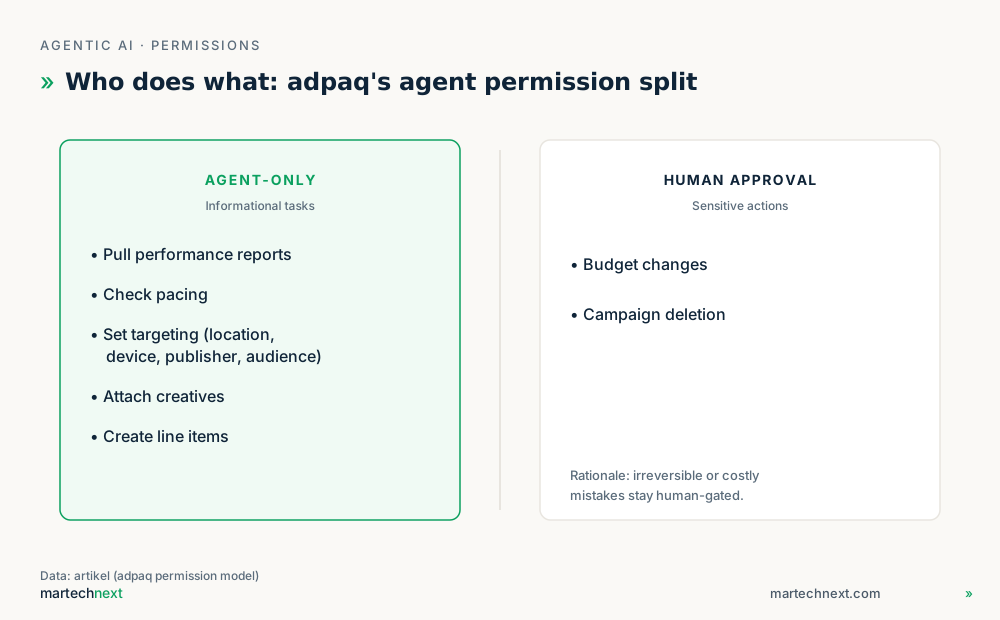
adpaq has built in a permission layer: informational tasks, like pulling reports or checking pacing, can be fully agent-driven. Sensitive actions, budget changes or campaign deletion, always require explicit human approval.
Why an MCP server is not just a fancier API
If you've built or bought martech integrations before, your first instinct might be: didn't we already have APIs for this? Fair question. Here's the actual difference.
A traditional API is built for developers to write fixed, predictable integrations. You know exactly what call does what, ahead of time. An MCP server is built for an AI agent to discover what's possible on the fly, in natural language, and decide which actions to chain together to reach a goal it wasn't explicitly told the steps for.
That distinction matters because it's the difference between generative AI and agentic AI, and adpaq's own framing gets this right: generative AI mostly helps you write or analyze; agentic AI acts, autonomously, across multiple steps, to reach an outcome. Setting up a campaign isn't one action. It's targeting, creative linking, budget allocation, and reporting, chained together. That chaining is exactly what MCP is designed to let an agent do safely.
This is why MCP adoption in martech is worth watching closely, even when the individual announcements look small. It's infrastructure, not a feature.
The MartechNext take
Let's connect this to a thesis I keep coming back to: automation with human accountability. AI should handle the operational layer, the repetitive campaign mechanics, while humans keep the judgment calls, the taste, the relationships. What decides how fast any of this actually gets deployed isn't how capable the AI is. It's how much control the humans around it are willing to give up. I've called this the trust/control curve lagging the capability curve, and adpaq's permission split is a textbook illustration of it.
Look at what they actually gated. Reporting, targeting mechanics, creative linking: agent territory. Budget changes and deletions: human-only. That's not arbitrary. It's the two categories of action that, if an agent gets them wrong, cost you money you can't easily claw back versus mistakes you can catch and fix in the next report. That's a sensible first cut at the control problem, and it's more thoughtful than a lot of "AI-powered" platform launches I've seen that bolt a chatbot onto a dashboard and call it agentic.
What's genuinely strong here: adpaq didn't wait for a big platform to define the standard for them and then bolt on a wrapper. They built their own MCP server, ahead of a standard still very much in motion, in a niche (programmatic audio) where AI-native tooling isn't crowded yet. That's the early-mover instinct that has paid off in every previous platform shift, AdWords, Facebook Ads, TikTok, WhatsApp Business API. The companies that build the foundation before the channel matures are the ones still standing when it does. A Dutch DSP getting there before the bigger ad tech players is a genuinely interesting bet.
Now let's apply some scrutiny, because that's the job.
First: "first in programmatic audio" is a category claim, and category claims are almost always narrower than they sound. First in programmatic audio is a much smaller claim than first in programmatic advertising, and audio is a relatively small slice of the ad tech market to begin with. That doesn't make it worthless, being early in a niche is exactly how you build a moat before anyone bigger notices, but don't read "first" as "leading the industry."
Second: there are zero performance numbers in this announcement, and that's actually refreshing, but also a reminder to wait. No claim yet about how much faster campaign setup gets, no claim about how agent-built campaigns perform against human-built ones. Good, because if adpaq had shipped a number like "campaigns launch 60% faster" on day one of a partner pilot, I'd apply the same checklist I apply to every vendor stat: what's the baseline, who's the comparison group, and is the pilot agency's team more AI-fluent than the average buyer (a classic selection effect)? The absence of numbers here isn't a red flag. It's honesty about being in a validation phase. Watch what numbers show up once the pilot concludes, and ask those questions then.
Third: "the user always stays in control" is the kind of line every agentic AI vendor says right now, and it's worth being precise about what it actually means in this case. Here it means something specific and checkable: budget changes and deletions require approval. It doesn't mean a human reviews every targeting decision or every creative pairing the agent makes. That's a meaningfully narrower version of "control" than the phrase implies at first read, and it's worth asking any vendor making this claim to specify exactly which actions are gated, not just to accept the reassurance.
Fourth, and this is the one agency buyers should sit with: if an agent can build a full campaign from a one-line brief, what exactly is the campaign specialist doing next year that they're doing today? adpaq's own answer, working out how AI can "collaborate optimally" with campaign specialists (their words, paraphrased), is the right question to be asking. But it's an open question, not a solved one. The honest answer right now is: nobody fully knows yet, including adpaq. That uncertainty is normal at this stage of a technology, not a knock against the announcement.
What to check before an agent touches your ad accounts
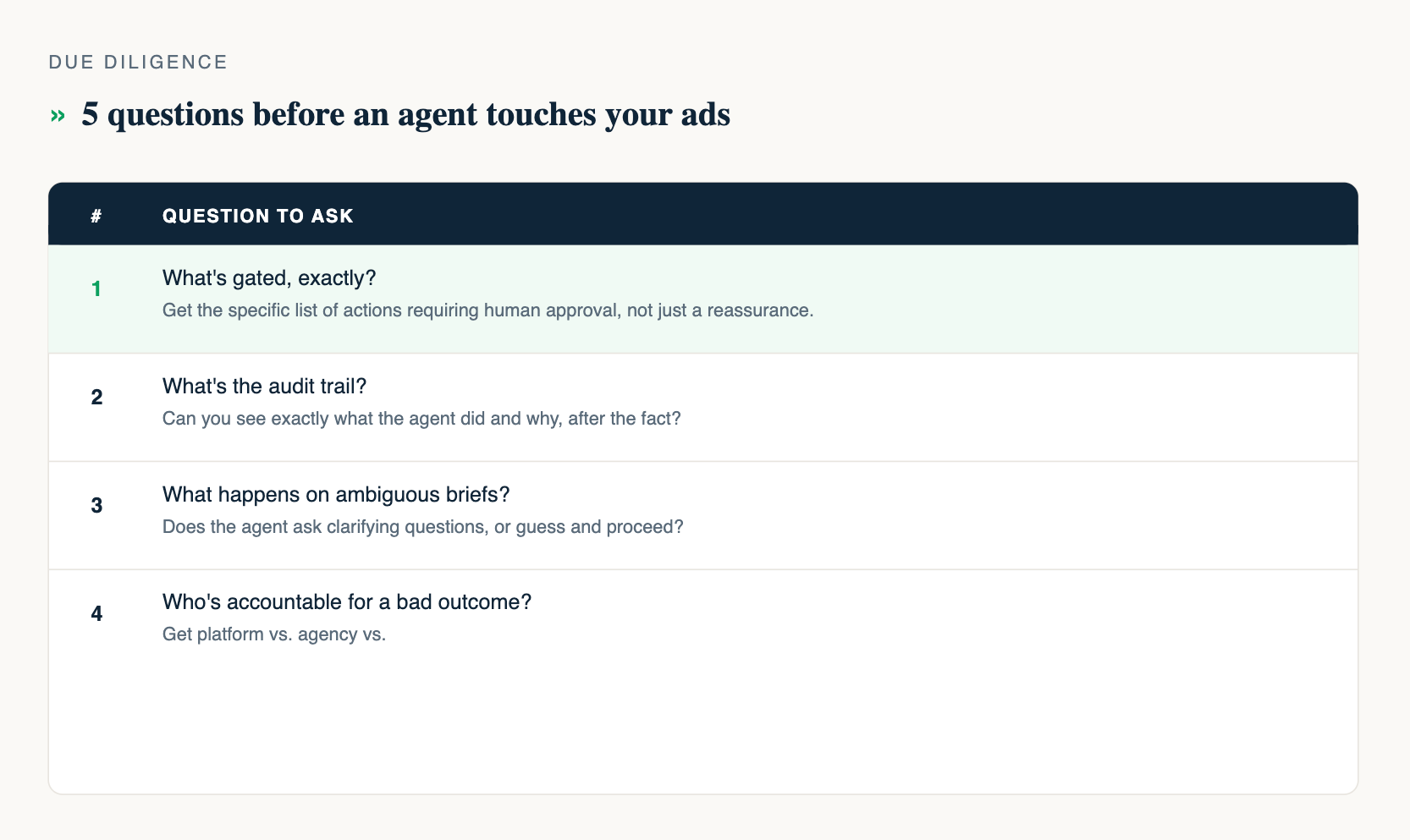
If your agency or in-house team is evaluating agentic AI tools for ad platforms, whether it's adpaq's MCP server or a competitor's equivalent, here's a short list worth running through before you plug anything in:
1. What's gated, exactly? Get the specific list of actions that require human approval versus actions the agent can execute unsupervised. Don't accept "you're always in control" as an answer on its own.
2. What's the audit trail? If an agent sets a wrong targeting parameter, can you see exactly what it did and why, after the fact?
3. What happens on ambiguous briefs? A one-line brief has gaps. Does the agent ask clarifying questions, or does it guess and proceed?
4. Who's accountable for a bad outcome? If an agent-built campaign underperforms or overspends inside its approved budget, is that a platform issue, an agency issue, or a "well, you approved the budget" issue? Get this in writing before, not after.
5. Is this reversible fast? How quickly can a human pause or roll back an agent action once it's live?
None of these are reasons to avoid the technology. They're the due diligence that separates "we adopted agentic AI" from "we adopted agentic AI and it went fine."
The bigger pattern: MCP is becoming ad tech plumbing
This isn't an isolated story. Model Context Protocol adoption is moving through martech the way REST APIs did a decade ago, quietly, platform by platform, until one day every serious tool has one and you can't remember a time they didn't. adpaq is early. It won't be the last DSP, ESP, or CDP to ship one this year.
That connects directly to a thesis I've written about before: the conversation is becoming the interface layer for commerce and, increasingly, for the tools marketers use to run commerce. (See: Meta Business Agents 2026) We've mostly talked about this in the context of customers chatting with brands. adpaq's announcement is the same shift happening one layer up the stack: marketers chatting with their own platforms instead of clicking through them.
Verdict
Small, narrow rollout. Genuinely early signal. adpaq isn't claiming to have solved agentic AI in ad tech, and the fact that they're running a controlled pilot with one implementation partner before opening it up is the right level of caution for infrastructure this new.
The permission model (informational tasks to the agent, financial and destructive actions to the human) is the correct starting split, and it's a useful reference point for anyone building or buying similar tooling. But the honest read is: this is a bet on where the industry is heading, not proof that it's arrived. The real test is what happens during the Abovomaxlead pilot, whether agent-built campaigns hold up on reliability and usability, not just speed.
My take: this is worth watching, not worth over-hyping. The companies that get MCP integrations right, with sensible guardrails, before the standard fully matures, are the ones who'll own the workflow when every buyer expects to brief a campaign the way they'd brief a colleague. adpaq just made an early, sensible move in that direction. Whether it pays off depends entirely on execution over the next few quarters, not on the announcement itself.
Watching how your platforms handle agentic AI, or wrestling with where to draw the human-approval line in your own stack? I'd love to exchange thoughts.
-- Bram Versteegh
Bram Versteegh is the founder of MartechNext, covering the business of AI in marketing: who's building it, who's funding it, and how industries put it to work.
Enjoyed this piece? Every week, What's Next delivers sharp analysis, the latest funding rounds in AI marketing, and the martech news that actually matters. Straight to your inbox, free.