Google ships three new Gemini models, but the one martech vendors actually need is still missing
Google released three Gemini models this week, but skipped 3.5 Pro. For martech vendors building on Gemini, that gap is a real decision point.


Here's the news that matters more than it looks like it does: Google shipped three new Gemini models this week, and the one everyone building serious AI products actually wanted wasn't among them.
If you run a martech stack, or you're evaluating vendors who build their agents on top of Google's models, this is worth five minutes of your attention. Not because Gemini is broken. Because it tells you something concrete about how to think about the AI vendors in your funnel right now.
The details
On Tuesday, Google DeepMind released Gemini 3.6 Flash, 3.5 Flash-Lite, and 3.5 Flash Cyber, according to TechCrunch. 3.6 Flash is positioned as the new workhorse: better coding and multimodal performance, and up to 17% fewer tokens burned per task than its predecessor, which makes it cheaper to run at scale. Flash-Lite is the budget option. Flash Cyber is a specialized security model, limited for now to governments and select partners.
What didn't ship: Gemini 3.5 Pro, the flagship reasoning model that Google's own team teased back in May, saying it was "already being used internally" and would roll out "next month." That was two months ago. Bloomberg reported last week that Google is hitting internal delays because 3.5 Pro isn't meeting its own performance targets. Meanwhile Pro hasn't been updated since February, and in that same window OpenAI has pushed out GPT-5.5 and started rolling GPT-5.6, and Anthropic has shipped Opus 4.8, Sonnet 5, and wider access to Fable 5.
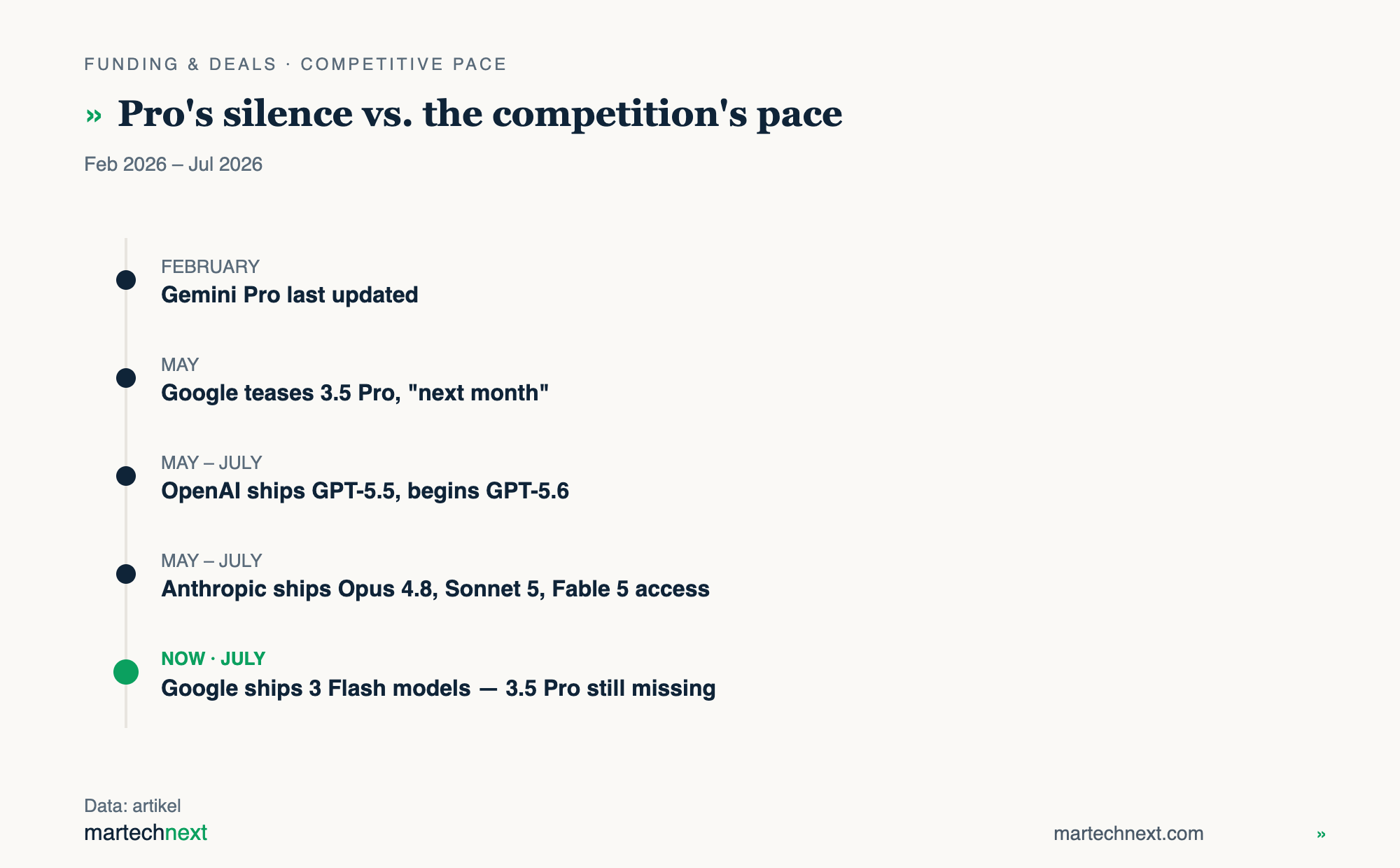
Google DeepMind's product lead Logan Kilpatrick said the team is testing 3.5 Pro with partners now and hopes to "land soon." He also confirmed Google has kicked off pre-training for Gemini 4.
The MartechNext take
Let's separate two things, because vendors and marketers keep conflating them: the capability curve and the control curve.
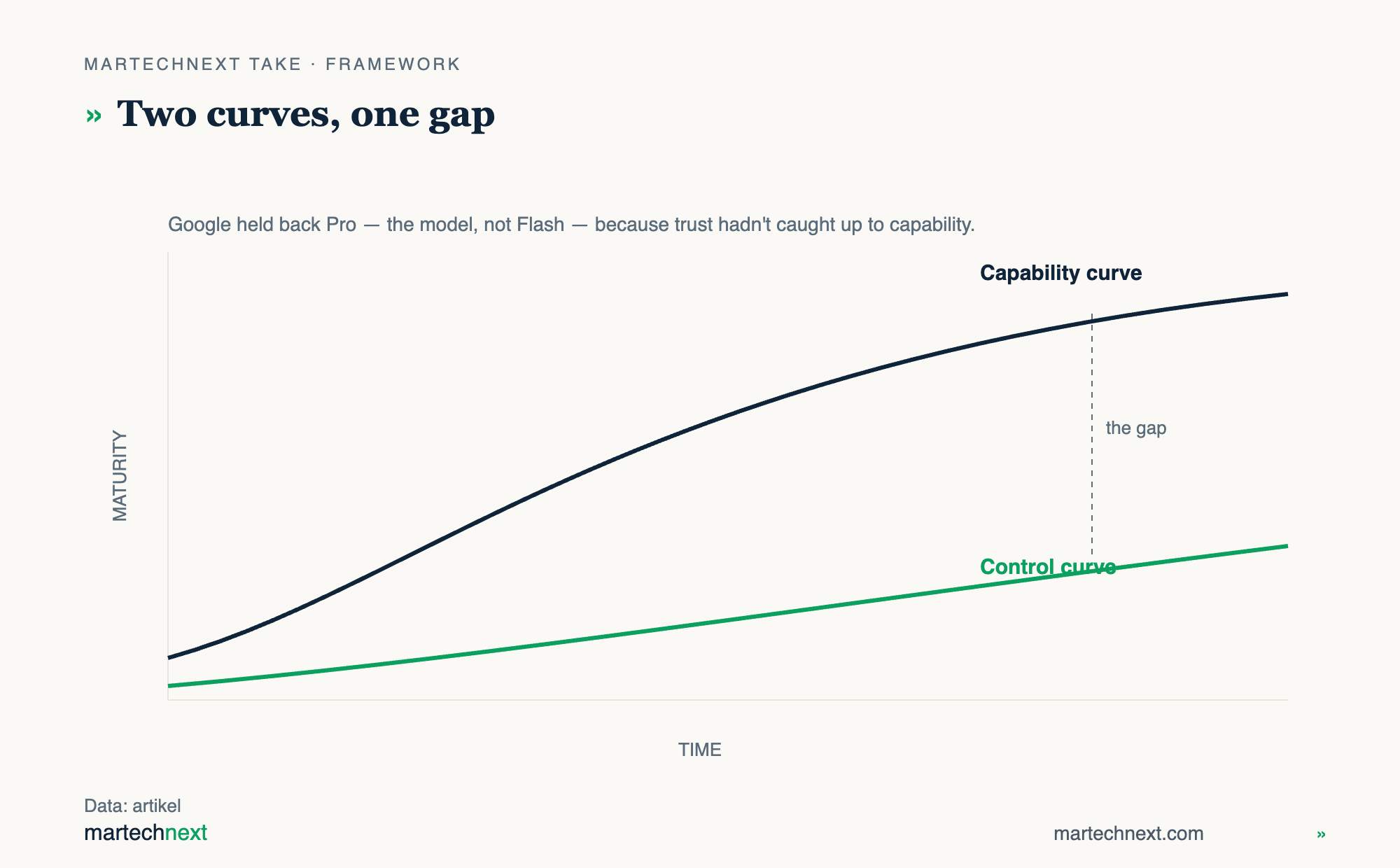
The capability curve is what these models can technically do. It's moving fast, arguably faster than anyone's ability to responsibly deploy it. The control curve is a different question entirely: how much trust and oversight does a business actually put around a model before letting it touch customers, budgets, or brand voice? That curve moves much slower, and it should. This is a thesis I keep coming back to, because every quarter gives a fresh example of the gap.
This week's release is a textbook version of that gap. Google didn't hold back Flash models, the ones doing the unglamorous, high-volume work: classification, summarization, quick agent actions. It held back Pro, the model you'd trust with complex reasoning, nuanced copy, or decisions with real consequences if it gets something wrong. That's not an accident. That's Google being honest, in its own quiet way, that Pro isn't ready for the trust level its own roadmap promised.
Here's why that's actually useful for you, not just a caveat. If you're evaluating a martech vendor right now, whether it's a personalization engine, a content agent, or a conversational commerce tool, ask them one direct question: which Gemini model is this built on, and what happens to my output quality if Google swaps it under the hood next quarter?
Vendors building on Flash-tier models today are making a defensible bet: lower cost, faster inference, good enough for high-volume operational tasks like tagging, routing, or first-draft generation. Vendors quietly waiting on 3.5 Pro to ship before they finalize their reasoning-heavy features are also making a defensible bet: they'd rather ship something reliable a quarter late than something clever and unstable on time. Both are legitimate strategies. What's not legitimate is a vendor pitching you Pro-level reasoning claims on a Flash-tier foundation, or worse, not being able to tell you which model powers which part of their product at all.
The honest caveat here: model swaps under the hood are mostly invisible to you as a buyer, and that's the actual risk, not "Google is falling behind." Whether Google ships 3.5 Pro next month or next quarter says very little about the long-term model race (this is a company mid-way through training Gemini 4, not a company in retreat). It says a lot about whether the vendor sitting between you and that model has a plan for exactly this kind of delay. Ask them. If they don't have an answer, that's the finding, not the six-week gap between Pro announcements.
The other thing worth naming: this is the same commoditization pattern I wrote about with Kimi K3. The model layer keeps getting cheaper and more interchangeable. The moat was never going to be "which frontier model do you use." It's going to be what you build around it: the data flywheel, the workflow, the human judgment layer that decides when to trust the output and when not to. Models come and go on a release schedule. Your customer data and your retention numbers don't.
Verdict
This isn't a red flag for Gemini, and it isn't a green flag either. It's a prompt to do the diligence you should already be doing on every AI vendor in your stack: which model is under the hood, what's the fallback plan if that model changes or slips, and does the vendor's trust level in their own product match the trust level they're asking from you. Google being cautious about shipping Pro is, if anything, a decent sign that somebody at Google is still respecting the control curve. I'd rather work with vendors who show the same restraint than ones who ship first and figure out the trust question later :)
-- Bram Versteegh
Bram Versteegh is the founder of MartechNext, covering the business of AI in marketing: who's building it, who's funding it, and how industries put it to work.
Enjoyed this piece? Every week, What's Next delivers sharp analysis, the latest funding rounds in AI marketing, and the martech news that actually matters. Straight to your inbox, free.