Pre-Seed, Big Thesis: Why Investors Are Betting on AI-Search Visibility Tools Now
ChatFeatured raised a $2M pre-seed for an AI search visibility agent. Small round, big ambition: here's what it signals about the GEO funding wave.


In this article:
- Why a $2M Toronto pre-seed round is worth your attention even though the number itself is small
- What ChatFeatured actually does, and what its funding announcement leaves unsaid
- How this round fits a wider wave of capital chasing "AI search visibility" (Profound, Peec AI, and others)
- Why this connects to two MartechNext theses: the conversation as the new funnel, and early movers winning channels
- The real question every buyer should ask before adopting a GEO tool: is this a moat, or a feature Semrush ships next quarter?
- A practical read on whether to pilot, wait, or ignore this category right now
Picture a mid-sized B2B software company whose marketing director just typed their own product category into ChatGPT and watched three competitors get named before their brand did. No warning, no ranking report, no dashboard alert. Just silence where visibility used to be.
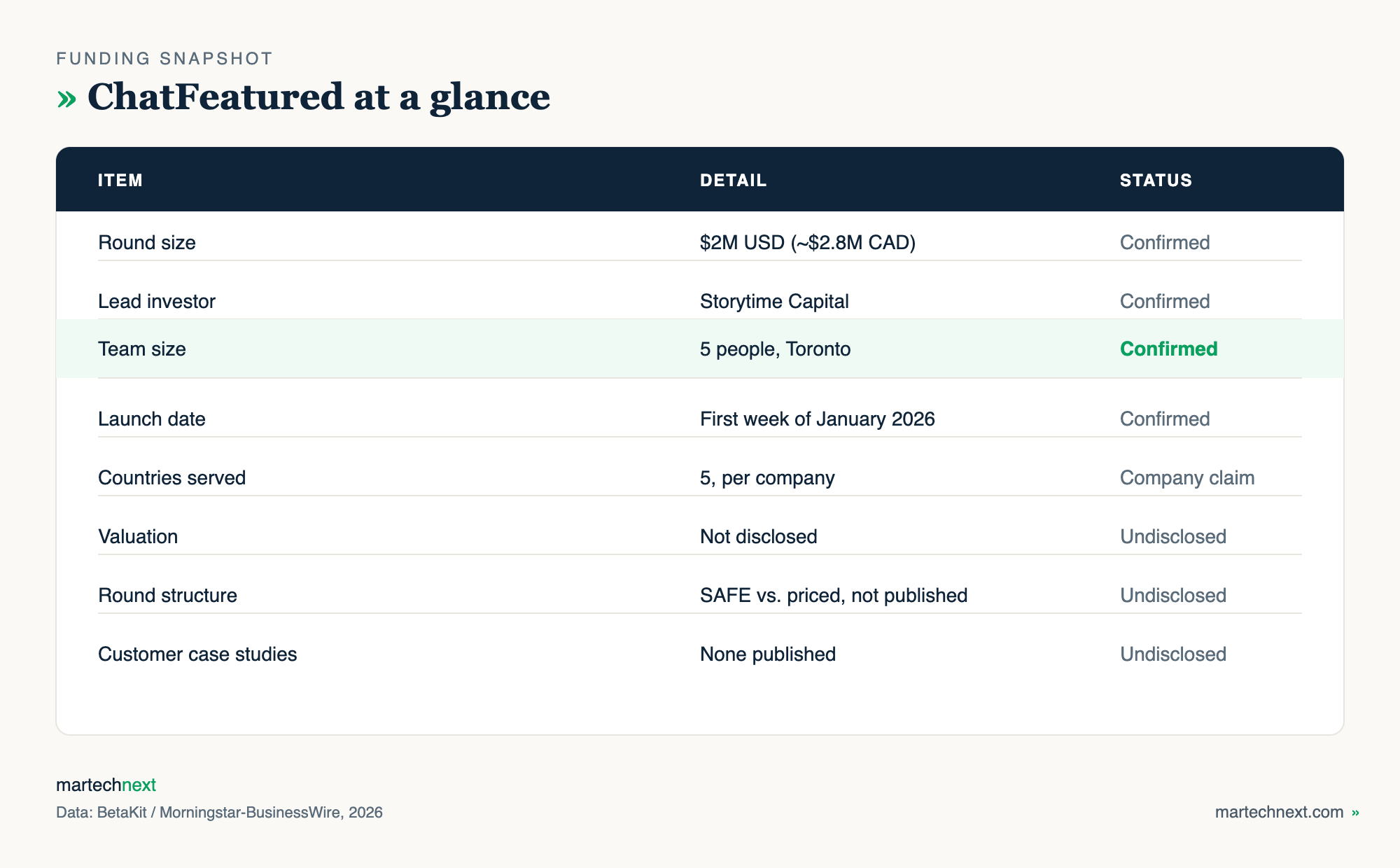
That scene is becoming routine, and it's exactly the gap a wave of new startups wants to fill. The latest is ChatFeatured, a five-person Toronto company that just closed an oversubscribed $2 million USD (roughly $2.8 million CAD) pre-seed round, led by Storytime Capital with participation from Garage Capital and BY Venture Partners, according to the company's announcement covered by BetaKit and syndicated via Morningstar/BusinessWire. The company reportedly targeted $1.5 million and raised more on investor demand.
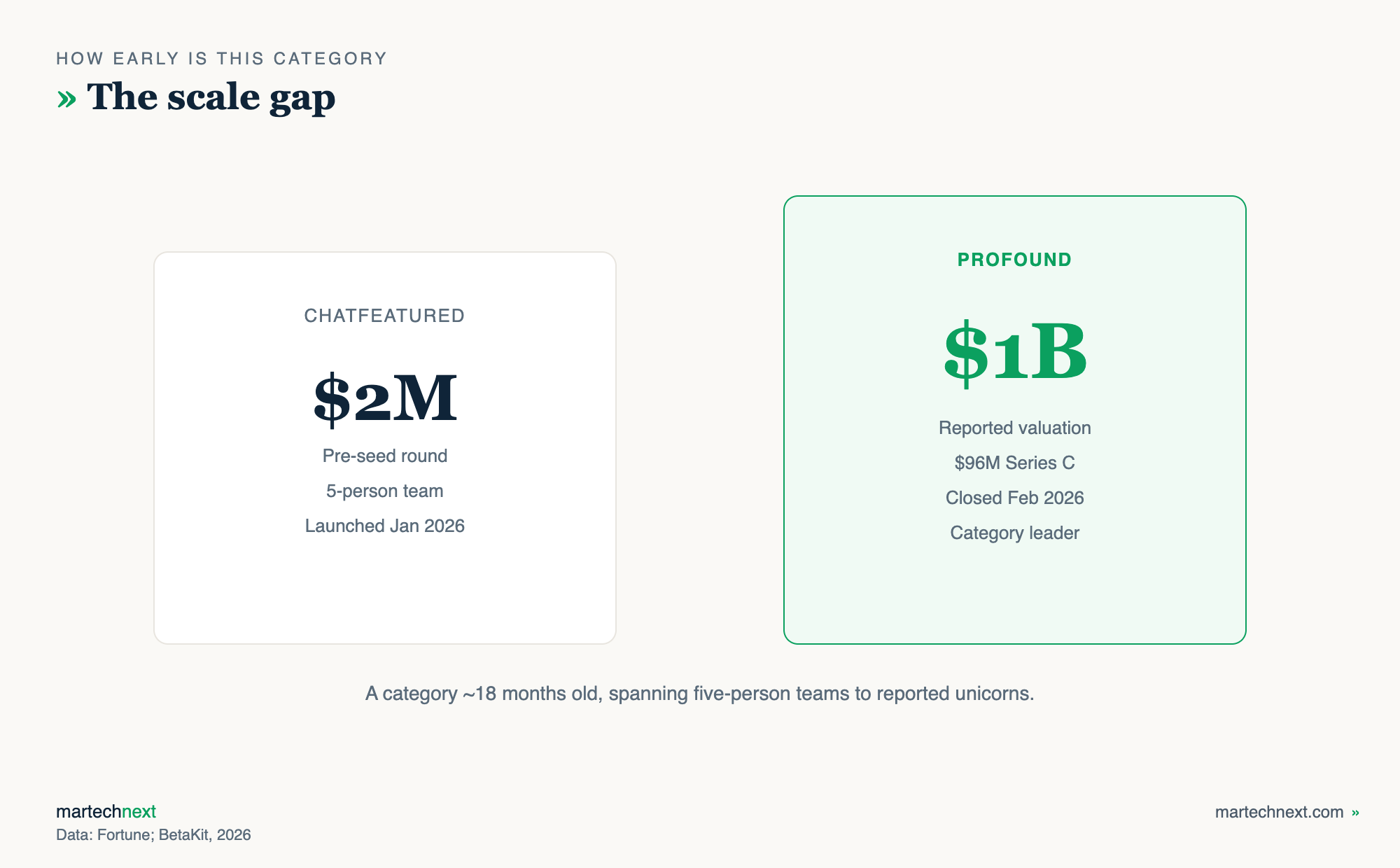
Two million dollars is not, on its own, news. What makes it worth a proper look is where it lands: a category where the leader just raised at a reported $1 billion valuation. That gap between a five-person seed-stage team and a unicorn tells you something about how early we are, and how fast investors think this is going to move.
The details
Here's what's confirmed. ChatFeatured launched in the first week of January 2026 out of Toronto and, per the company, already serves customers in five countries. The founding team is Farris Nasr (CEO), Nithiiyan Skhanthan (CTO), and Ryan Nahas (founding Head of Revenue), backed by a five-person team total. The funds are earmarked for product development and go-to-market.
The product itself is positioned as an AI search optimization platform: it identifies how a company gets mentioned (or doesn't) by major chatbots and generates a strategy to increase visibility. One line from the announcement sums up the ambition: it aims to build "an autonomous AI search agent for marketing teams."
No valuation was disclosed, in either the press release or the BetaKit coverage. No round structure (SAFE versus priced equity) was published. Worth flagging up front, because it matters for how you read everything that follows: I couldn't verify the round size or investor list independently through a third-party filing, so I'm relying on the company's own disclosure, same as everyone else covering this story.
What ChatFeatured is, and isn't, yet
Let's be honest about what a seed-stage funding announcement actually tells you: almost nothing about whether the product works. It tells you a small group of angel and pre-seed investors liked the team, the market timing, and the pitch. That's it.
No published customer case studies. No before-and-after visibility metrics. No technical detail on what "autonomous agent" actually means under the hood: which LLMs it monitors, how it scores mentions, whether the "strategy" it generates is genuinely tailored or a templated content plan. I looked for this and came up empty, which isn't unusual at this stage, but it's a gap you should notice before you take the marketing language at face value.
None of that makes ChatFeatured a bad bet. Plenty of category-defining products started with less than this. It just means the honest label for where this sits is "promising, unproven," not "market-validated."
The GEO gold rush
ChatFeatured is not raising in a vacuum. It's entering a category that's suddenly attracting real capital.
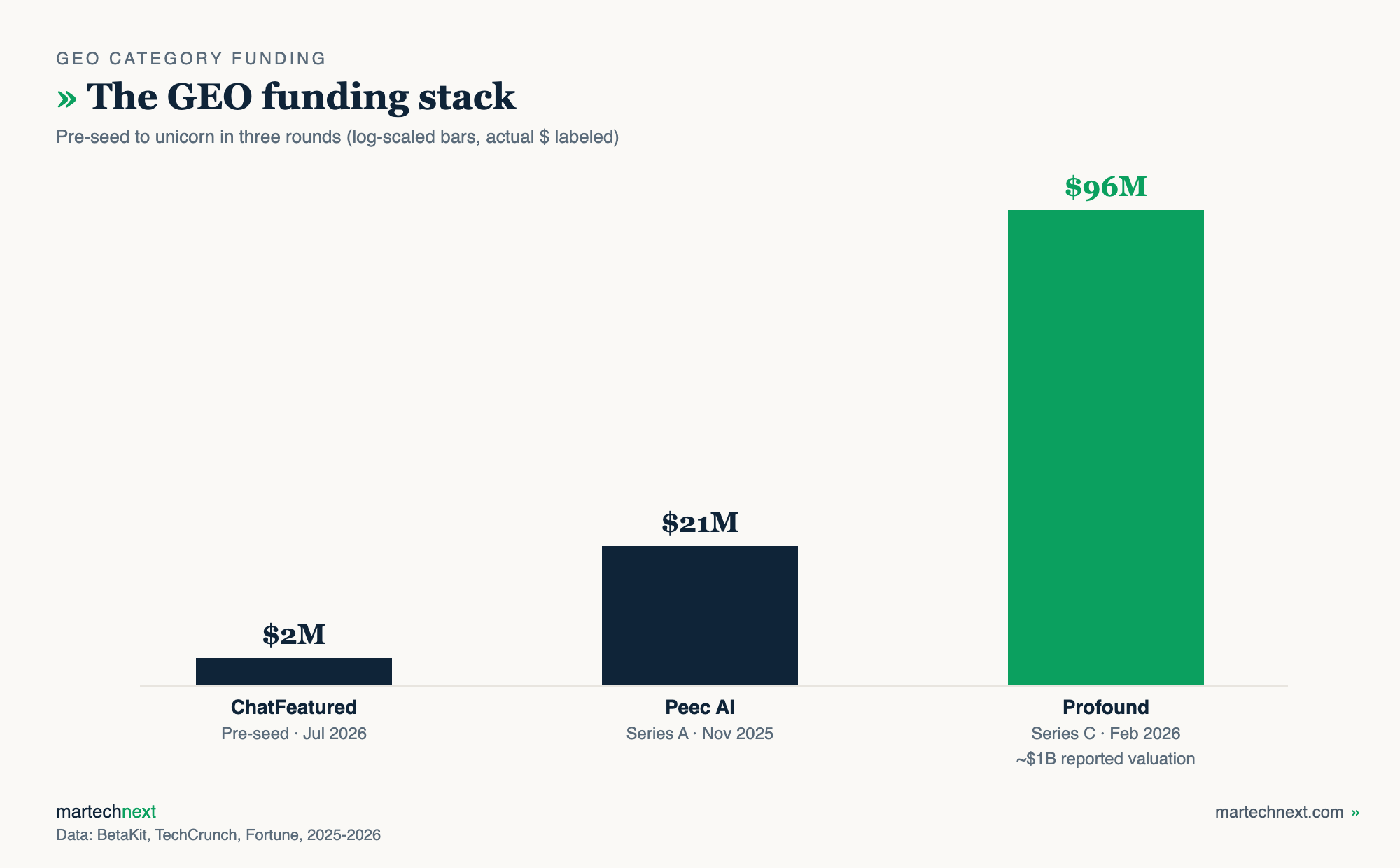
Profound, widely seen as the category leader in this space, raised a $96 million Series C at a reported $1 billion valuation in February 2026, according to Fortune. Peec AI, a similar player, raised a $21 million Series A in November 2025 to help brands "win in AI search," per TechCrunch.
Line those three up and you get a rough shape of the category: an established leader nearing unicorn status, a well-funded Series A challenger, and a scrappy pre-seed entrant trying to find its wedge. That's a classic early-market pattern, and it usually means one of two things is about to happen: either the category consolidates around two or three winners within eighteen months, or it turns out to be a feature that gets absorbed into tools marketers already pay for. More on that in a minute.
I'll flag the obvious limit here too: I have not done a feature-by-feature comparison of ChatFeatured against Profound, Peec AI, Athena, Rankscale, or Otterly.ai. What I can tell you with confidence is that all of them are chasing the same underlying shift, and that shift is the real story.
Why this matters: the conversation is the new funnel
Here's the thesis I keep coming back to on MartechNext: commerce and discovery are moving into messaging threads and AI answers. ChatGPT, Meta's Business Agents, WhatsApp business flows: the funnel doesn't start on a search results page anymore, it starts inside a conversation. When a prospective customer asks an AI assistant "what's the best project management tool for a 20-person agency," the answer that gets surfaced is the new page-one ranking. If your brand isn't in that answer, you don't get a click you can retarget. You just don't exist for that moment.
That's why GEO (generative engine optimization) is getting funded like a discipline, not a feature. It's SEO's structural cousin: same underlying question (how do I get found), completely different mechanics (you're optimizing for what an LLM says about you, not what a crawler indexes). Feed quality, off-site consistency, and how your brand shows up across scattered third-party content all start to matter in ways classic SEO tooling never measured.
And this is where the second thesis kicks in: early movers win channels. Every platform shift, AdWords in the 2000s, Facebook ads in the early 2010s, TikTok organic in 2020, WhatsApp business messaging more recently, rewarded the brands and vendors who built real capability before the channel matured and got crowded. The investors backing ChatFeatured, Profound, and Peec AI are making a bet that GEO is at that early stage right now, and that whoever builds category position and customer habits first has a durable edge later. That's not a guaranteed outcome. But it's a coherent bet, and it's the same bet that made early AdWords agencies and early TikTok-native brands rich.
The moat question
Here's the part I'd push hardest on if I were writing the check: what's the actual moat?
Every AI startup claims a data moat. The honest test is asking why an incumbent with distribution couldn't just copy it. Semrush, Ahrefs, and HubSpot already own the SEO and content workflows most marketing teams live in daily. Adding an "AI mention tracker" panel to an existing dashboard is not a hard engineering problem for a company with that user base and that data pipeline.
So the real question for ChatFeatured, and for the category generally, is whether visibility tracking and optimization strategy stays a standalone product worth paying for separately, or becomes table stakes bundled into tools marketers already have open. My honest read: the tracking and reporting layer commoditizes fast. What might stay defensible is the strategic layer: understanding why an LLM mentions one brand over another, and being able to act on that with genuinely tailored content and structured data, not generic advice. That's a harder problem, and it's the one worth watching whether ChatFeatured, or anyone in this category, actually solves.
There's also a quieter question worth asking, tied to a thesis I return to often: does a tool like this help a brand get its product and content data in proper shape before chasing AI mentions, or does it jump straight to "AI-generated strategy" on top of the same messy, inconsistent brand data that's always been there? MIT's widely cited research puts AI project failure rates at 95%, largely because tools get bolted onto disorganized data rather than structured processes. I don't know yet which category ChatFeatured falls into. Neither does anyone outside the company, based on what's public.
The skeptic's lens, proportionately applied
A few things worth holding onto before you get too excited or too dismissive:
"Oversubscribed" and "following investor demand" are the company's own framing, repeated across a press release and its syndicated pickup, not independently verified by a third party. That doesn't make it false, it just means treat it as marketing copy, not confirmed fact.
No valuation, no round structure, no published case studies. That's normal for a five-person, six-month-old company. It's also a reason to withhold judgment on whether this is "smart bet" or "hype" until there's actual evidence: repeat customers, published visibility improvements, a Series A.
And the scale gap matters. $2 million next to Profound's $96 million and reported $1 billion valuation isn't a competitive rivalry yet, it's an early entrant testing whether there's room for more than one winner in a category that's maybe eighteen months old. That's worth remembering the next time a GEO vendor's pitch deck compares itself to "the Profound of X."
What to watch
If you're a martech buyer or a founder circling this space, here's what would actually move my read on ChatFeatured, or any GEO tool, from "interesting bet" to "worth adopting":
1. A published case study with real numbers. Not "increased visibility," but specific query sets, specific competitor comparisons, before-and-after mention rates.
2. A follow-on round within 12-18 months. Pre-seed to seed within that window usually signals genuine traction, not just a good pitch.
3. Whether Semrush, HubSpot, or a similar incumbent ships a comparable feature. If they do within the next year, that tells you the standalone-category thesis is shakier than the funding numbers suggest.
4. Whether the product actually helps structure brand and content data, or just layers AI-generated advice on top of whatever's already there.
The verdict
I don't think ChatFeatured is a bad bet, and I don't think it's proven either. It's a small, credible team making a coherent wager on a real shift: AI answers are becoming a discovery surface, and almost nobody outside SEO specialists is tracking how their brand shows up there yet. That's a genuine gap, and being early to it is exactly the kind of move that's paid off in every prior platform shift I've watched.
What I'd tell a marketing team weighing whether to act right now: don't wait for the category to fully sort itself out before you start monitoring your own AI-search presence, because by the time it's obvious, the cheap seats will be gone. But also don't treat a $2 million pre-seed announcement as proof of anything beyond "smart investors think this space is worth a bet." Pilot, ask for real numbers before committing budget, and watch whether the incumbents move.
I don't have all the answers here, and I suspect the category itself doesn't yet either ;)
Wrestling with GEO strategy in your own organization? I'd love to exchange thoughts.
-- Bram Versteegh
Bram Versteegh is the founder of MartechNext, covering the business of AI in marketing: who's building it, who's funding it, and how industries put it to work.
Enjoyed this piece? Every week, What's Next delivers sharp analysis, the latest funding rounds in AI marketing, and the martech news that actually matters. Straight to your inbox, free.