AI Max and the End of the Keyword: What Intent Matching Means for Your Search Budget
Google says AI Max unlocks billions of new monetizable searches. Here's what the claim doesn't show, and what it means for your search budget strategy.


In this article:
- Why Google's "billions of new monetizable searches" claim deserves scrutiny, not stenography
- What AI Max for Search actually changes under the hood (and what Google won't disclose)
- Why the conversion-lift numbers Google has published keep shifting: 14%, then 27%, then 15%, then 27% again
- What the AAA and Etsy case studies do, and don't, prove
- How this connects to the bigger shift from keywords to conversation as the unit of intent
- A practical way to test AI Max without handing over your entire search strategy on faith
Picture a performance marketing lead sitting down for a Q1 budget review. Search has been the most predictable line item in the plan for a decade: you know your keywords, you know your match types, you know roughly what a click costs. Then someone forwards a slide from Google's latest earnings call. The company's chief business officer says AI Max is unlocking "billions of net new searches that weren't really monetizable before" (Alphabet Q4 2025 earnings call, via ppc.land). No number. No baseline. No timeframe. Just "billions," repeated across marketing press with the confidence of a settled fact.
That's the moment worth pausing on. Not because AI Max is nothing, it's genuinely one of the more important shifts in Search this year, but because the way Google is framing it tells you a lot about where the accountability line is moving in AI-driven advertising.
What AI Max actually is
Let's start with what's real. AI Max for Search isn't a new campaign type, it's an optimization layer you switch on inside your existing Search campaigns with one toggle (Google Ads Help, support.google.com). Once enabled, it does three things:
1. Expands matching beyond your keyword list using broad match and keywordless signals, so ads can serve on queries you never explicitly targeted.
2. Generates and tests ad creative and final URLs automatically, including URL expansion to send traffic to whichever landing page Google's system thinks converts best.
3. Uses AI to interpret the intent behind a search, not just the words in it.
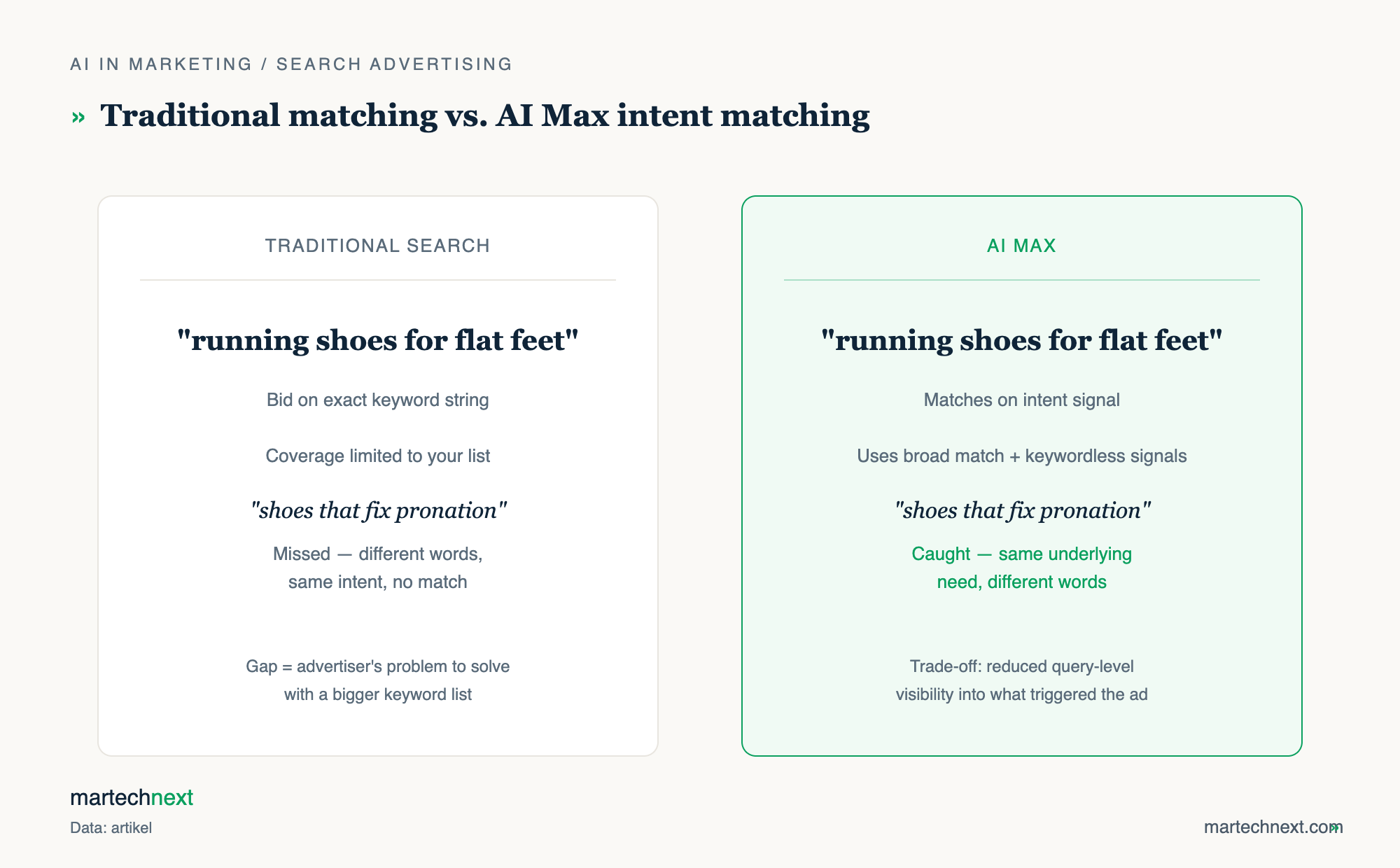
That last point is the real story. For twenty years, Search has run on lexical matching: you bid on strings of text, Google matches strings of text, and the gap between "running shoes for flat feet" and "shoes that fix pronation" was your problem to solve with a bigger keyword list. AI Max collapses that gap. It matches on what the searcher means, not what they typed.
What Google does not disclose is how. There's no public detail on whether AI Max runs on Gemini, on an embeddings model, or on an evolution of Performance Max's existing keywordless system (TipRanks, tipranks.com). The public language is deliberately qualitative: the system is "predicting what they might need next." For an industry that spent a decade obsessing over Quality Score mechanics, that's a strikingly thin explanation for something that now sits between every advertiser and every query.
Tracing the "billions" claim
Here's the thing about "billions of new monetizable searches": it originates from exactly one place, an earnings call. Alphabet CBO Philipp Schindler said it during the Q4 2025 report, in the context of Alphabet posting $119.8 billion in quarterly revenue, up 24% year over year, with Search ad revenue growing double digits (ppc.land, bestmediainfo.com). Google's own "Think with Google" page repeats the line with a footnote, but the footnote doesn't lead anywhere. No dataset. No definition of "monetizable." No comparison period.
That matters for a simple reason: this was said to investors, in a quarter where Google needed a growth story for Search in an AI-answers world. "We found billions of new searches to sell ads against" is exactly the sentence a market wants to hear when the narrative elsewhere is that AI chat interfaces might shrink traditional search volume. I'm not saying the claim is false. I'm saying it's investor relations framing repeated as product fact, and those are different things. If you've read my piece on the value-over-volume thesis, you'll recognize the pattern: a big, round, unfalsifiable number standing in for a metric you could actually act on.
The conversion numbers that keep moving
If the "billions" line is unverifiable, the conversion-lift numbers are at least numbers, but they don't sit still.
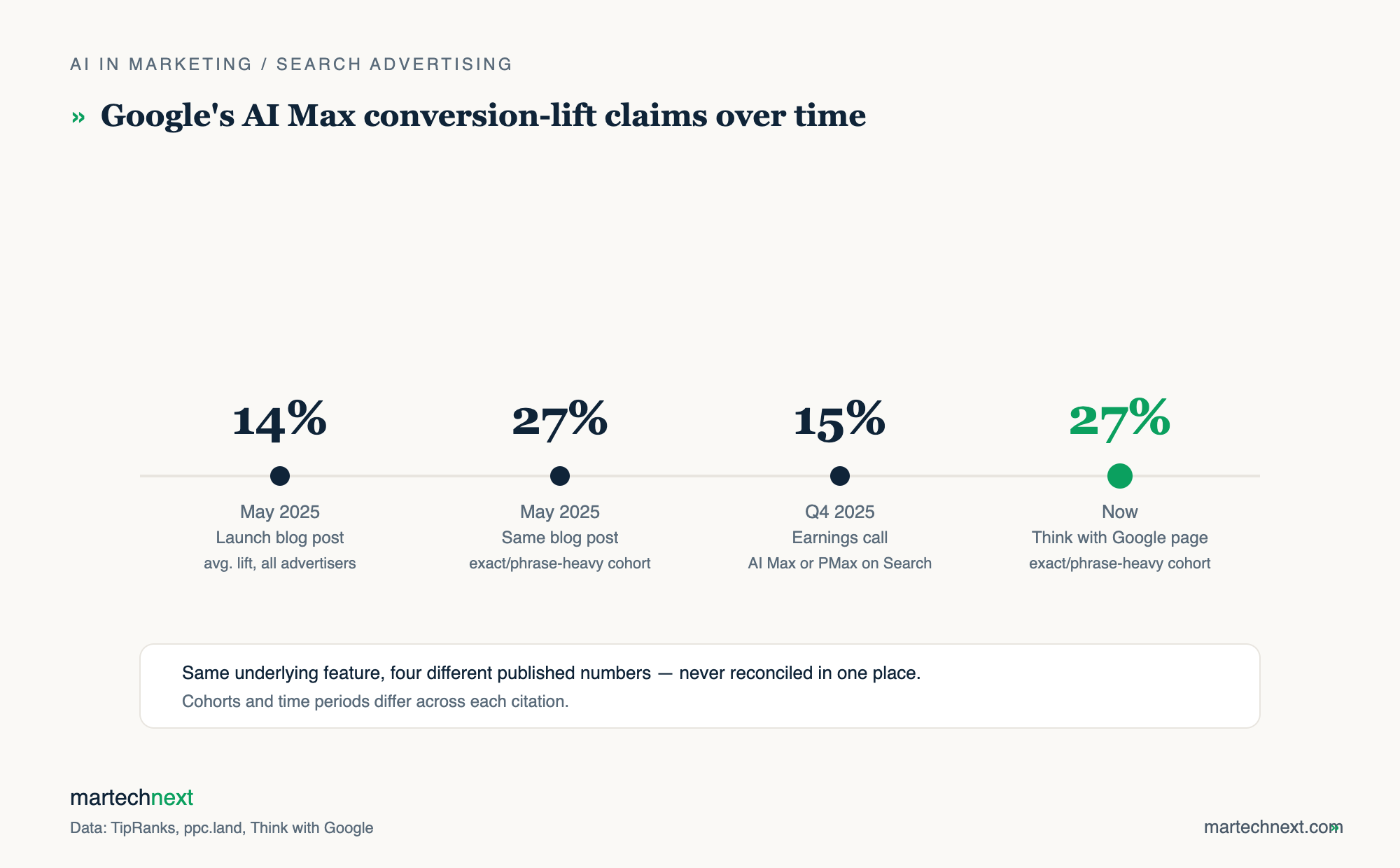
- At the May 2025 launch, Google's blog cited a 14% average lift in conversions or conversion value at similar CPA/ROAS, rising to 27% for advertisers still mostly running exact and phrase match (TipRanks, quoting Google's blog).
- On the Q4 2025 earnings call, Schindler cited 15% more conversions or conversion value for advertisers using AI Max or Performance Max on Search, at similar ROAS (ppc.land).
- Google's current "Think with Google" page is back up to 27%, again framed around advertisers coming from exact/phrase-match-heavy setups.
None of these are necessarily wrong. But 14, 15, and 27 are three different numbers, describing what look like three different advertiser cohorts over three different periods, and Google has never reconciled them in one place. If you're the marketer deciding whether to flip the AI Max switch on your biggest campaign, "somewhere between 14% and 27%, depending on who you already were before you started" is not a number you can put in a business case. It's a range that flatters whichever side of it Google wants to lead with that quarter.
The case studies: real, but not proof
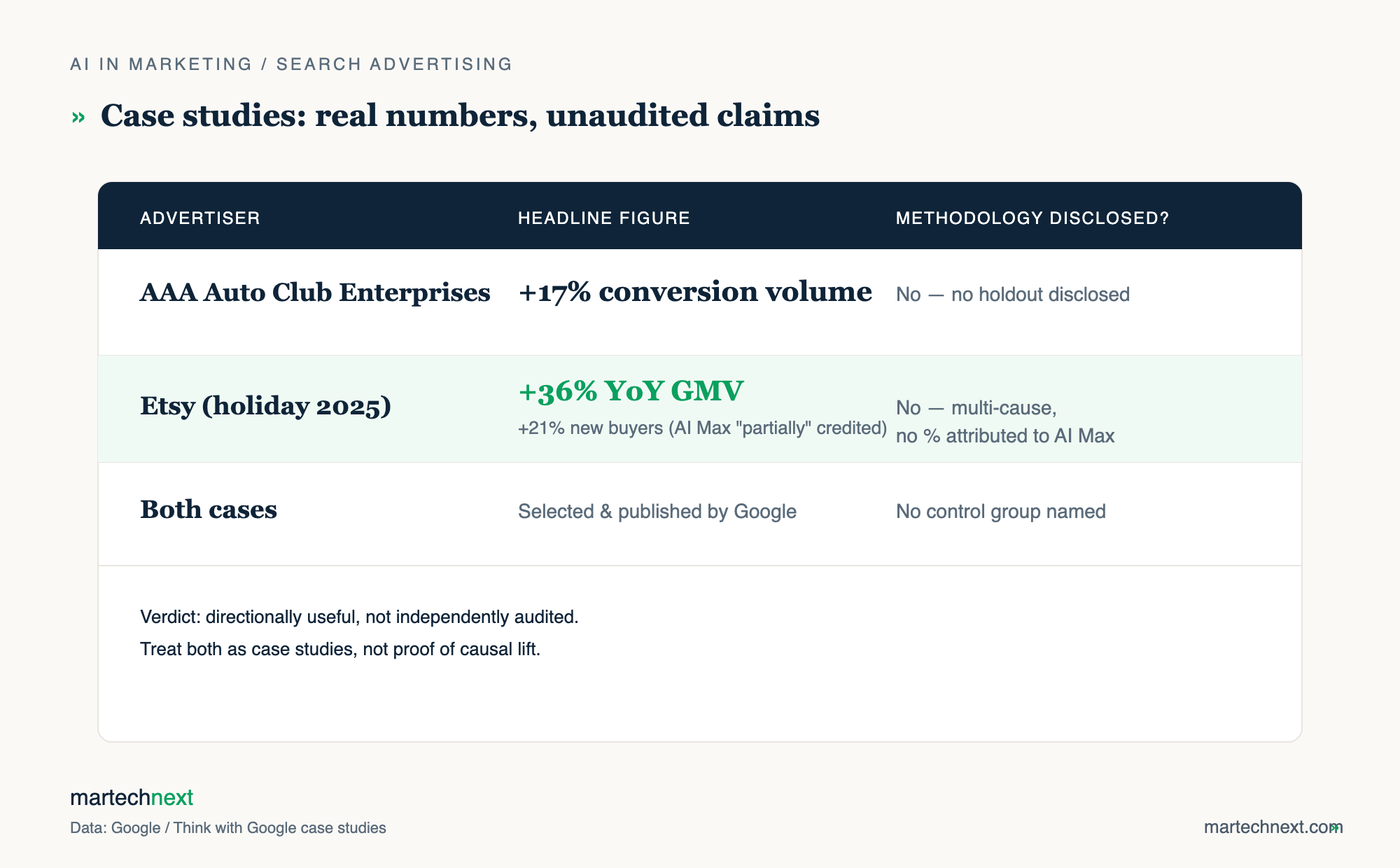
Two named examples give the claim some texture. AAA Auto Club Enterprises reportedly saw a 17% improvement in conversion volume using AI Max for personalized creative. Etsy attributed part of a 36% year-over-year GMV increase over the 2025 holiday period, plus a 21% jump in new buyer acquisition, partly to AI Max (both via Google/Think with Google case studies).
These are worth taking seriously. Etsy's scale alone makes a 36% GMV swing notable, even shared across multiple causes. But both examples share the same structural weakness as every vendor case study I've ever scrutinized, including, to be fair, the ones I've published myself: Google selected them, Google published them, and there's no disclosed holdout methodology. We don't know what "partially attributed to" means in percentage terms, and we don't know what Etsy or AAA would have seen with a clean control group running the old matching logic in parallel. Directionally useful. Not independently audited. Treat it that way.
Why this matters more than a feature update
Step back from AI Max specifically and look at the pattern. This is the same move Google made with broad match, then with Performance Max, and it's the same move the whole industry is making around AI-mediated demand capture: the unit of targeting is shifting from the keyword to the intent, and increasingly, to the conversation.
I've written before about how commerce is moving into messaging and AI answer surfaces, and about how brands need to think about GEO the way they once thought about SEO. AI Max is the Search-side version of that same shift. Google isn't just getting better at reading your keyword list, it's replacing the keyword list as the primary unit of advertiser control. That's thesis #6 in action: the conversation, or in this case the intent behind the query, is becoming the new funnel, and Search is adapting to stay inside it.
That's genuinely exciting if you think about what it unlocks. A travel brand that only bid on "flights to Lisbon" was always leaving money on the table from the traveler who typed "cheapest way to get to Portugal in October with two kids." Intent matching closes gaps human keyword lists never could, the same logic behind why one-to-one recommendation beats static segments (thesis #3). Early movers who learn to work with intent-based matching, rather than fight it, are likely to capture a disproportionate share of that newly reachable demand before competition (and CPCs) catch up, the same pattern we saw with early AdWords, early Facebook, and early WhatsApp adopters (thesis #7).
But it's also, honestly, a control question. AI Max is by definition keywordless in parts of its matching, which means less visibility into exactly which queries triggered your ad (Adalysis has written specifically about the reporting gaps this creates, adalysis.com). That's thesis #5, automation with human accountability, tested in real time: Google is asking advertisers to trust the intent-matching layer with less line-of-sight than the keyword era ever required. Whether that trust is earned isn't something Google's case studies can answer. Only your own data can.
What to actually do about it
You don't need to boycott AI Max, and you don't need to flip it on blind, either. Here's the sequence I'd run:
1. Turn it on in one campaign, not your whole account. Pick a mid-size Search campaign with clean conversion tracking, not your top-of-funnel brand campaign, and not something with murky attribution.
2. Run it as a genuine holdout test, not a before/after comparison. Split budget or split by geography/audience so you have a clean control group running your existing keyword strategy in parallel.
3. Measure LTV:CAC and incrementality, not conversion count. A 15% lift in conversions means nothing if those conversions skew toward lower-value customers or convert on branded terms you'd have won anyway.
4. Pull search term reports weekly while you test. Yes, visibility is reduced, but it isn't zero, and the gaps Adalysis and others have documented are worth understanding before you scale spend.
5. Set a decay-rate check. If the lift is real, it should hold up over 60-90 days, not just in the first flush of a new inventory pool that hasn't had time to get competitive (and expensive) yet.
6. Treat every published percentage, 14, 15, 27, or otherwise, as directional, not as your expected outcome. Your account, your audience, and your baseline match-type mix will move the number in either direction.
The honest version of AI Max's pitch isn't "billions of new searches, take our word for it." It's "we've built a matching layer that's genuinely better at reading intent than your keyword list ever was, and the way to find out if that's true for you is to test it like you'd test anything else that touches your budget."
Verdict
AI Max is a real capability shift, not a rebrand, and I'd be surprised if intent-based matching doesn't eventually become the default way Search works for everyone. The direction is right. But "billions of new monetizable searches" is a talking point built for an earnings call, not a metric you should plan a quarter around, and the conversion-lift numbers Google has published are inconsistent enough that I wouldn't take any single one at face value.
My take: adopt AI Max early, on a contained slice of your account, with a genuine holdout test running alongside it. Early movers who learn the new matching logic while it's still cheap will likely do well out of this. Just don't confuse Google's growth story with your own performance data. Those are, as always, two different things ;)
Wrestling with how much control to hand over to AI-driven matching in your own account? I'd love to exchange thoughts.
-- Bram Versteegh
Bram Versteegh is the founder of MartechNext, covering the business of AI in marketing: who's building it, who's funding it, and how industries put it to work.
Enjoyed this piece? Every week, What's Next delivers sharp analysis, the latest funding rounds in AI marketing, and the martech news that actually matters. Straight to your inbox, free.