Meta AI Can Now Act, Not Just Chat: What That Means for Your Funnel
Meta AI can now plan, book, and execute tasks on your behalf. Here's what an agentic Meta AI means for marketers and why the thread is becoming the funnel.

In this article:
- What Meta actually announced with Muse Spark 1.1, and why "it acts" is the important word, not "it chats"
- Why a mood board for your kitchen renovation is, functionally, a shopping list Meta AI built without you clicking anything
- How this extends the thread-as-funnel thesis I've been tracking since Meta's Business Agents rollout
- The caveats that actually matter: this is a consumer assistant, not (yet) a checkout agent, and the claims are Meta's own
- A practical roadmap for getting your brand ready to be recommended, not just ranked
Picture someone opening the Meta AI app to plan a birthday dinner. They type one sentence: find somewhere for Saturday, check if I'm free, send me a few options. Thirty seconds later they have three restaurant suggestions, cross-referenced against their calendar, ready to book.
Nobody searched Google. Nobody opened a reservation app. Nobody scrolled a map with pins on it. The AI did the research, checked the calendar, and shortlisted the outcome. The person just picked one.
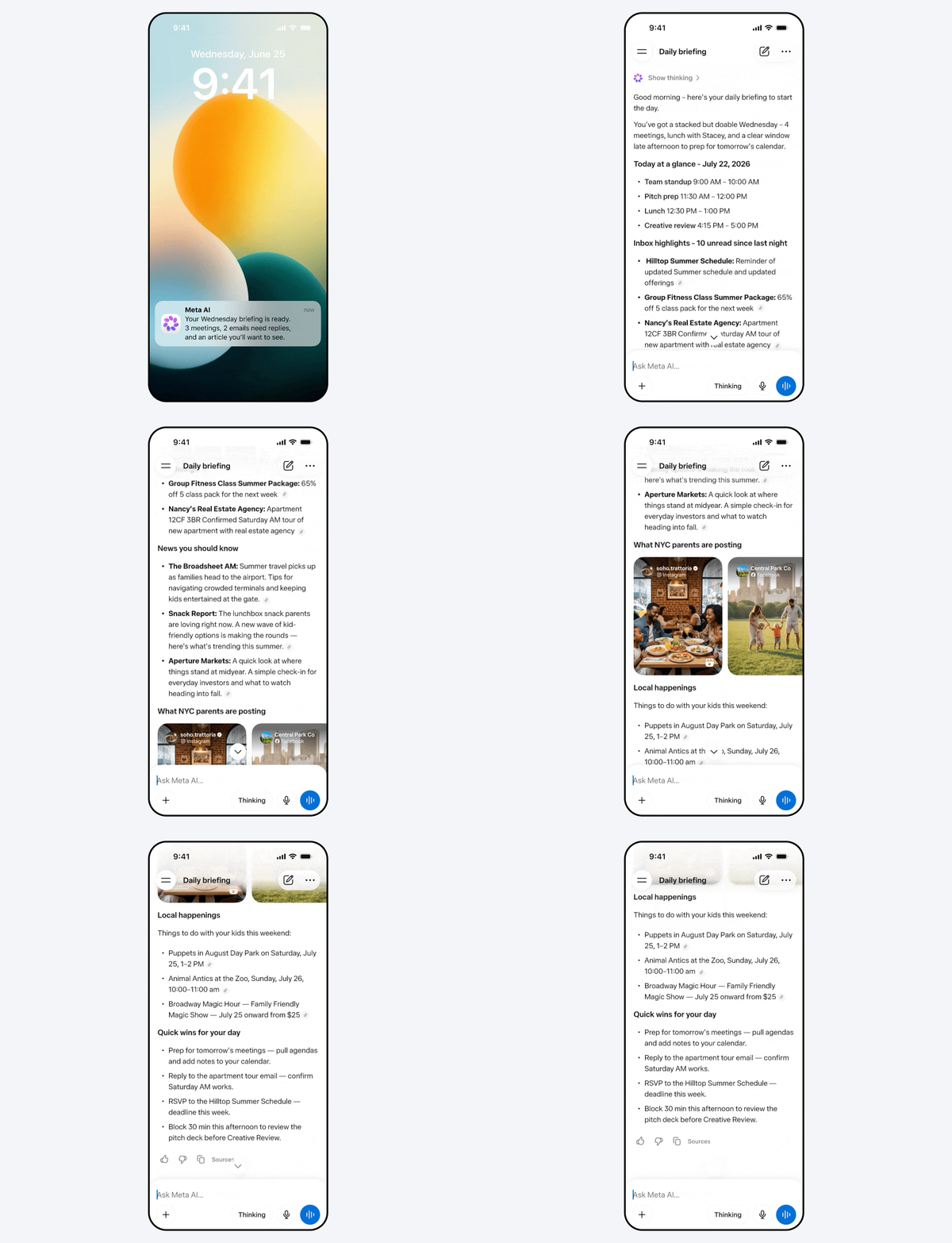
That is the shift Meta announced on July 24, 2026, and it deserves more attention from marketers than it's getting. Powered by a new model called Muse Spark 1.1, Meta AI can now, in Meta's words, "make plans, work with your apps, and follow through from start to finish." It builds running schedules, scouts Marketplace for furniture that fits a stated budget and style, drafts mood boards, gives daily briefings pulled from your calendar, and keeps working on tasks you only had to set up once.
Meta's own framing is blunt: Meta AI "doesn't just think, it acts." That's a marketing line, sure, but it's also an accurate description of a genuine capability jump, from answering questions to executing plans.
What Meta actually shipped
Strip away the lifestyle examples and three things are new here:
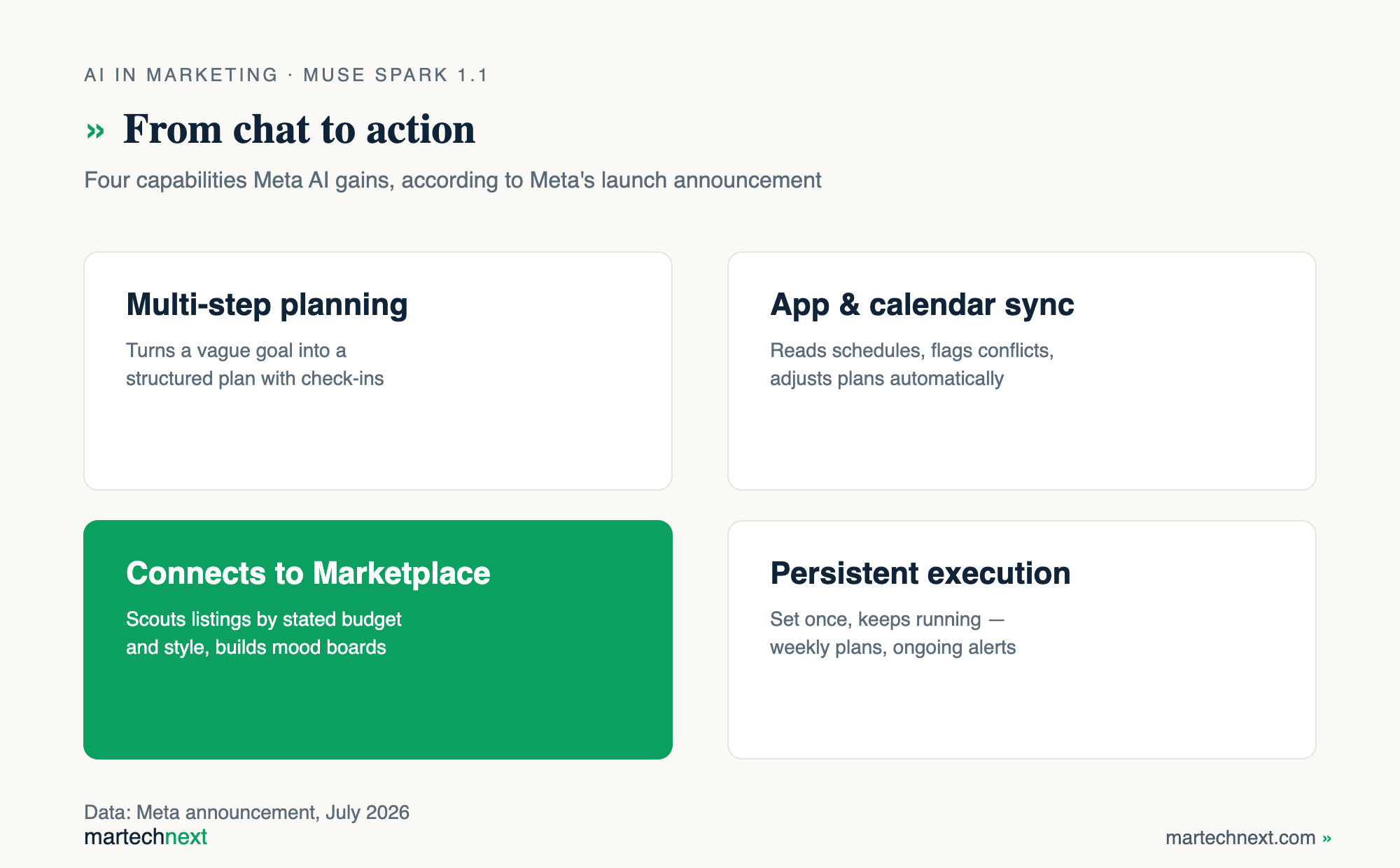
1. Multi-step planning. Meta AI can decompose a vague goal ("help me train for my first half marathon") into a structured plan with recurring check-ins, not a single generated answer.
2. App and calendar connectivity. It reads your schedule, flags conflicts, and adjusts plans around real constraints instead of asking you to do that manually.
3. Persistent, recurring execution. You set a task once (a weekly meal plan, a heads-up on sneaker drops) and it keeps running without re-prompting. That's the "agent" part: it doesn't wait for you to come back.
Also notable: everything Meta AI produces (mood boards, training plans, slide decks) lives inside your Meta AI history, which quietly turns the assistant into a persistent workspace, not a search box you visit and leave.
Why marketers should care: the thread just got hands
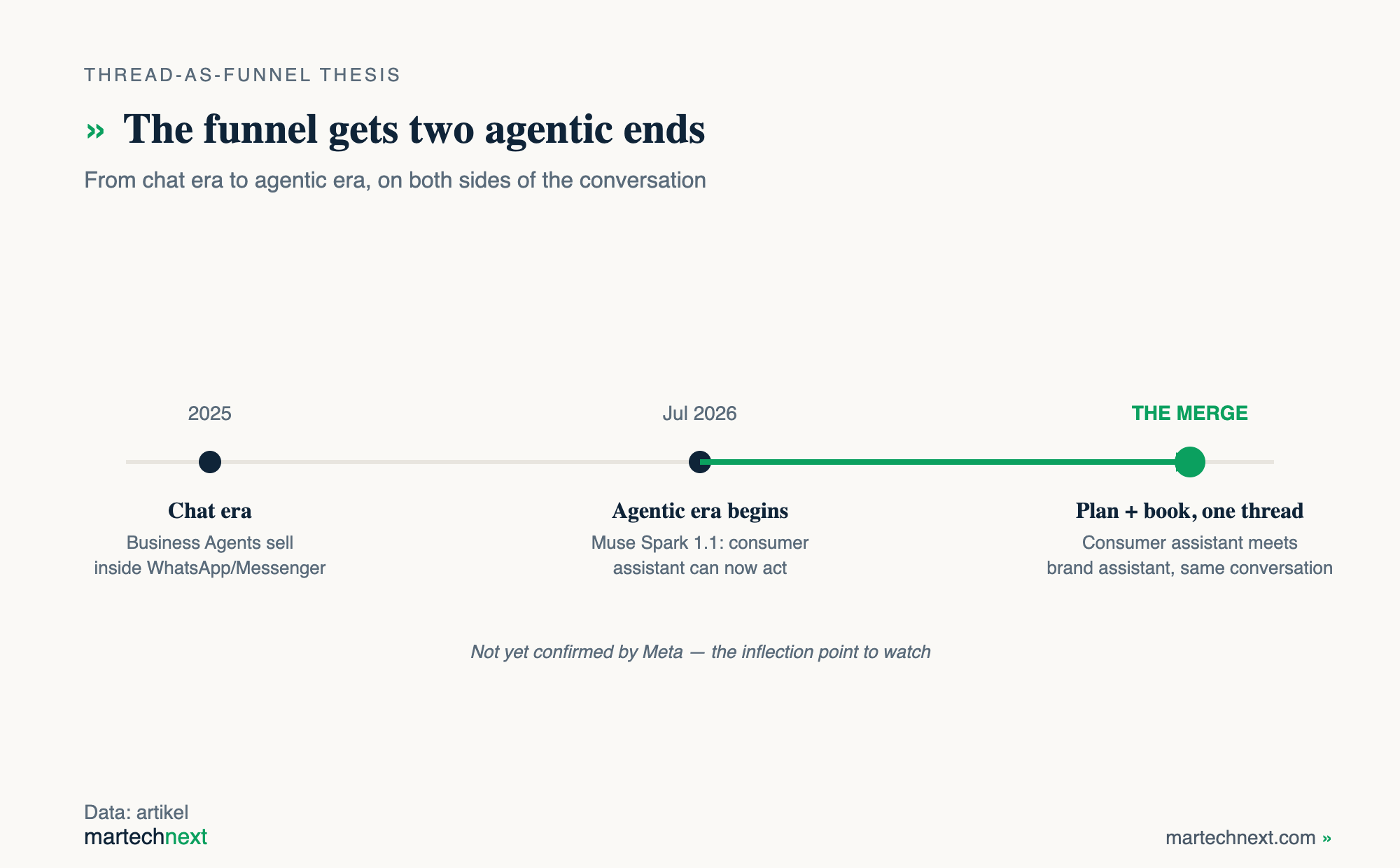
I've written before about the thread becoming the new funnel as commerce moves into messaging and AI answers. Meta's Business Agents already let brands sell inside a WhatsApp or Messenger conversation. What's new here is the other side of that equation: the consumer's assistant is now agentic too, not just the brand's.
That matters because a funnel with two agentic ends behaves very differently from a funnel with one.
When Meta AI scouts Marketplace listings for a kitchen renovation and builds a mood board, it is, functionally, running a discovery and consideration phase on the shopper's behalf, unprompted by any brand, invisible to any campaign dashboard, and outside any attribution model built for clicks. The shopper never typed a product name. They typed an intent ("I'm renovating my kitchen, here's my budget and style") and the AI translated that into a shortlist.
This is the logical extension of what I called generative engine optimization in the GEO deep dive: brands don't get found because they rank, they get found because they get recommended by a system that's already done the comparison shopping for the user. Muse Spark 1.1 just moves that recommendation step from "answering a question" to "executing a plan," which is a much stickier position to be in. An AI that answers a question once is a search result. An AI that runs your weekly meal plan or tracks sneaker drops for months is a standing subscription to being your shopping assistant, and whichever brands that assistant defaults to win by default, repeatedly, without a single ad served.
That's the part worth sitting with: this isn't a new channel to bid on. It's a new decision-maker to be legible to.
The mood board is a shopping list
Here's a concrete, hypothetical example of why this matters operationally, not just philosophically.
Say a home goods retailer sells kitchen fixtures through Marketplace. Under the old model, that retailer competes on search terms, images, and price inside a marketplace listing page. Under the new model, when Meta AI is asked to build a renovation mood board, it's making editorial-style judgment calls: which fixtures suit "this style," which fit "this budget," which combination "comes together" well. That's a recommendation engine deciding, on the user's behalf, who gets shortlisted before the user ever compares options themselves.
This is the same one-to-one-beats-segments logic I keep coming back to: the constraint that used to force brands into broad segments and generic listings is disappearing, and it's disappearing on the demand side now too. The AI isn't matching a segment to an offer. It's matching one person's stated style and budget to one shortlist. Product data quality, structured attributes, and consistent Marketplace listings stop being back-office hygiene and start being the actual battleground, because an AI agent can't recommend what it can't confidently parse.
If your product feed is inconsistent across channels (different prices, missing attributes, stale inventory), you're not just risking a bad ad. You're risking exclusion from a shortlist you'll never see being built.
The caveats that actually matter
I'd be doing exactly what I criticize vendors for if I took Meta's own framing at face value here, so two things genuinely matter before anyone reorganizes a Q3 roadmap around this.
First: this is a consumer productivity assistant, not a commerce agent, yet. The examples Meta shared (kitchen mood boards, marathon training plans, birthday dinner logistics) are personal life admin, not transactional checkout flows. Marketplace browsing is the closest thing to commerce in the announcement, and even there, the AI is surfacing options, not completing purchases. Meta's Business Agents are still the more direct commerce play. Muse Spark 1.1 is the layer that will eventually feed intent into that commerce layer, but "eventually" is doing real work in that sentence, and Meta hasn't confirmed a timeline for merging the two (confirm from announcement).
Second: the capability claims are Meta's own, from a launch post, with no independent benchmark attached. "Plans, follows through, course-corrects in real time" is a compelling pitch. It's also exactly the kind of claim that deserves the same scrutiny I'd apply to any startup's demo video. Agentic AI has a well-documented gap between announced capability and reliable, repeated real-world execution. I'd want to see this working consistently across a few hundred real user sessions, not a handful of curated examples, before treating "it acts" as a settled fact rather than a launch promise. Rollout scope (which markets, which languages, which apps it connects to beyond calendar and Marketplace) also isn't fully specified yet (confirm from announcement).
Neither caveat is a reason to ignore this. Both are reasons to treat it as an early signal to prepare for, not a channel to buy into this quarter.
What to do now
You don't need a Meta AI campaign strategy yet, because there isn't a buyable unit here. What you need is to be legible to an agent that's increasingly making decisions before your brand gets a say. A practical short list:
1. Audit your product data as if an AI, not a person, is the first reader. Structured attributes, consistent pricing across channels, clean Marketplace listings. This is the same discipline GEO requires, and it's now doing double duty.
2. Get your Business Agent presence in order if you're on WhatsApp or Messenger, because the agentic consumer assistant and the agentic brand assistant are on a collision course, and you want to already be in the room when they meet.
3. Watch for the merge, not the launch. The real inflection point isn't "Meta AI can plan a dinner." It's the day Meta AI can plan a dinner and book the table through a Business Agent in the same thread. Track that announcement closely; it's the one that turns this from interesting to urgent.
4. Treat this as evidence for a pattern, not a one-off. Every major platform (Google, OpenAI, now Meta) is racing toward agentic assistants that act on the user's behalf. The brands that win the next five years won't be the ones with the biggest ad budgets on these platforms. They'll be the ones whose data is clean enough, and whose offers are structured enough, to be confidently recommended by something that isn't human.
Verdict
Meta AI going agentic isn't a martech tool launch, and I wouldn't treat it as one. It's a signal about where consumer decision-making is heading: away from search-and-compare, toward delegate-and-review. The claims are Meta's own and the commerce piece isn't built yet, so there's nothing to "activate" this week. But the direction is consistent with everything else I've been tracking since Meta's Business Agents rollout: the conversation is becoming the funnel, and now the consumer's side of that conversation has hands, too.
My advice: don't wait for a Meta AI ad product to appear before you act. By the time it does, the brands with clean product data and a functioning Business Agent presence will already be the ones getting recommended. Everyone else will be optimizing for a funnel that quietly moved somewhere else.
Wrestling with what an agentic assistant layer means for your own funnel? I'd love to exchange thoughts.
-- Bram Versteegh
Bram Versteegh is the founder of MartechNext, covering the business of AI in marketing: who's building it, who's funding it, and how industries put it to work.
Enjoyed this piece? Every week, What's Next delivers sharp analysis, the latest funding rounds in AI marketing, and the martech news that actually matters. Straight to your inbox, free.