When the Agent Is the Customer: Who Owns the Data When ChatGPT Does the Shopping?
AI agents are entering product discovery. Here's what marketers stand to gain, and lose, when the agent shops on the customer's behalf.


In this article:
- Why agentic commerce is real in discovery, but still unproven at checkout
- The actual risk: not visibility, but losing the interaction that builds your data flywheel
- What OpenAI's Instant Checkout retreat and Google's Universal Commerce Protocol tell us
- Where the opportunity still sits, and why it's bigger than "getting the AI to recommend you"
- A practical way to think about where you want the agent, and where you don't
- A clear verdict on how seriously to take this right now
Picture a customer who asks an AI agent to buy moisturizer. The agent compares a thousand SKUs on price, reviews, and delivery speed, and picks one. The customer never sees the packaging. Never reads the brand story. Never gets the chance to notice the product they already loved sitting right there in the results. The agent decides, the customer receives a box, and something quiet but important disappears from the process: the moment of choosing.
That scene comes from strategist Jess Graham, cited in a sharp piece on MarTech.org called "The real risk in agentic commerce". It's worth reading in full, because it names something a lot of martech teams have been dancing around: the real threat of agentic commerce isn't visibility. It's ownership. Specifically, ownership of the interaction data that makes your personalization, your retention, and your entire growth engine smarter over time.
I've written before about the data flywheel as one of the core theses of this newsletter: every interaction a customer has with your brand should make your system smarter, and that compounding advantage, not the underlying model, is your real moat. Agentic commerce is the first real test of that thesis at scale. If the agent sits between you and the customer, who's collecting the data that spins the flywheel? You, or OpenAI, or Google, or whoever owns the agent?
That's the question this article is built around. Not "how do I rank in ChatGPT," but "what happens to my customer relationship when I'm no longer the one having the conversation."
Discovery is already agentic. Checkout mostly isn't, yet
Let's separate hype from what's actually shipped, because the two protocols making news right now tell two very different stories.
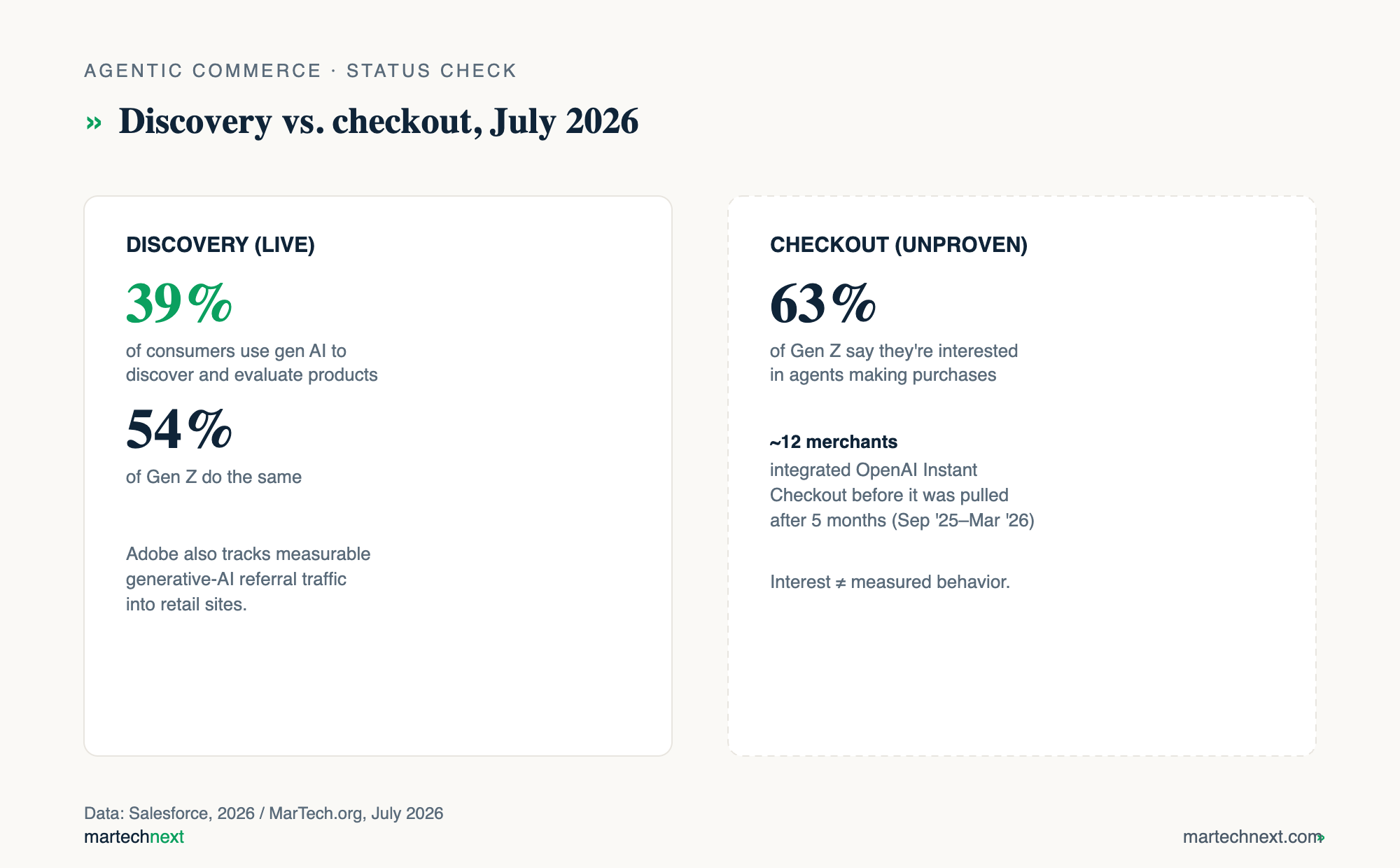
OpenAI launched Instant Checkout in September 2025, allowing purchases to complete inside ChatGPT. Five months later, in March 2026, it pulled the feature. Only about a dozen merchants had integrated, usage stayed low, and shoppers who researched inside ChatGPT still preferred to finish the purchase on the retailer's own site (MarTech.org, July 2026). OpenAI didn't abandon commerce, it repositioned: the current model is discovery-first, routing shoppers out to merchant storefronts where the retailer handles payment.
Google took the opposite bet. Its Universal Commerce Protocol, announced at NRF in January 2026 with partners including Shopify, Etsy, Wayfair, Target, Walmart, and Visa, is live and expanding: cart support, catalog access, and identity linking are already in use (MarTech.org, July 2026).
Read those two moves together and the picture sharpens. Checkout is still being negotiated, and nobody has fully cracked it. Discovery is already agentic, and that's where the ground is shifting under marketers' feet right now.
The consumer numbers back that up. Salesforce found 39% of consumers, and 54% of Gen Z, have used generative AI to discover and evaluate products (Salesforce, 2026). Adobe has separately tracked measurable traffic from generative AI tools flowing into retail sites (Adobe, 2026). That's not stated interest, that's people behaving differently already.
What's much thinner is evidence of agents actually completing purchases on someone's behalf. Salesforce also found 63% of Gen Z say they're interested in AI agents making purchases for them (Salesforce, 2026), but "interested" is a survey answer, not a transaction log. This is a distinction I'd apply the same skepticism to as any vendor benchmark: stated intent and measured behavior are not the same thing, and conflating them is how roadmaps get built on vibes.
The real risk isn't ranking, it's disappearing from the moment of choice
Here's the sharpest idea in the source piece, and it's worth sitting with: a brand an agent buys is one the algorithm selected. A brand a customer asks for by name is something the brand had to earn. The first is procurement. Nobody falls in love with sourcing.
That distinction should reframe how martech teams think about "AI visibility." Being legible to an agent (structured data, clean feeds, a product catalog the model can parse) is necessary. I've written about this before in the context of GEO: getting found by AI answer engines is the new SEO, and the fundamentals rhyme. But legibility to the machine is not the same as presence with the human. You can be perfectly optimized for agentic discovery and still be a stranger to the person who receives the box.
And that's where the data flywheel thesis gets tested for real. If an agent handles discovery, comparison, and eventually purchase, the interaction, the browsing behavior, the hesitation, the comparison shopping, all of it happens inside somebody else's interface. You get the order. You don't get the story of how the customer got there. That story is exactly what your recommendation engine, your segmentation (or better, your one-to-one personalization), and your retention playbook are built on.
This is the same pattern as every previous platform shift, just one layer deeper. When Facebook's algorithm sat between brands and audiences, marketers lost first-party data too, and spent a decade building owned channels (email, WhatsApp, loyalty apps) to claw the relationship back. Agentic commerce raises the stakes, because now the intermediary isn't just distributing your message, it's making the purchase decision.
Let's be honest: most marketing teams are not close to ready to answer "what data do we actually own if the agent buys instead of the customer." That's not a criticism, it's a genuinely new question, and 2026 is the year to start answering it deliberately rather than by accident.
Where the real opportunity is (and it's bigger than SEO for robots)
None of this means retreat. The opportunity here is real, and it's bigger than the narrow "how do we get ranked" question most teams are stuck on.
First, discovery-layer agents are a new acquisition channel, and early movers win channels. Every platform shift, AdWords, Facebook, TikTok, WhatsApp, has rewarded whoever built the technical and content foundation before the channel matured. Clean product feeds, structured data, and consistent brand information across the web are cheap to build now and expensive to retrofit later. Do that work today.
Second, and more important: agentic discovery is exactly the argument for owning the relationship channel that sits outside the agent's reach. If ChatGPT or Google's protocol handles comparison shopping, the moment that still belongs to you is everything after the sale, and everything you can pull the customer back into directly. That's WhatsApp, email, loyalty, a direct app, a preference center, whatever your owned channel is. The brands that win in an agentic world won't be the ones who out-optimize the algorithm. They'll be the ones who give customers a reason to come back and ask for them by name, bypassing the agent entirely next time.
Full disclosure, as always: I'm the founder of Zoey, a WhatsApp journey automation platform for the travel industry, so I have skin in this game. But the logic holds regardless of channel: if an intermediary owns discovery, your job is to own retention and re-engagement so completely that the customer starts the next journey with you directly, not through the agent again.
Third, this is a genuine argument for investing in first-party data infrastructure now, before agentic checkout matures and the leverage shifts further away from brands. The right order still applies here: structure your data, automate the repetitive layer, then apply AI on top. Teams that have that foundation will be able to plug into whatever commerce protocol wins (OpenAI's, Google's, or something neither has announced yet) without scrambling. Teams still sitting on data spaghetti will be locked out of the interesting part of this shift no matter how well they rank.
A practical way to think about it
I'd break this into three questions every martech or CRM lead should be asking this quarter:
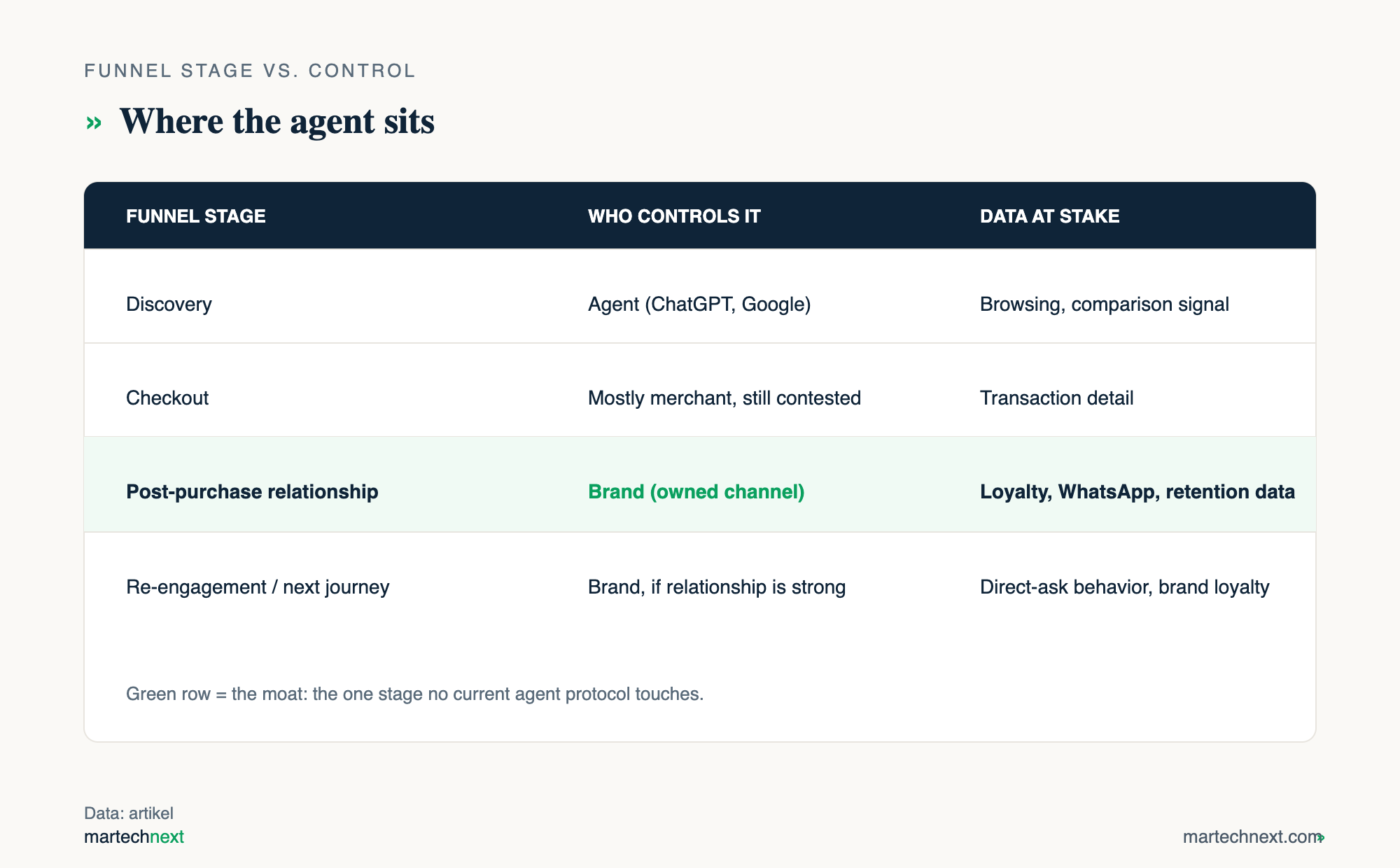
1. Where in our funnel does an agent currently intervene, or is likely to soon? Map discovery, comparison, and purchase separately. Right now the honest answer for most brands is "discovery, maybe, purchase, not yet." That will change, and the protocol wars (OpenAI vs. Google) will decide how fast.
2. What data do we lose if that stage goes agentic? If an agent completes the purchase, you lose the browsing signal, the comparison behavior, the moment of hesitation. That's real flywheel data. Decide now what you can still capture post-purchase (loyalty enrollment, WhatsApp opt-in, a review request) to rebuild the picture.
3. Where is our owned channel strong enough that customers bypass the agent and come to us directly? This is the actual defense. Not better SEO for robots, but a relationship good enough that the customer skips the comparison shopping next time because they already know what they want.
None of this requires a grand agentic commerce strategy document. It requires an honest audit of where the agent sits between you and the customer today, and a plan to keep or rebuild the parts of that relationship that matter most.
My verdict
The MarTech.org piece is right to push back on the "how do we get ranked in ChatGPT" framing. That's the easy question, and chasing it alone will leave marketers optimizing for procurement while losing the actual relationship. But I wouldn't overcorrect into alarm either. The data so far (Salesforce, Adobe) shows agents genuinely reshaping discovery. It does not yet show agents reshaping checkout at scale. OpenAI tried and pulled back within five months. Google's protocol is live and growing, but "growing" and "dominant" are different words.
So: take agentic discovery seriously, right now, as a channel worth optimizing (clean feeds, structured data, consistency). Take agentic checkout seriously as a coming risk worth preparing for, not a current emergency worth panicking over. And treat owning the post-purchase relationship, the part no agent can currently touch, as the actual moat. The brands that get this right in 2026 won't be the ones who game the algorithm best. They'll be the ones customers still bother to ask for by name.
Wrestling with where agentic discovery fits into your own funnel? I'd love to exchange thoughts :)
-- Bram Versteegh
Bram Versteegh is the founder of MartechNext, covering the business of AI in marketing: who's building it, who's funding it, and how industries put it to work.
Enjoyed this piece? Every week, What's Next delivers sharp analysis, the latest funding rounds in AI marketing, and the martech news that actually matters. Straight to your inbox, free.