Your Match Rate is the most important marketing metric you’re probably ignoring
Cookies are gone, ATT cut off device IDs, and your match rate quietly caps every campaign. Here's why it's your real competitive moat now.


In this article:
- What "match rate" actually measures, and why every vendor defines it slightly differently
- Why the gap between the audience you build and the audience you reach is structurally widening
- How a low match rate quietly inflates your CAC and hides your real LTV
- Who's selling the fix (Rokt mParticle, LiveRamp, TransUnion/Neustar) and what to actually verify before you buy
- Why this is a data-structuring problem before it's ever an AI problem
- A short, practical checklist to find out where you actually stand
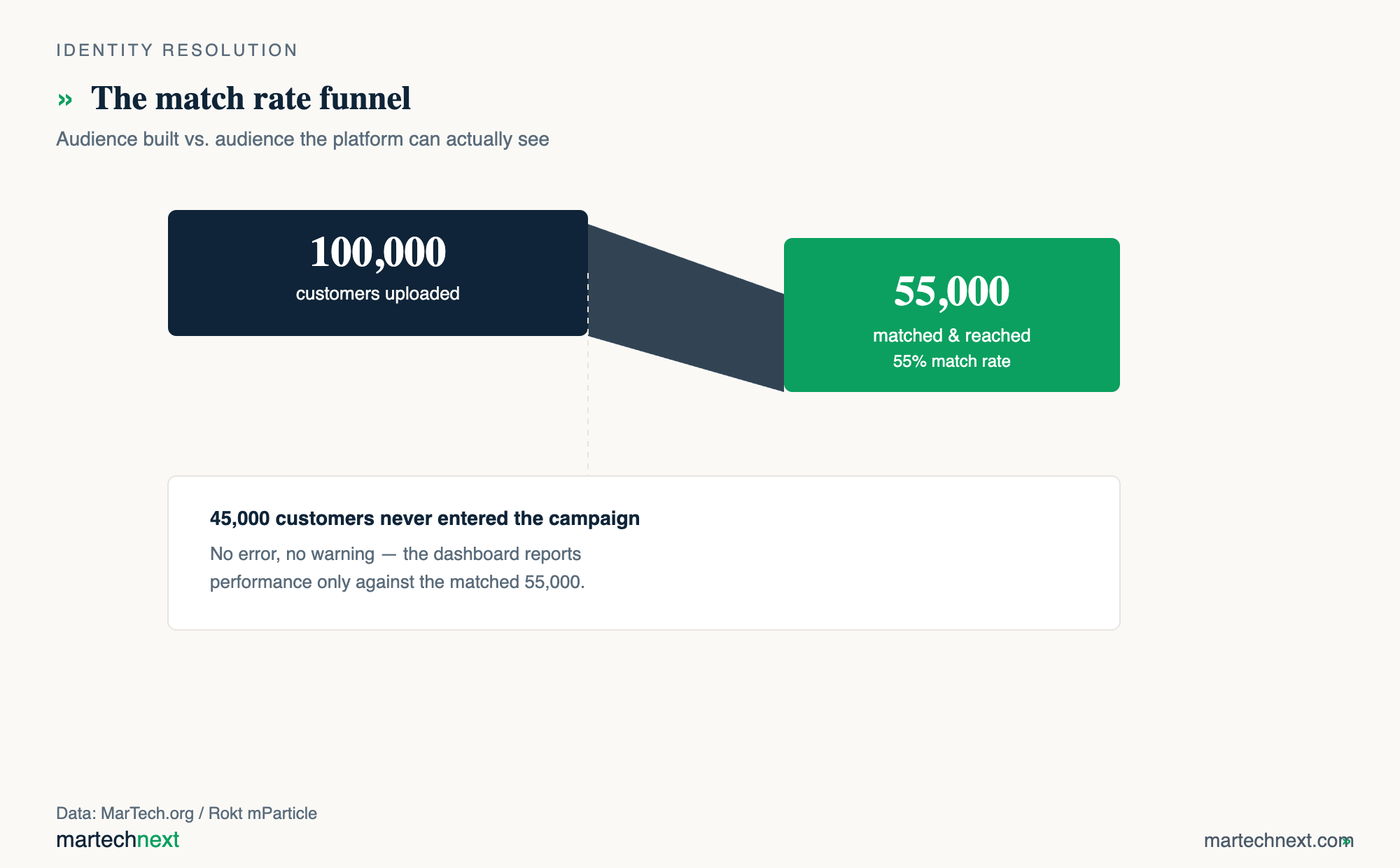
Picture a mid-sized retailer's growth marketer building a lookalike audience from 100,000 loyal customers and pushing it to a major ad platform for a retention campaign. The campaign dashboard looks healthy: decent CTR, reasonable CPM, ROAS in the range leadership expects. Nobody in the review meeting asks how many of those 100,000 people the platform could actually recognize. If the answer is 55,000, the campaign never touched the other 45,000 at all, and nothing in the reporting says so. The numbers just look like a smaller, quieter version of success.
That invisible gap has a name: match rate. It's the share of an uploaded audience that a platform can resolve to one of its own known identities, usually by matching hashed emails or phone numbers against its logged-in user base. And according to Rokt mParticle, most performance marketers don't track it, because most performance marketers don't know it's a number at all (MarTech.org)
I think that's the most useful thing published on identity in months, and it lands at exactly the moment it should. Third-party cookies are dying, Apple's App Tracking Transparency has cut deep into device-level tracking, and every walled garden keeps tightening how it lets outside data in. In that environment, match rate isn't a niche ad-ops metric. It's becoming the ceiling on everything you do with customer data, and the flip side of that ceiling is an opportunity: the brands with clean, well-resolved first-party identity are about to have a real, compounding edge over everyone still uploading messy lists and hoping for the best.
What match rate actually measures (and why nobody agrees on the definition)
Strip away the vendor language and match rate is simple: you upload a list of customer identifiers, the receiving platform tries to match each one to an identity it already recognizes, and match rate is the percentage that resolves.
The mechanics matter more than the definition, though. When you push a first-party audience to Meta, Google, or any ad platform, you're not targeting "your customers." You're targeting the subset of your list the platform can resolve to its own logged-in accounts. Everything else falls out silently, no error, no warning, just a smaller campaign running under the name of a bigger one (MarTech.org).
Here's the illustration Rokt mParticle itself uses, and it's a clean one: build an audience of 100,000 customers, upload it somewhere that matches 55%, and your campaign runs against 55,000 people while the other 45,000 simply don't exist to the platform, regardless of how sharp your creative or bidding is.
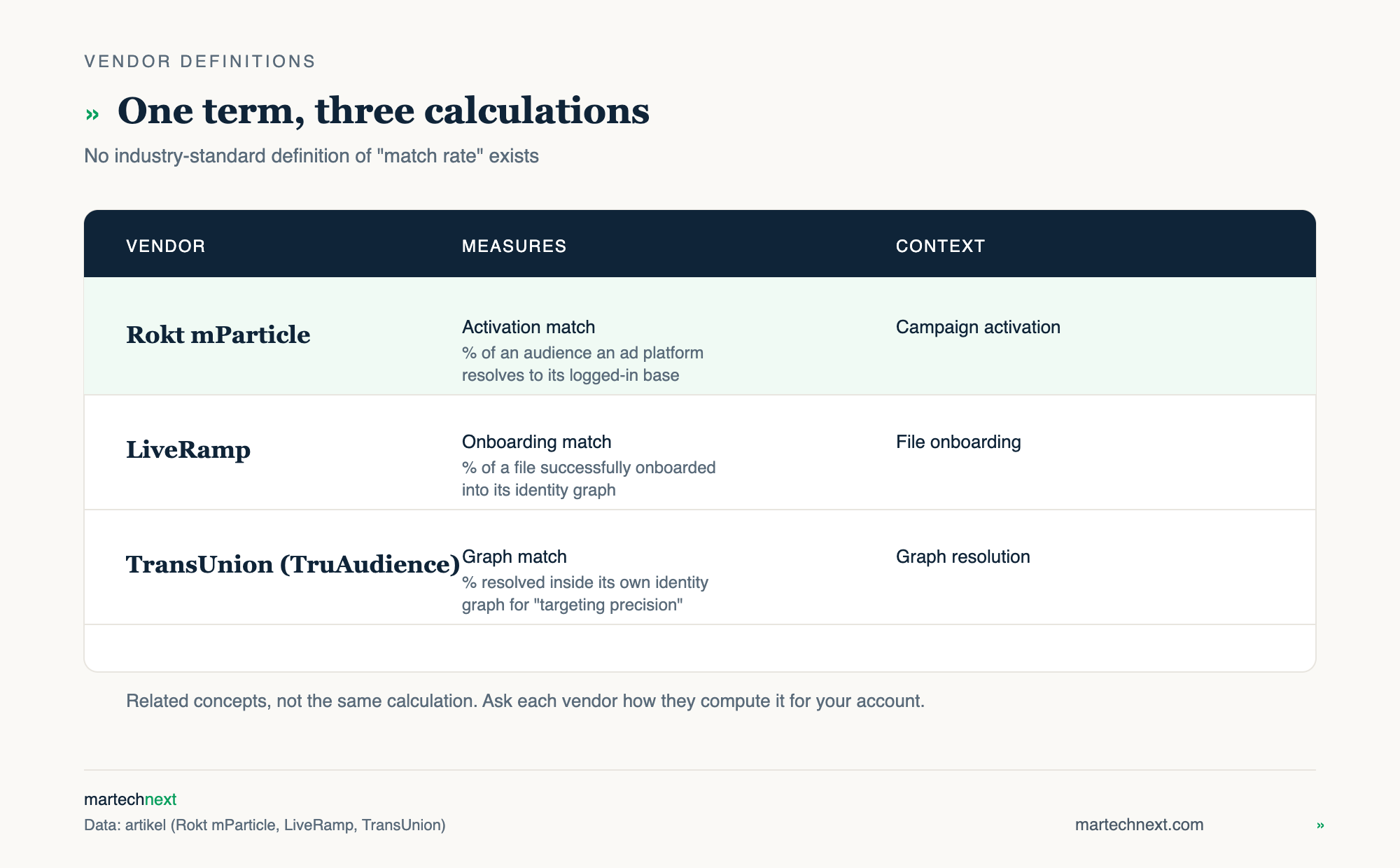
Now here's the part that should make you pause before you take any vendor's match rate number at face value: there is no single, industry-standard definition of "match rate." LiveRamp measures match rate in the context of onboarding a file into its identity graph. mParticle (now Rokt mParticle) measures it in the context of activating an audience against an ad platform's own logged-in base. TransUnion, having folded in Neustar, measures it inside its TruAudience identity graph for "targeting precision." These are related concepts, but they're not the same calculation, and a vendor quoting an impressive match rate percentage is very often answering a slightly different question than the one you're asking (research on this remains incomplete; treat cross-vendor comparisons as directional, not apples-to-apples, until you've confirmed methodology directly with each vendor).
That inconsistency is a genuinely fair reason to be skeptical of any single benchmark you're handed. It is not a reason to ignore the metric. Ask your own platforms, right now, what their match rate methodology is and how they calculate it for your account. Most marketers have never asked the question, which is exactly Rokt mParticle's point.
Why the gap is widening, not narrowing
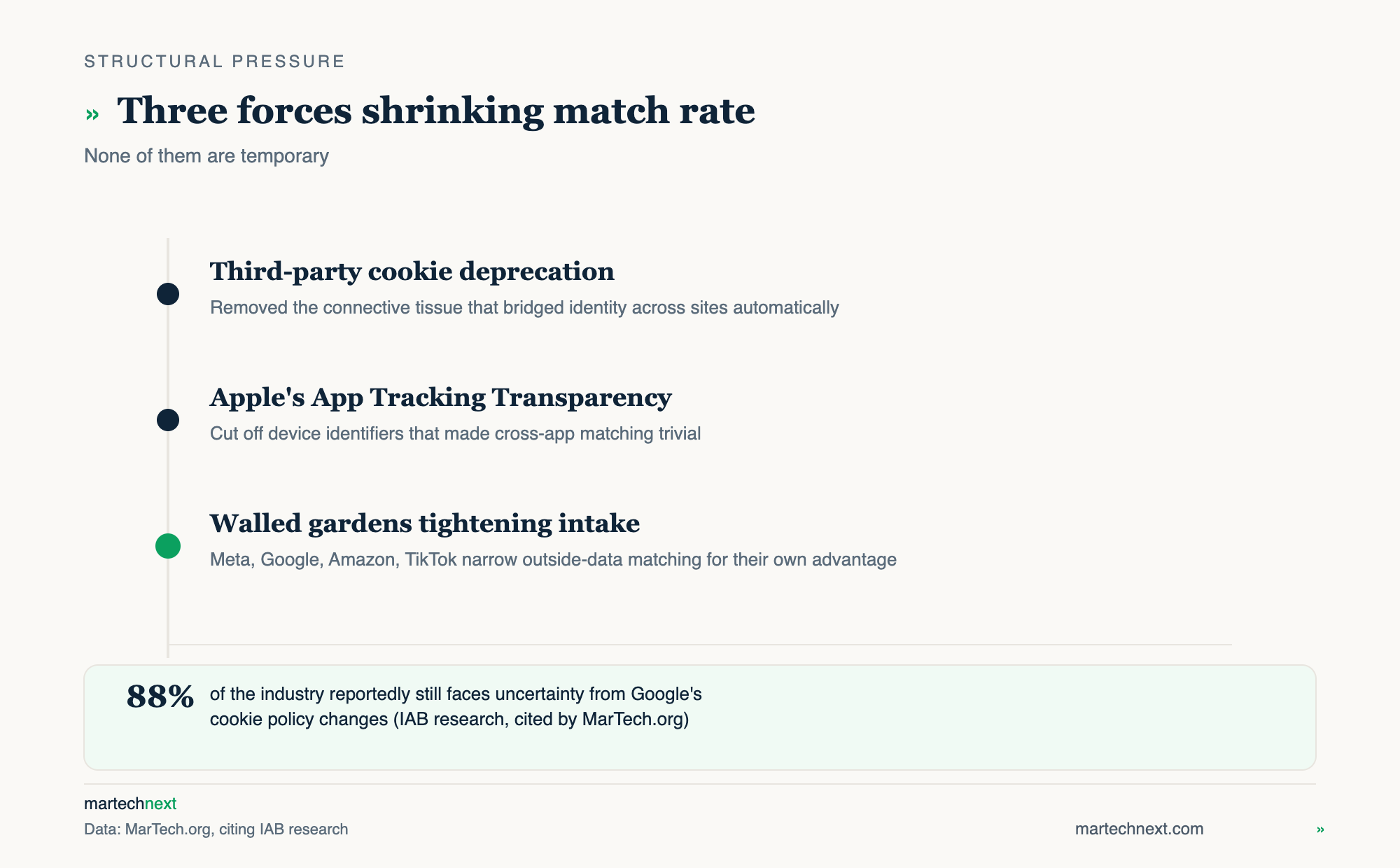
Three structural forces are driving match rates down across the industry, and none of them are temporary.
Third-party cookie deprecation removed the connective tissue that let platforms bridge an identity across sites without you doing anything. Apple's App Tracking Transparency cut off the device identifiers that used to make cross-app matching trivial. And the walled gardens (Meta, Google, Amazon, TikTok) keep narrowing what outside data they'll accept and how they'll resolve it, because tighter matching logic serves their own privacy posture and their own data advantage at the same time.
Layer on the mundane stuff that never goes away: the customer who signs up with a work email and buys with a personal one, the phone number formatted three different ways across three different systems, the record that's been stale for two years. None of that is new. What's new is that these ordinary data-hygiene failures used to be quietly compensated for by third-party identity graphs stitching things together in the background. That compensation layer is gone. The stitching now has to happen inside your own systems, or it doesn't happen at all.
IAB research, cited by MarTech.org, put a striking number on industry readiness for this shift: 88% of the industry reportedly still faces uncertainty from Google's cookie policy changes (MarTech.org). I'd treat that figure as a single, industry-survey data point rather than gospel (I couldn't independently verify the underlying IAB methodology for this piece), but directionally it matches what every martech operator already feels: most teams have not actually rebuilt their identity infrastructure for a world without third-party cookies. They've just watched their match rates quietly erode and adjusted their expectations downward instead.
The business cost: your CAC is worse than you think, and your LTV is invisible
This is where match rate stops being an ad-ops curiosity and becomes a straight line to the metric I keep coming back to on this blog: LTV:CAC "Focus on value, not volume".
A low match rate inflates your effective CAC in a way that never shows up as a line item. You're paying full price to reach an audience, but the platform is only delivering a fraction of it, and worse, you have no idea which fraction. Maybe it skews toward your most engaged, easiest-to-match customers (the ones with clean, recent, single-device data) and away from the higher-value but messier segments you actually built the campaign to reach. Per-audience-member cost goes up. Nobody notices, because the dashboard reports performance against the matched audience, not the audience you paid to build.
The LTV side is quieter and arguably worse. If you can't resolve a customer's identity across channels and touchpoints, you can't see their full value. A customer who books directly on your site, opens your emails on a different address, and interacts with your brand on WhatsApp under yet another identifier looks, on paper, like three partial customers instead of one valuable one. Any retention model, recommendation engine, or churn score you build on top of that fragmented picture is built on top of "data spaghetti," which is exactly the failure mode MIT points to when it explains why the overwhelming majority of enterprise AI initiatives fail to deliver value.
This is thesis #1 in miniature: value over volume breaks down the moment you can't even reliably count your customers.
Who's selling the fix, and what to actually check before you buy
Rokt mParticle, formed out of the roughly $300 million merger between Rokt and mParticle, has built its "Match Boost" feature specifically to close this gap for audience activation across major ad platforms. It's not the only identity vendor making this pitch. LiveRamp has built its business on identity resolution and match rate as a core product metric for years. TransUnion, after acquiring Neustar, folded that identity data into its TruAudience graph and markets the combination as improved "targeting precision". Google's PAIR and Meta's Advanced Matching offer comparable ideas natively inside the walled gardens themselves.
I'll say this plainly: I could not independently verify any specific match rate lift percentage from any of these vendors for this piece, including Match Boost's. That's not a knock on the product, it's a statement about what publicly available reporting currently supports. Vendor-run benchmarks are directionally credible (these companies aren't going to build a whole feature around a made-up problem), but a lift number quoted in a launch announcement is not the same thing as an independently audited result on your specific customer file. If a vendor gives you a match rate improvement claim, ask three follow-up questions before you sign anything: matched against what baseline, measured by whose definition, and verified by whom.
That's not cynicism for its own sake. It's the same scrutiny I'd apply to any personalization case study, including ones I've published myself: the claim is usually real, but "real" and "verified on your data" are two different things.
The MartechNext take: this is a data problem before it's an AI problem
Here's why I think this article deserves more attention than it's getting. Match rate is a clean, concrete illustration of a thesis I keep repeating on this blog: the right order is data first, then automation, then AI. You cannot personalize, recommend, or model retention for a customer your system can't reliably recognize across touchpoints. A brilliant recommendation engine trained on fragmented identity data will still produce mediocre recommendations, not because the model is weak, but because the data feeding it is spaghetti.
It's also a direct hit on the data flywheel thesis. Every interaction is supposed to make your understanding of a customer richer: the browse, the email open, the WhatsApp reply, the purchase, the return. That only compounds if those interactions get stitched to the same identity. A low match rate doesn't just cost you reach on one campaign, it breaks the flywheel at the source: data keeps accumulating, but it never consolidates into one sharper picture of the customer. You end up with more data and the same blurry understanding you had a year ago.
And it connects to early movers win channels. Every platform shift of the last fifteen years, AdWords, Facebook, TikTok, WhatsApp, has rewarded whoever built solid foundations before the channel matured. As commerce keeps moving into messaging threads and AI answer engines, identity resolution becomes the prerequisite for showing up there at all. You can't personalize a WhatsApp journey or feed a recommendation into an AI shopping assistant for a customer you can't recognize. The brands solving match rate now are quietly building the foundation the next channel will run on.
What to actually do about it: a short, practical checklist
You don't need to buy anything to start. Match rate is measurable with what you already have.
1. Ask every ad platform you use what your current match rate is, and how they calculate it. Most account managers can pull this; most marketers have simply never asked.
2. Get your definitions straight before comparing vendors. Onboarding match rate, activation match rate, and graph match rate are related but not identical. Write down which one each vendor is quoting.
3. Audit your own identifier hygiene first. Standardize email and phone formatting, deduplicate aggressively, and resolve known aliases (work email, personal email, loyalty ID) into a single profile before you blame the platform.
4. Run it as a holdout test, not a vendor claim. If a vendor promises a match rate lift, split your audience, run the improved matching on one half, and measure incrementality against the untouched half. That's the same discipline I'd apply to any personalization claim, including my own.
5. Treat match rate as a standing KPI, not a one-time audit. It decays as your customer base grows and identifiers splinter further. Check it quarterly, not once.
None of this requires an AI model. It requires structured, unified, well-governed first-party data, which is exactly the boring, unglamorous prerequisite that thesis #2 keeps insisting on.
Verdict
Match rate is a real, underused metric, and Rokt mParticle deserves credit for putting a name on a problem most marketing teams feel but never measure. The structural pressure behind it (cookie deprecation, ATT, tightening walled gardens) is genuine and not going away. Where I'd hold back is on trusting any single vendor's percentage as gospel: the definitions aren't standardized, the lift claims aren't independently verified, and "improve your match rate" is a pitch every identity vendor in this space is making right now.
My take: don't buy the fix before you've measured the problem. Audit your own match rate this quarter, on your own terms, with your own holdout test. If it's as low as the industry patterns suggest, you've just found a lever with more upside than another round of creative testing, and you'll know exactly what you're paying for when a vendor comes knocking :)
Wrestling with identity resolution or match rate in your own stack? I'd love to exchange thoughts.
-- Bram Versteegh
Bram Versteegh is the founder of MartechNext, covering the business of AI in marketing: who's building it, who's funding it, and how industries put it to work.
Enjoyed this piece? Every week, What's Next delivers sharp analysis, the latest funding rounds in AI marketing, and the martech news that actually matters. Straight to your inbox, free.